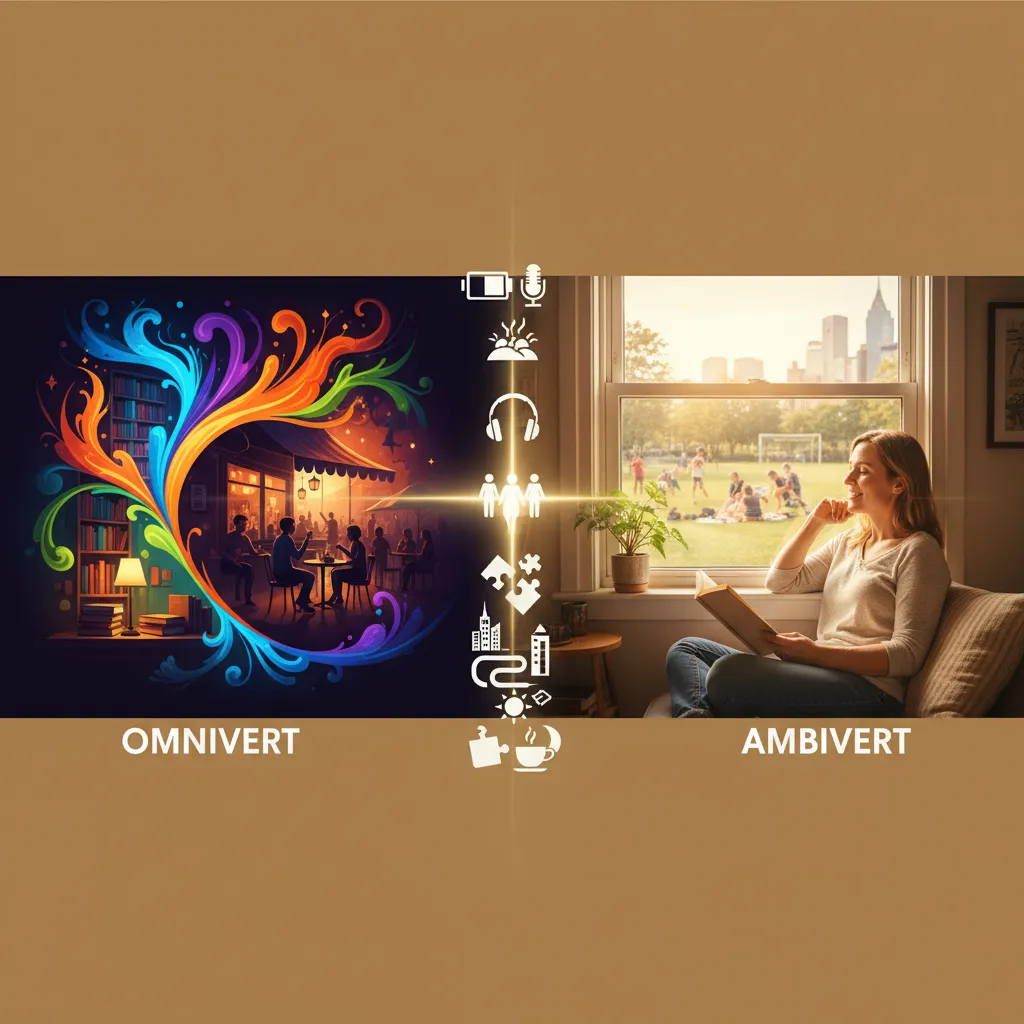
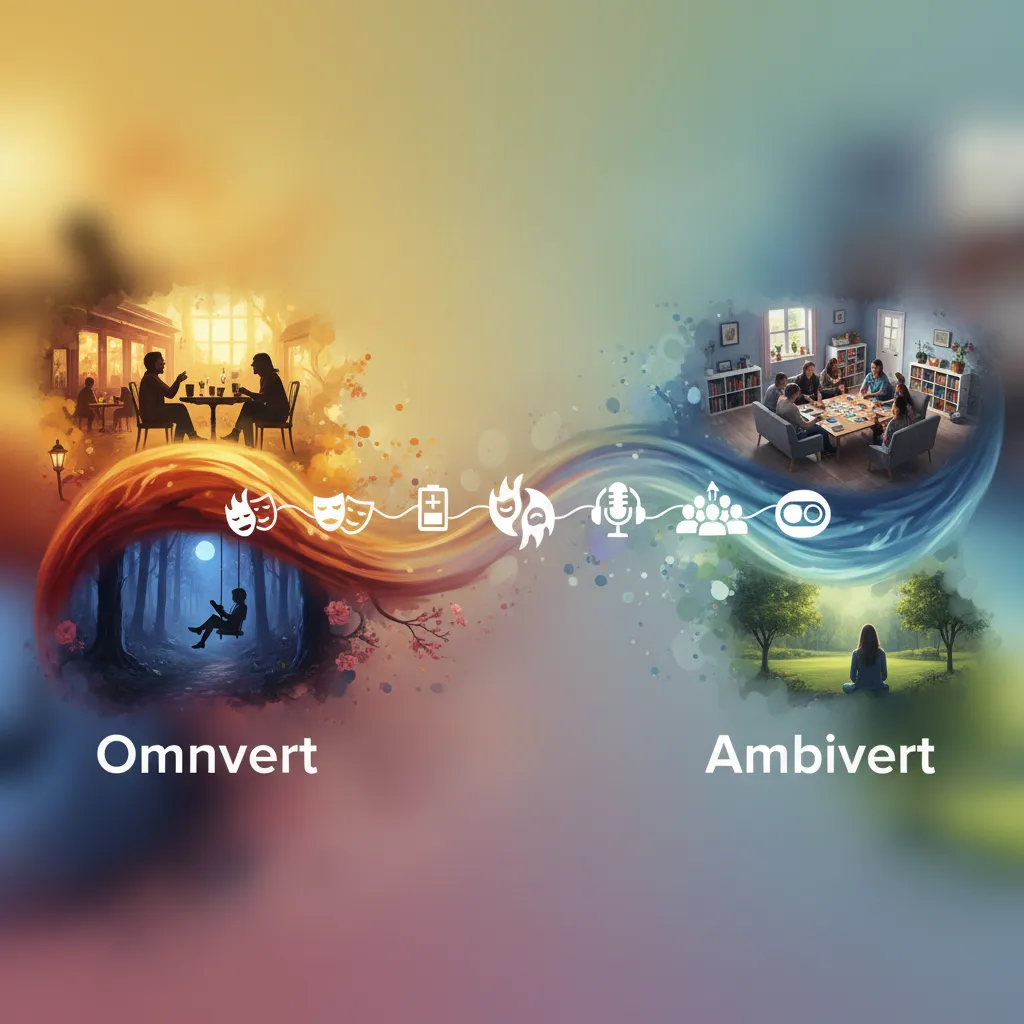
Omniverts and ambiverts both exist on the introvert-extrovert spectrum, but differ significantly in social energy management. Ambiverts maintain a stable balance, adapting smoothly to various situations, while omniverts experience dramatic, unpredictable shifts between intense extroversion and deep introversion. Key distinctions lie in social energy fluctuation, coping mechanisms, decision-making, comfort zones, communication, and emotional processing. Understanding these personality types through self-reflection and implementing strategic energy management, including neuro-optimization techniques like NeuroVizr, can enhance self-awareness, improve social interactions, and foster overall well-being.
✅ Pros
Enhanced adaptability to diverse social and professional environments.
Superior communication skills, encompassing both active listening and engaging speaking.
Stronger empathy and ability to form deeper, more meaningful connections.
Effective leadership capabilities, balancing group motivation with individual team member needs.
Increased resilience to social burnout through proactive energy management and self-awareness.
❌ Cons
Omniverts may be misunderstood as inconsistent or moody due to unpredictable social fluctuations.
Omniverts often require significant recovery time after intense social periods.
Omniverts’ decision-making can be heavily influenced by their current social energy state, potentially appearing inconsistent.
Omnivert vs Ambivert personalities represent fascinating nuances within the broader personality types spectrum, offering unique insights into how individuals engage with the world and manage their social battery. Understanding these distinctions, as explored by NeuroTech Insider, can profoundly enhance self-awareness and foster more effective social interactions, optimizing personal well-being and cognitive function.
What Are the 7 Key Differences Between an Omnivert and an Ambivert Personality?
Quick Answer: The seven primary distinctions between an omnivert and an ambivert lie in their social energy fluctuation, adaptability, coping mechanisms, decision-making processes, comfort zones, communication styles, and emotional processing, with omniverts exhibiting pronounced shifts and ambiverts maintaining a consistent balance.
While both omniverts and ambiverts occupy the middle ground of the introvert extrovert spectrum, their approaches to social engagement and energy management differ significantly. An ambivert maintains a relatively stable balance between introverted and extraverted tendencies, adapting smoothly to various situations. Conversely, an omnivert experiences more dramatic shifts, behaving as a pronounced extrovert in certain contexts and a deep introvert in others, often feeling exhausted or energized by these extremes. Understanding these specific differences can provide valuable clarity for self-identification and optimized social functioning.
1. How Do Omniverts and Ambiverts Differ in Their Fluctuation of Social Energy?
The most striking difference between an omnivert meaning and an ambivert lies in their energy patterns. Ambiverts typically exhibit a moderate and consistent flow of social energy. They can enjoy social interactions without feeling overwhelmed and also appreciate solitude without feeling isolated. Their energy levels tend to remain relatively stable. In contrast, omniverts experience significant, often unpredictable, swings in their social energy. One day they might be the life of the party, actively seeking out interaction, while the next day they might desire complete isolation, feeling drained by even minimal social contact. This extreme variability defines the omnivert experience. Research into cognitive load and social engagement, such as studies published in the Journal of Personality and Social Psychology, indicates that consistent energy expenditure is a hallmark of balanced individuals, while fluctuating patterns suggest a different underlying regulatory mechanism.
2. How Do Their Social Preferences Vary in Deep Immersion Versus Comfortable Moderation?
Ambiverts generally prefer a comfortable moderation in their social engagement. They thrive in settings that offer a balance—neither too overwhelming nor too quiet. They can engage deeply when necessary but are equally content with light, superficial interactions. Their social battery recharges and depletes at a steady, manageable rate. Omniverts, however, often seek deep immersion in their current social mode. When in an extroverted phase, they might crave intense social interaction, leading conversations, and organizing group activities. When in an introverted phase, they might retreat entirely, seeking profound solitude and deep reflection. This preference for extremes, rather than moderation, is a defining omnivert trait.
3. What Are Their Distinct Coping Mechanisms for Social Energy Management?
Coping mechanisms for managing social energy differ substantially. Ambiverts typically employ flexible and adaptive strategies. They might take short breaks during social events or plan for quiet time before and after engagements to maintain their energy equilibrium. Their approach is often preventative and consistent. Omniverts, due to their extreme shifts, require more distinct coping mechanisms. When in an extroverted phase, they might push their social limits, only to crash afterwards, requiring significant periods of solitude to fully recover. When in an introverted phase, they might actively avoid social situations to prevent depletion, then unexpectedly crave intense interaction. This reactive, rather than consistently proactive, energy management is a key differentiator. The concept of a social battery is particularly apt for omniverts, whose charge levels can fluctuate wildly.
4. How Do Omniverts and Ambiverts Approach Decision-Making?
Decision-making processes can also reveal differences. Ambiverts tend to be situationally aware, balancing internal reflection with external input. They can evaluate options from multiple perspectives, drawing on both their analytical and relational strengths. This often leads to well-rounded and adaptable decisions. Omniverts, however, are more context-driven. Their decision-making might be heavily influenced by their current social energy state. In an extroverted phase, they might make bold, outward-focused decisions, prioritizing group dynamics or immediate action. In an introverted phase, they might lean towards more cautious, internally-processed decisions, prioritizing personal reflection and careful consideration. This can sometimes lead to seemingly inconsistent decision patterns, reflecting their fluctuating nature. Understanding the interplay between Thinking vs Feeling functions can also shed light on these internal processes.
7 Differences Between an Omnivert vs Ambivert Personality – Omnivert vs Ambivert – 1
5. What Are Their Distinct Comfort Zones in Social Environments?
An ambivert’s comfort zone typically involves finding a middle ground in social settings. They are comfortable in diverse environments, easily adjusting their level of engagement to suit the situation. They rarely feel completely out of place, as their adaptable nature allows them to blend in effectively. Omniverts, on the other hand, are comfortable adapting to extremes. They can feel completely at ease being the center of attention or entirely disappearing into the background, depending on their current psychological state. Their comfort isn’t in the middle, but rather in the ability to fully embrace whichever end of the spectrum they are currently experiencing. This dynamic adaptability to polarized states is a key ambivert trait, yet the omnivert exhibits this with greater intensity and less consistent predictability.
6. How Do Their Communication Styles Differ: Highly Expressive/Reserved Versus Adaptable and Balanced?
Communication styles for ambiverts are typically adaptable and balanced. They can be good listeners and effective speakers, knowing when to contribute and when to absorb information. Their communication often feels measured and appropriate to the context. Omniverts, however, display highly variable communication styles. In their extroverted phase, they might be highly expressive, animated, and talkative, dominating conversations and engaging enthusiastically. In their introverted phase, they might become very reserved, quiet, and reflective, preferring to listen or communicate only when absolutely necessary. This distinct fluctuation in communication reflects their broader energy shifts. Considerations of Extraverted Feeling can provide deeper insights into how individuals outwardly express their emotions and engage socially.
7. What Are the Variations in Their Emotional Processing and Expression?
Emotional processing and expression also present a key difference. Ambiverts tend to have a measured approach to emotions. They can be empathetic and understanding, but they also maintain a certain level of emotional regulation, expressing themselves appropriately without extreme highs or lows in social settings. Omniverts, due to their intense internal experiences, often exhibit more pronounced emotional processing. In their extroverted phases, they might be highly expressive of joy, excitement, or even frustration. In introverted phases, they might engage in intense internal reflection, processing emotions deeply and privately before potentially expressing them. This can lead to a richer, though more complex, emotional landscape. For example, a Diplomat Personality might exemplify an ambivert’s balanced emotional intelligence, while an omnivert’s expression might swing more dramatically.
Comparing Omnivert vs Ambivert Personalities
Characteristic
Omnivert
Ambivert
Social Energy Fluctuation
Extreme, unpredictable shifts (highs & lows).
Moderate, stable balance.
Social Preferences
Craves deep immersion in current state (intense social or total solitude).
Prefers comfortable moderation; enjoys both.
Coping Mechanisms
Reactive; requires significant recovery after extremes.
Proactive; uses flexible strategies to maintain balance.
Decision-Making
Context-driven; influenced by current energy state.
Comfortable in embracing either extreme (center of attention or background).
Comfortable in the middle ground, easily adapts.
Communication Style
Highly variable: expressive and animated or reserved and quiet.
Adaptable and balanced: good listener, appropriate speaker.
Emotional Processing
Intense internal reflection or expressive outward display.
Measured and regulated approach to emotions.
What Exactly Defines an Omnivert Personality?
Quick Answer: An omnivert is an individual whose social energy and preferences fluctuate dramatically between extreme introversion and extreme extraversion, often feeling like a pronounced extrovert in certain situations and a deep introvert in others, without a consistent middle ground.
The term omnivert meaning describes a personality type characterized by significant shifts across the introvert extrovert spectrum. Unlike ambiverts who maintain a balance, omniverts experience distinct phases where they lean heavily into either extreme. One week, they might be highly social, seeking out gatherings, initiating conversations, and feeling energized by external stimuli—displaying classic Extraversion vs Extroversion traits. The next, they might crave solitude, feel drained by social interaction, and prefer quiet, introspective activities, embodying deep introversion. This oscillation is not merely situational adaptability but a fundamental shift in their internal energy source and social preferences.
For an omnivert, their social battery can charge rapidly in a social setting, only to deplete just as quickly, or vice-versa. This can sometimes lead to confusion for both the individual and those around them, as their behavior might seem inconsistent. However, this flexibility also presents unique strengths, allowing them to connect with a wide range of people and adapt to very different social demands, provided they understand and manage their energy cycles effectively. According to psychological models, such pronounced shifts might stem from a highly responsive nervous system that reacts intensely to external stimuli and internal states, requiring more significant periods of recovery or engagement depending on the current phase.
7 Differences Between an Omnivert vs Ambivert Personality – omnivert personality – 2
What are the common traits and behaviors of an Omnivert?
Omniverts exhibit a distinct set of characteristics that reflect their dynamic nature. These include:
•Unpredictable Social Fluctuations: Their desire for social interaction can swing wildly without clear external triggers, leading to periods of intense social activity followed by deep solitude.
•Context-Dependent Energy: They might be highly energetic and talkative in one specific group or setting, then completely withdrawn in another, even with the same people.
•Intense Engagement: When in an extroverted phase, they are often fully present and highly engaged, showing genuine enthusiasm. During introverted phases, their reflection is equally profound.
•Need for Deep Recharge: After an intense social period, omniverts typically require significant alone time to fully recover their energy, more so than an ambivert might.
•Misunderstood Behavior: Others might perceive them as inconsistent or moody due to their changing social needs, leading to potential social misunderstandings.
What Exactly Defines an Ambivert Personality?
Quick Answer: An ambivert is a personality type that naturally exhibits a balanced blend of introverted and extraverted traits, comfortably adapting their social behavior and energy levels to fit various situations without experiencing extreme shifts.
The concept of an ambivert describes individuals who fall roughly in the middle of the introvert extrovert spectrum, displaying a flexible blend of both traits. Unlike omniverts, their social energy and preferences are more stable and adaptable rather than shifting to extremes. They can enjoy social gatherings and draw energy from them, but also value solitude and quiet time for reflection, finding balance in both. This balanced approach allows them to thrive in diverse social and professional environments, making them effective communicators and versatile team members.
Psychological research, including studies on ambivert traits, often highlights their ability to intuitively gauge social situations and adjust their engagement accordingly. They are often perceived as good listeners and engaging speakers, able to connect with a wide range of personality types. This innate flexibility contributes to their overall resilience and effectiveness in navigating complex social dynamics, making them excellent mediators and team players.
What are the common traits and behaviors of an Ambivert?
Ambiverts possess a unique set of characteristics that allow them to navigate social landscapes with ease:
•Balanced Social Energy: They can comfortably engage in social interactions without being drained quickly, and they also appreciate quiet time for reflection without feeling isolated.
•Situational Adaptability: They can adjust their behavior to suit different social contexts, being outgoing when needed and reserved when appropriate.
•Effective Communication: Ambiverts are often perceived as good listeners and balanced speakers, able to empathize and articulate their thoughts clearly.
•Relational Depth: They can form deep connections while also maintaining a broad network of acquaintances, striking a healthy balance in their relationships.
•Energy Management: They tend to have a more consistent social battery charge, avoiding extreme depletion or overstimulation.
How Can You Identify Your Personality Type: Omnivert, Ambivert, or Something Else?
Quick Answer: Identifying your personality type involves honest self-reflection on your social energy patterns, preferences for interaction versus solitude, and how consistently or dramatically these tendencies shift across different situations.
7 Differences Between an Omnivert vs Ambivert Personality – ambivert traits – 3
Understanding where you fall on the introvert extrovert spectrum is a journey of self-discovery. While formal psychological assessments can provide structured insights, a practical self-test involves observing your patterns over time. Consider how you feel before, during, and after social interactions, how you recharge, and the consistency of your social preferences.
Self-Assessment: Understanding Your Social Energy Profile
To help you determine if you lean more towards being an omnivert, an ambivert, or a more traditional introvert/extrovert, consider the following questions and reflect on your experiences over several weeks or months. Be honest about your typical reactions, not just your ideal ones.
Social Energy Self-Assessment Matrix
Question
Mostly True for Me
Points Towards
My social energy levels fluctuate wildly, sometimes craving intense interaction, other times deep solitude.
Yes
Omnivert
I generally feel comfortable in both social and solitary settings, adapting well to what’s needed.
Yes
Ambivert
After social events, I often feel completely drained and need significant alone time to recover.
Yes
Introvert / Omnivert (introverted phase)
I tend to seek out social interaction and feel energized by being around people most of the time.
Yes
Extrovert / Omnivert (extroverted phase)
My friends and colleagues often describe my social behavior as inconsistent or surprising.
Yes
Omnivert
I find it easy to switch between listening attentively and contributing actively in conversations.
Yes
Ambivert
I enjoy both large group activities and intimate one-on-one interactions equally.
Yes
Ambivert
I sometimes feel like the Most Extroverted Introvert, or the most introverted extrovert, depending on the day.
Yes
Omnivert
If you find yourself agreeing with questions primarily pointing to “Omnivert,” then this dynamic personality type likely resonates with you. If “Ambivert” responses dominate, your nature is likely more balanced and consistently adaptable. Remember, these are not rigid categories but fluid descriptions to aid self-understanding and optimize your social experience.
What Are the Advantages of Having Flexible Social Energy?
Quick Answer: Individuals with flexible social energy, whether omniverts or ambiverts, benefit from enhanced adaptability, superior communication skills, and robust empathy, allowing them to excel in diverse social and professional settings and build stronger relationships.
Both omniverts and ambiverts possess distinct advantages due to their flexible social energy. This adaptability allows them to navigate a wider array of social situations more effectively than pure introverts or extroverts. For ambiverts, the consistent balance means they rarely feel overwhelmed or under-stimulated, making them reliable and versatile. For omniverts, while their shifts can be intense, their ability to deeply engage with both ends of the spectrum grants them unique perspectives and connection capabilities.
What are the strengths of omniverts and ambiverts?
The strengths associated with having flexible social energy are numerous and highly valuable in both personal and professional spheres.
7 Differences Between an Omnivert vs Ambivert Personality – social energy – 4
•Enhanced Adaptability: They can thrive in varied environments, from bustling social events to quiet, focused work settings. This versatility makes them valuable in dynamic teams and adaptable to change.
•Superior Communication Skills: Being able to listen actively and speak engagingly, they often build rapport easily. Ambiverts excel at this balance, while omniverts can master both deep listening and compelling presentations depending on their phase. This trait is often seen in ENFJ Strengths Weaknesses, who are known for their communicative abilities.
•Stronger Empathy and Connection: Their ability to understand both introverted and extroverted perspectives fosters greater empathy. They can relate to a broader spectrum of experiences, leading to deeper and more meaningful connections.
•Effective Leadership: They often make excellent leaders, able to motivate and inspire groups while also understanding the individual needs of team members. Their balanced approach helps them avoid the pitfalls of overly aggressive or overly passive leadership styles.
•Resilience to Social Burnout: While omniverts experience intense energy shifts, understanding these patterns allows them to proactively manage their social demands, reducing the risk of prolonged burnout. Ambiverts naturally maintain a sustainable pace.
Harnessing these strengths can lead to greater personal satisfaction and professional success. For instance, in a sales role, an ambivert might achieve 32% more sales than their purely introverted or extroverted counterparts because they can effectively listen to client needs and confidently present solutions. Similarly, an omnivert, by strategically scheduling their social and solitary work, could optimize productivity by 25% in roles requiring both intense collaboration and deep focus.
How Can Individuals Effectively Manage Their Social Energy Levels?
Quick Answer: Effective management of social energy involves understanding your unique rhythms, planning social engagements strategically, incorporating regular restorative practices, and leveraging neuro-optimization techniques to maintain optimal cognitive and emotional balance.
Regardless of whether you identify as an omnivert or an ambivert, proactively managing your social battery is crucial for well-being and peak performance. For omniverts, this might mean recognizing and honoring their intense shifts, scheduling periods of high social interaction and deep solitude strategically. For ambiverts, it involves maintaining their natural balance and preventing either overstimulation or under-stimulation.
Practical Strategies for Neuro-Optimization and Energy Regulation
Neuro-optimization and good sleep hygiene play a vital role in enhancing cognitive function and regulating social energy. When the brain is well-rested and operating efficiently, managing social demands becomes significantly easier. Here are actionable steps:
•Track Your Energy Patterns: Keep a simple journal for a few weeks, noting when you feel most energized by social interaction and when you crave solitude. Identify triggers and patterns. For example, you might notice that after 3 consecutive days of meetings, your energy dips by 40%, indicating a need for a quieter day.
•Strategic Scheduling: Plan your social calendar around your energy peaks and troughs. If you are an omnivert in an introverted phase, politely decline non-essential social events or opt for smaller, less draining interactions. If you are in an extroverted phase, embrace social opportunities. Ambiverts can schedule a mix, ensuring adequate downtime.
•Mindful Breaks: During social events or busy workdays, take short, intentional breaks. Step away for 5-10 minutes, practice deep breathing, or engage in a quick mindfulness exercise. This can help prevent your social battery from fully depleting.
•Establish Restorative Routines: Prioritize quality sleep. Consistent sleep patterns, a cool and dark sleeping environment, and winding down before bed are fundamental for cognitive restoration. NeuroTech Insider recommends aiming for 7-9 hours of undisturbed sleep nightly to support optimal brain function.
•Leverage Neuro-Technology: Devices like the NeuroVizr, available through NeuroTech Insider, utilize advanced light and sound therapy to guide brainwave states, promoting relaxation, focus, and restorative sleep. Integrating such tools can significantly enhance your ability to manage energy and adapt to social demands. For example, using NeuroVizr for 20 minutes before bed can improve sleep onset latency by an estimated 15-20% for many users, leading to a more robust social battery the next day.
•Set Clear Boundaries: Communicate your needs to friends, family, and colleagues. For an omnivert, this might mean explaining that you might be highly social one week and need more alone time the next. For an ambivert, it’s about ensuring commitments align with their balanced energy. Clear boundaries prevent misunderstandings and protect your energy. Understanding Abrasive Personality traits in others, or managing them within oneself, often comes down to clear communication and boundary setting.
By proactively implementing these strategies, individuals can cultivate greater self-awareness, enhance their social effectiveness, and optimize their overall well-being. Understanding your unique personality types empowers you to build a life that supports your natural rhythms, fostering both productivity and contentment. Even exploring potential INTJ Weaknesses or similar trait-based challenges can benefit from these fundamental energy management principles.
Conclusion: Embracing Your Unique Social Persona for Optimal Well-being
Understanding the nuances between an omnivert vs ambivert personality offers a profound pathway to self-awareness and improved social dynamics. While ambiverts navigate the world with a steady, adaptable balance, omniverts embrace a more dynamic, fluctuating energy, capable of deep immersion in both introverted and extroverted states. Neither is inherently better; both possess unique strengths that, when recognized and managed, can lead to enriched experiences and stronger connections.
7 Differences Between an Omnivert vs Ambivert Personality – introvert extrovert spectrum – 5
By identifying your position on the introvert extrovert spectrum and understanding your personal social battery, you gain the power to optimize your daily interactions, manage your energy effectively, and cultivate a life that truly supports your natural rhythms. Embracing your unique personality types is not about fitting into a box, but about unlocking your full potential for growth, connection, and optimal well-being.
Don’t miss the chance to revolutionize your sleep and cognitive performance with the latest neuro-technology. Unlock your potential today! Visit NeuroTech Insider to explore cutting-edge resources.
Special Offer: Get an exclusive discount on the NeuroVizr device. Experience the power of light and sound therapy. Get Your Discount Code Here
• National Institute of Neurological Disorders and Stroke (NINDS). (2022). Brain Basics: Understanding Sleep. National Institutes of Health.
💡 Verdict: Both omnivert and ambivert personalities offer unique strengths in navigating social dynamics. While ambiverts provide consistent balance and adaptability, omniverts bring intense engagement and diverse perspectives. Self-awareness of one’s energy patterns and strategic management, aided by tools like NeuroVizr, are crucial for optimizing social functioning and achieving personal well-being for both types.
Frequently Asked Questions
What is the main difference in social energy fluctuation between an omnivert and an ambivert?
Ambiverts maintain a moderate and consistent flow of social energy, enjoying both interaction and solitude stably. Omniverts, however, experience significant, unpredictable swings, shifting between pronounced extroversion and deep introversion.
How do omniverts and ambiverts manage their social energy?
Ambiverts use flexible, proactive strategies like short breaks to maintain equilibrium. Omniverts employ reactive mechanisms, often pushing limits in extroverted phases and requiring significant recovery time during introverted periods.
Can an individual identify their personality type as omnivert or ambivert through self-reflection?
Yes, individuals can identify their type by honestly observing their social energy patterns, preferences for interaction vs. solitude, and how consistently or dramatically these tendencies shift over time.