Oura vs. Apple Watch: A Biohacker’s Deep Dive into Which Dashboard Monitors Sleep Better for Optimal Brain Performance
In the relentless pursuit of peak human performance, the quality of our sleep often serves as the unseen engine powering our cognitive and physical capabilities. Imagine your brain not merely as an organ, but as a meticulously engineered, high-performance vehicle. Just as a race car demands precise diagnostics and optimal fuel for every lap, your brain requires an equally sophisticated understanding of its nightly recovery cycles to operate at its zenith. Yet, for many, the ‘check engine’ light of chronic fatigue, mental fog, or inconsistent focus remains perpetually illuminated, without a clear diagnostic roadmap.
As a neuroscientist and biohacker dedicated to unlocking the brain’s full potential, I constantly evaluate the tools that promise to provide us with granular insights into our most critical biological processes. Sleep, being the ultimate restorative mechanism, is paramount. The modern landscape of wearable technology offers compelling solutions, with two titans often squaring off in the arena of sleep tracking: the minimalist elegance of the Oura Ring and the ubiquitous versatility of the Apple Watch. But which of these sophisticated dashboard monitors truly offers the superior diagnostic capability for your brain’s nightly recalibration? Which one empowers you with the actionable data needed to fine-tune your internal engine for unparalleled waking performance? Let’s dismantle the mechanics, analyze the data streams, and uncover the scientific truths behind these powerful biohacking devices.
Key Takeaways
- • The Oura Ring excels in dedicated, passive sleep monitoring with superior battery life and a focus on recovery metrics.
- • The Apple Watch offers broad health tracking and smartwatch functionality, with improving but less specialized sleep insights.
- • Oura generally provides more granular, recovery-focused data, including body temperature shifts, critical for understanding sleep & temperature and overall physiological state.
- • Accuracy in sleep stage detection, while improving for both, remains a challenge for wrist/finger-based wearables compared to clinical polysomnography.
Understanding the Core Mechanics: How Wearable Tech Deciphers Your Sleep Engine
Before we pit the Oura Ring against the Apple Watch, it’s crucial to grasp the fundamental science behind how these portable monitors attempt to decode the intricate symphony of your sleep. At their core, most consumer sleep trackers rely on a combination of physiological sensors and algorithms. The primary methods include:
- • Actigraphy: Using accelerometers to detect movement patterns. The assumption is that less movement correlates with deeper sleep stages.
- • Photoplethysmography (PPG): This optical technology measures changes in blood volume under the skin to determine heart rate (HR) and heart rate variability (HRV). These metrics are vital indicators of autonomic nervous system activity, which fluctuates significantly across sleep stages.
- • Temperature Sensors: Some devices, like the Oura Ring, incorporate sensitive temperature sensors to track subtle shifts in body temperature, a key indicator for sleep & temperature regulation and the progression of sleep stages.
- • Oxygen Saturation (SpO2): Newer models also include SpO2 sensors to detect blood oxygen levels, which can be indicative of breathing disturbances during sleep.
These raw data points are then fed into proprietary algorithms, often leveraging machine learning, to infer sleep onset, wake times, and the different sleep stages: Light, Deep (Slow-Wave Sleep), and REM (Rapid Eye Movement). Understanding your sleep efficiency score and the distribution of these stages is fundamental to optimizing your brain’s recovery, memory consolidation, and emotional regulation. The body’s internal clock, the Circadian Rhythm, dictates much of this intricate dance, influencing not only when we sleep but also the quality and structure of those sleep cycles.
Form Factor & Comfort: Ring vs. Watch – Which Fits Your Biohacking Lifestyle?
The first and perhaps most visceral point of comparison between the Oura Ring and the Apple Watch lies in their fundamental design: a discreet ring versus a versatile smartwatch. This choice dramatically impacts user experience, especially for continuous, unobtrusive sleep tracking.
The Oura Ring: The Stealth Biohacker’s Choice
The Oura Ring embodies minimalism and dedicated purpose. Worn on the finger, it’s designed to be virtually unnoticeable during daily activities and, crucially, throughout the night. Its form factor allows for optimal sensor placement for physiological measurements:
- • Comfort: Many users find the ring less intrusive than a watch for sleeping. There’s no bulky screen, no bright lights, and it’s less prone to snagging on bedding. This is a significant advantage for those seeking the best ring for sleep tracking.
- • Sensor Placement: The finger, with its rich network of arteries and capillaries, offers a robust site for PPG and temperature sensing. This can theoretically lead to more stable and consistent data collection compared to a wrist-based device that might shift during sleep.
- • Aesthetics: Its sleek, unobtrusive design blends seamlessly into daily wear, appealing to those who prefer not to wear a traditional watch or want to avoid a “techy” look.
The Apple Watch: The Multifunctional Powerhouse
The Apple Watch, conversely, is a full-featured smartwatch that happens to include sleep tracking as one of its many capabilities. Its wrist-worn form factor brings both advantages and considerations:
- • Versatility: It’s an all-in-one device for notifications, fitness tracking, communication, and health monitoring. For many, this consolidates multiple devices into one.
- • Comfort during Sleep: While wearable for sleep, its larger size and weight compared to a ring can be a distraction for some users. The bright screen, even in sleep mode, can be a concern for light sleepers.
- • Wrist-Based Data: While the wrist is a common site for wearables, movement during sleep or looser fit can sometimes introduce noise into sensor readings for Apple Watch sleep tracking.
For a dedicated biohacker prioritizing uninterrupted sleep data and minimal interference, the Oura Ring’s form factor often presents a compelling argument. However, for those seeking a holistic health and lifestyle companion where sleep tracking is one component, the Apple Watch offers unmatched integration into an existing digital ecosystem.
Data Dashboard & Metrics: Decoding Your Nightly Performance Report
This is where the true value proposition for optimizing brain performance emerges. The raw data collected by these devices is merely information; its transformation into actionable insights through intuitive dashboards and specific metrics is what empowers the user. Both devices track core sleep metrics, but their emphasis, presentation, and the depth of analysis differ significantly.
Oura’s Dashboard: A Recovery-Centric Biofeedback System
The Oura app is designed from the ground up as a dedicated sleep and recovery dashboard. It presents data with a clear focus on actionable insights, often framed around readiness and balance. Key metrics include:
- • Sleep Score: A single, comprehensive metric derived from total sleep, REM sleep, deep sleep tracking, latency, timing, efficiency, and disturbances.
- • Readiness Score: This is a powerful feature, assessing your physiological recovery based on sleep, HRV, RHR, body temperature, and activity levels. It provides a daily gauge of your body’s capacity for stress and performance.
- • Heart Rate Variability (HRV): A crucial indicator of autonomic nervous system balance. Higher HRV generally signifies better recovery and resilience, while lower HRV can indicate stress or overtraining. Oura provides both nightly average and detailed trends.
- • Resting Heart Rate (RHR): Another vital sign, typically lower RHR during sleep is indicative of better cardiovascular health and recovery.
- • Body Temperature Deviation: Oura tracks subtle changes from your baseline body temperature. Elevated temperatures can signal illness, stress, or even ovulation, offering early warning signs or insights into hormonal cycles.
- • Respiratory Rate: Measures breaths per minute, which can indicate stress or respiratory issues.
- • Activity Score: Integrates daily movement with recovery metrics, guiding optimal activity levels.
Oura’s strength lies in its ability to contextualize these metrics, providing guidance and trends over time. For a neurohacker, understanding how various interventions (diet, exercise, meditation, supplements) impact HRV, RHR, and sleep stage distribution is invaluable for optimizing brain health and function.
Apple Watch’s Dashboard: A Broad Health Ecosystem
The Apple Watch integrates its sleep tracking capabilities within the broader Health app ecosystem. While it has significantly improved its sleep features in recent years, its approach is more generalist:
- • Sleep Stages: The Apple Watch now provides detailed breakdowns of sleep stages (Awake, REM, Core/Light, Deep).
- • Time Asleep: Tracks total time spent in bed and time actually asleep.
- • Heart Rate: Records resting heart rate during sleep, and often provides a sleep heart rate graph.
- • Respiratory Rate: Measures breaths per minute, similar to Oura.
- • Blood Oxygen: Newer models include SpO2 tracking, which can be useful for detecting potential breathing issues.
- • Temperature Sensing (Newer Models): The latest Apple Watch models (Series 8 and later, Ultra) include wrist temperature sensing, primarily for cycle tracking in women, but the data can also offer insights into sleep disturbances.
The Apple Watch sleep data is presented cleanly within the Health app, allowing for integration with other health metrics like activity, mindfulness, and nutrition. While it provides solid foundational sleep data, it generally lacks the sophisticated recovery scores and contextualized feedback that Oura specializes in. The insights are more raw data-driven, requiring the user to do more of the interpretive work themselves to connect sleep patterns to their overall brain performance and daily readiness.
For a biohacker, the choice here boils down to specialization versus integration. Oura offers a dedicated, deep dive into recovery, while Apple Watch provides competent sleep tracking as part of a broader health and lifestyle monitoring suite. When it comes to truly understanding the nuances of your nightly engine tune-up, Oura’s dashboard tends to offer more finely-tuned diagnostics for sleep and recovery metrics.
Battery Life: Powering Your Pursuit of Peak Performance
Consistent data collection is the bedrock of effective biohacking. Without it, trends become unreliable, and insights are fragmented. Battery life, therefore, is not merely a convenience but a critical factor in the utility of a sleep tracking device. This is arguably one of the most significant differentiators between the Oura Ring and the Apple Watch.
Oura Ring: The Marathon Runner
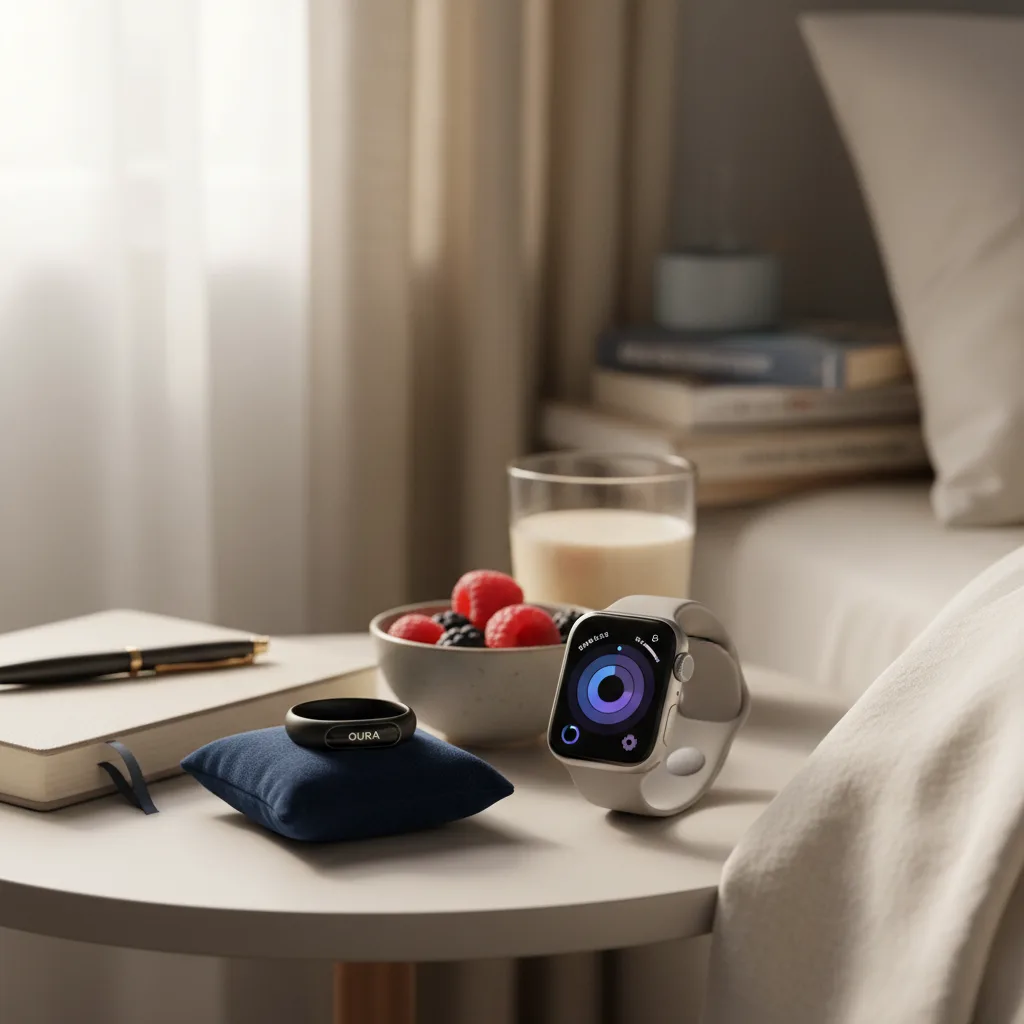
The Oura Ring is engineered for longevity. Its minimalist design and single-purpose focus allow for exceptional battery life:
- • Range: Typically 4-7 days on a single charge.
- • Charging Time: Usually 20-80 minutes for a full charge.
This extended battery life means you can wear the Oura Ring continuously for nearly a week without interruption, ensuring an unbroken stream of sleep and activity data. For a biohacker, this consistency is invaluable for establishing baselines, identifying long-term trends, and correlating sleep patterns with daily performance or specific interventions. The fact that you rarely have to think about charging it means less data loss and a more seamless integration into your daily routine, making it a reliable ring for tracking sleep without hassle.
Apple Watch: The Daily Sprinter
The Apple Watch, with its vibrant display, powerful processor, and multitude of functions, demands more frequent refueling:
- • Range: Typically 18-36 hours, depending on the model and usage.
- • Charging Time: Around 1.5-2.5 hours for a full charge.
To effectively use the Apple Watch for sleep tracking, users must integrate daily charging into their routine, often either before bed or first thing in the morning. While manageable, this can occasionally lead to missed nights of data if forgotten. For someone committed to continuous monitoring of Apple Watch sleep, this daily charging ritual can be a point of friction, potentially leading to gaps in their valuable sleep data stream.
From a biohacking perspective, Oura’s superior battery life offers a distinct advantage for those prioritizing consistent, uninterrupted sleep data. It minimizes the cognitive load of device management and maximizes the data fidelity required for sophisticated self-experimentation and optimization.
Sleep Stage Accuracy: Unveiling the Brain’s Nocturnal Symphony
The holy grail of sleep tracking is the accurate differentiation of sleep stages. Each stage – Light, Deep (Slow-Wave Sleep), and REM – plays a distinct and crucial role in cognitive restoration, memory consolidation, emotional processing, and even physical repair. For a neuroscientist, understanding the distribution and quality of these stages is paramount to optimizing brain function. While polysomnography (PSG) in a lab remains the gold standard, consumer wearables strive to approximate this complex analysis.
The Science of Sleep Stages and Wearables
Sleep stages are characterized by specific brainwave patterns, eye movements, and muscle tone. Wearables, lacking direct brainwave (EEG) access, infer these stages primarily from heart rate, heart rate variability, movement (actigraphy), and in some cases, skin temperature and respiratory rate. This inference, while increasingly sophisticated, inherently carries limitations.
- • Light Sleep (N1, N2): Often the easiest for wearables to detect, characterized by slowing heart rate and reduced movement.
- • Deep Sleep (N3/SWS): Crucial for physical restoration, growth hormone release, and memory consolidation (a key aspect of Neuroplasticity). It’s characterized by very slow heart rate, low movement, and distinct Delta brain waves. Wearables typically estimate this by observing sustained periods of minimal movement and low heart rate. Deep sleep tracking is highly valued.
- • REM Sleep: Essential for emotional regulation, learning, and dreaming. Characterized by increased brain activity, often similar to wakefulness (Theta and Alpha waves), rapid eye movements, and muscle paralysis. Wearables attempt to identify REM by changes in HRV and heart rate, often following periods of deep sleep, combined with minimal movement.
Oura vs. Apple Watch: A Comparative Look at Accuracy
Independent validation studies comparing wearables to PSG often show varying degrees of accuracy. Generally, both devices perform reasonably well in detecting overall sleep vs. wakefulness, but differentiating between specific sleep stages remains their biggest challenge.
- • Oura Ring: Often cited in studies as having a higher correlation with PSG for sleep staging, particularly for deep sleep tracking and REM, compared to many other consumer wearables. Its placement on the finger might offer a more stable signal for PPG compared to the wrist, potentially contributing to this edge.
- • Apple Watch: With successive generations and algorithm refinements, the Apple Watch sleep tracking has significantly improved. It now provides sleep stage data that is generally considered good for consumer-grade tracking, but some studies might show it slightly overestimates light sleep and underestimates deep sleep compared to PSG.
It’s important to view these devices as powerful trend trackers rather than perfect diagnostic tools. Their true value for a biohacker lies in identifying consistent patterns and how lifestyle changes affect those patterns over time, rather than providing a single, medically precise nightly readout. For those seeking even higher accuracy in brainwave-driven sleep stage detection, specialized devices like a sleep tracker headband that incorporates EEG sensors might be a more appropriate, albeit more intrusive, choice.
Price, Subscriptions, and Value: Investing in Your Cognitive Capital
The financial investment is a practical consideration for anyone buying sleep tech. Beyond the initial purchase price, the long-term cost of ownership, especially with the rise of subscription models, plays a significant role in the overall value proposition.
Oura Ring: Device + Subscription Model
The Oura Ring utilizes a combined model:
- • Device Cost: The Oura Ring itself has an upfront cost that varies depending on the finish and generation, typically ranging from $299 to $549 (as of late 2025).
- • Subscription: To access the full suite of Oura data, insights, and features, a monthly membership is required. This subscription is mandatory for full functionality, typically around $5.99/month. Without it, only basic metrics are accessible.
- • Value Proposition: The subscription funds ongoing research, algorithm development, and app improvements, making it a continuous investment in specialized sleep and recovery science. For those who derive significant actionable insights from Oura’s detailed metrics and readiness scores, this ongoing cost is often justified by the tangible improvements in their cognitive and physical performance.
Apple Watch: Upfront Device Cost, Ecosystem Value
The Apple Watch operates on a more traditional hardware-purchase model:
- • Device Cost: The upfront cost of an Apple Watch ranges significantly based on the model (SE, Series, Ultra), typically from $249 to $799+.
- • Subscription: Basic sleep tracking features within the native Health app do not require a separate subscription. However, third-party sleep apps (which may offer more advanced features) might have their own subscription fees. Apple does offer Apple Fitness+ and other services, but these are separate from core sleep tracking.
- • Value Proposition: The Apple Watch’s value comes from its sheer versatility as a smartwatch, fitness tracker, and health monitor. For users already embedded in the Apple ecosystem, the sleep tracking is an added benefit without an additional recurring cost for the basic features. Its value is broader, encompassing daily productivity, communication, and general health alongside sleep insights.
For the dedicated biohacker seeking the most in-depth and actionable sleep and recovery data, Oura’s subscription model can be seen as an investment in ongoing specialized insights. For the individual who desires competent sleep tracking as part of a comprehensive, multi-functional device ecosystem, the Apple Watch offers robust value without an additional mandatory recurring fee for its core sleep functions. When buying sleep tech, it’s crucial to weigh the immediate cost against the long-term value derived from the data and insights provided.
Beyond Sleep: Holistic Biohacking and Cognitive Enhancement
While our focus has been on which dashboard monitors sleep better, it’s essential to zoom out and consider how these tools integrate into a broader biohacking strategy for ultimate cognitive enhancement. Sleep is not an isolated event; it’s intricately connected to our waking performance, mood, focus, and overall brain health. A well-optimized sleep foundation profoundly impacts our ability to generate desired brainwave states—such as Alpha waves for relaxed alertness or Theta waves for deep meditative states and creativity—during our conscious hours.
Both Oura and Apple Watch, by providing data on heart rate, HRV, and activity, offer indirect insights into how daily stressors and recovery efforts influence your physiological state. This is where the ‘how’ and ‘why’ truly converge. By tracking these metrics, you can:
- • Identify Stressors: A consistently low HRV or elevated RHR, even with adequate sleep duration, might indicate underlying physiological stress (e.g., overtraining, illness, chronic psychological stress) impacting your sleep efficiency.
- • Optimize Recovery Protocols: Observe how practices like meditation, cold exposure, sauna use, specific nutrition, or targeted supplementation impact your sleep scores and readiness metrics.
- • Enhance Cognitive States: Understanding your recovery status can help you schedule demanding cognitive tasks for times when your brain is most primed for performance, or conversely, prioritize rest when your body signals a need for it.
For those seeking to further fine-tune their cognitive state and enhance states of deep relaxation or focus, exploring cutting-edge technologies such as visual brain entrainment tools can offer synergistic benefits, guiding your brainwave patterns to optimal states. These tools, alongside insights from your sleep tracker, can create a powerful feedback loop for personalized neuro-optimization. The data from devices like Oura and Apple Watch becomes a foundation upon which more advanced neuro-modulatory practices can be built, leading to a truly holistic approach to brain health and performance.
Conclusion: Choosing Your Sleep Sentinel for Cognitive Mastery
In the intricate dance of optimizing human potential, sleep is undoubtedly one of the most powerful, yet often overlooked, levers. Both the Oura Ring and the Apple Watch offer sophisticated means to peer into the nocturnal operations of your brain’s engine. However, their design philosophies and data presentation cater to slightly different needs within the biohacking community.
The Oura Ring emerges as the quintessential tool for the dedicated sleep biohacker. Its discreet form factor, exceptional battery life, and recovery-centric dashboard provide an unparalleled, uninterrupted stream of granular physiological data, including crucial sleep & temperature insights. It’s built for those who want to deeply understand their recovery metrics and make precise, data-driven adjustments to maximize cognitive performance and resilience.
The Apple Watch, on the other hand, stands as the champion of versatility. For users already invested in the Apple ecosystem, it offers a robust, multi-functional device that capably tracks Apple Watch sleep as part of a broader health and lifestyle monitoring suite. Its value lies in its seamless integration into daily life, providing a wide array of health metrics alongside improving sleep stage detection, albeit with a more demanding charging schedule and a less specialized focus on recovery.
Ultimately, the choice between Oura vs Apple Watch depends on your primary objective. If your goal is a deep, analytical dive into your sleep architecture and recovery state to fine-tune your brain for optimal performance, the Oura Ring offers a more specialized and often more insightful experience. If you desire competent sleep tracking as one component of a comprehensive, multi-purpose health and lifestyle device, the Apple Watch is an excellent choice. Regardless of your selection, remember that the true power lies not just in collecting data, but in actively interpreting it and making informed decisions to elevate your cognitive capital.
Expert Tip for Biohackers:
Start by tracking consistently for at least two weeks to establish a baseline. Then, introduce one change at a time – whether it’s optimizing your sleep environment, experimenting with a new pre-sleep ritual, or adjusting your diet. Observe how this single variable impacts your sleep metrics, especially HRV and deep sleep tracking. This systematic approach, leveraging your chosen device as a feedback loop, is the cornerstone of true self-experimentation and unlocks the path to sustained cognitive mastery.