
7 Ways AI Navigates Smart Cities Like an Autonomous Car: Optimizing Our Urban and Internal Landscapes
As a neuroscientist and biohacker, I often observe the human brain as the ultimate autonomous system – a complex, self-optimizing engine constantly navigating a deluge of sensory input, making split-second decisions, and striving for peak performance. Yet, in our modern world, many of us find our internal systems running on fumes, plagued by fatigue, lack of focus, or the pervasive feeling of being overwhelmed. We crave an upgrade, a more efficient operating system for our minds. This desire for optimal function mirrors the transformative journey our cities are undertaking. Just as we seek to fine-tune our neural pathways, urban centers are harnessing the power of Artificial Intelligence in Smart Cities to build more efficient, resilient, and responsive environments. These aren’t just technological advancements; they are fundamental shifts in how complex systems – be it a metropolis or a mind – achieve their highest potential.
Imagine your brain as a bustling metropolis, with countless neurons acting as vehicles traversing intricate neural highways. When traffic flows smoothly, thoughts are clear, decisions are sharp, and creativity sparks. But when congestion hits – perhaps from insufficient sleep, chronic stress, or information overload – our cognitive “city” grinds to a halt. Similarly, traditional cities grapple with gridlock, resource depletion, and slow responses to crises. AI in Smart Cities offers a blueprint for overcoming these challenges, much like an advanced autonomous vehicle intuitively navigates complex routes, anticipating obstacles and optimizing its journey. This article will delve into seven profound ways AI is reshaping our urban landscapes, drawing compelling parallels to how we can biohack our own cognitive performance, fostering an understanding of both external technological prowess and internal biological optimization. Prepare to see the future of urban living, and perhaps, a new perspective on your own brain’s potential.
Key Takeaways
- • AI in Smart Cities is fundamentally restructuring urban operations, from traffic management to disaster response, creating hyper-efficient and resilient environments.
- • The principles behind AI’s urban optimization – data analysis, predictive modeling, and adaptive systems – mirror the strategies for biohacking cognitive performance, emphasizing efficient information flow and resource allocation in the brain.
- • From the hyper-connectivity of 6G artificial intelligence to the intricate layers of AI in urban planning, these technologies are crafting cities that are not just smarter, but more responsive to human needs and environmental demands.
- • Understanding these urban transformations can inspire us to apply similar data-driven, adaptive strategies to optimize our own cognitive “operating systems” for enhanced focus, energy, and overall well-being.
What Exactly is AI in Smart Cities, and How Does it Mirror Our Brain’s Operating System?
Before we dive into the specific ways AI in Smart Cities is revolutionizing urban life, let’s establish a foundational understanding. At its core, a smart city leverages advanced technologies – particularly Artificial Intelligence – to collect and analyze data, making informed decisions that improve infrastructure, public services, and the quality of life for its inhabitants. Think of it as the city developing a highly sophisticated brain, capable of perception, analysis, learning, and proactive response.
This “urban brain” operates through a complex interplay of sensors, cameras, IoT devices, and powerful computational algorithms. Data streams in from countless points – traffic cameras, air quality monitors, waste bins, utility meters – forming a massive dataset that AI algorithms then process. This is where the magic happens: instead of relying on reactive, human-driven responses, the city can anticipate problems, identify patterns, and implement solutions with unprecedented speed and precision. The overarching goal of AI for smart cities is to create a dynamic, self-regulating ecosystem that continuously optimizes its functions.
The parallel to our own cognitive systems is striking. Our brains are constantly gathering sensory data, processing it in real-time, and making predictions about the future to guide our actions. Just as a smart city uses smart city network infrastructure to connect its diverse components, our neural networks facilitate seamless communication between different brain regions. When these networks are efficient, our cognitive functions – memory, focus, decision-making – operate optimally. When they’re hampered, we experience cognitive decline or inefficiency. Understanding these foundational parallels helps us appreciate the profound implications of AI for both urban and personal optimization.
1. AI as the Urban Traffic Controller: Optimizing Flow with Cognitive Precision
One of the most immediate and impactful applications of AI in Smart Cities is in managing the relentless flow of urban traffic. For decades, traffic management has been a reactive, often frustrating endeavor, leading to congestion, pollution, and lost productivity. However, AI is transforming this challenge into an opportunity for seamless mobility, much like a highly evolved brain automatically filters out irrelevant stimuli to maintain focus.
AI systems, integrated into the smart city network infrastructure, utilize a vast array of data inputs: real-time sensor data from roadways, traffic cameras, GPS data from connected vehicles, and even weather forecasts. This information is fed into sophisticated machine learning algorithms that can:
- • Predict Congestion Hotspots: By analyzing historical patterns and current conditions, AI can foresee where and when traffic jams are likely to occur, allowing for proactive intervention.
- • Dynamic Signal Timing: Instead of fixed light cycles, AI can adjust traffic signals in real-time based on actual traffic volume and flow, prioritizing major arteries during peak times or clearing paths for emergency vehicles.
- • Optimized Route Guidance: AI-powered navigation systems provide drivers with the fastest routes, not just based on distance, but on predicted travel times considering real-time traffic, accidents, and road closures. This also extends to public transportation, optimizing bus and train schedules.
- • Parking Management: Guiding drivers to available parking spaces reduces cruising, which is a significant contributor to urban congestion.
From a neuroscientific perspective, this mirrors how our brain manages its own internal “traffic.” When we are highly focused, our brain channels neural resources to relevant tasks, effectively minimizing distractions. This is akin to the brain entering an optimal Alpha or Theta wave state, where information processing is streamlined. AI’s ability to plan ‘traffic flow’ with AI creates a smoother, less stressful urban experience, allowing citizens to reclaim valuable time and mental energy – resources we can then reinvest in our own cognitive optimization.
2. The 6G Horizon: Powering Hyper-Connected Urban Cognition
The future of AI in Smart Cities is inextricably linked to the evolution of communication networks. While 5G laid the groundwork, the advent of 6G artificial intelligence promises to unlock unprecedented levels of connectivity and data processing capabilities, acting as the ultra-fast neural pathways for the city’s brain. To truly understand 6G network speed, we must grasp its fundamental advancements.
6G networks are projected to offer:
- • Terabit-per-second Speeds: Orders of magnitude faster than 5G, enabling instantaneous transfer of massive datasets.
- • Microsecond Latency: Near-zero delay, critical for real-time applications like autonomous vehicles, drone delivery, and remote surgery. This is where Edge AI computing will become even more prevalent, processing data closer to its source.
- • Ubiquitous Connectivity: Seamless integration across terrestrial, aerial, and even underwater environments, creating a truly interconnected world.
- • Integrated Sensing and Communication: 6G devices will not only communicate but also sense their environment, providing richer data for AI systems.
This level of network performance is essential for the full realization of truly smart cities. It allows AI algorithms to process unimaginable volumes of data from an exponentially growing number of IoT devices in real-time. Imagine millions of sensors, cameras, and even personal devices constantly feeding information into the smart city network infrastructure, enabling AI to create a dynamic, living digital twin of the city. This digital twin can simulate scenarios, predict outcomes, and optimize every facet of urban operation.
From a biohacking perspective, 6G is akin to upgrading the brain’s entire communication system. Faster, more efficient neural transmission means quicker processing, enhanced learning, and more robust cognitive function. The implications of 6G & Health are also a critical consideration, as such pervasive high-frequency networks require careful study regarding their potential interactions with biological systems and our own neural activity.
3. AI as the Urban Guardian: Predictive Resilience in Disaster Management
When disaster strikes, the speed and accuracy of a city’s response are paramount. Traditional disaster management often relies on emergency services reacting to events as they unfold. However, AI in Smart Cities is shifting this paradigm from reactive to proactive, transforming urban centers into resilient entities capable of anticipating, mitigating, and rapidly recovering from crises. This is the city’s equivalent of a highly trained nervous system, capable of detecting threats and initiating protective responses before conscious awareness fully registers.
How does AI in disaster management work?
- • Early Warning Systems: AI can analyze meteorological data, seismic readings, social media feeds, and sensor networks to predict natural disasters like floods, wildfires, or earthquakes with greater accuracy and lead time. This allows for earlier evacuations and resource staging.
- • Optimized Resource Allocation: During an emergency, AI can quickly assess damage, identify affected areas, and direct first responders, medical supplies, and aid efficiently, minimizing chaos and maximizing impact.
- • Dynamic Evacuation Routes: In situations requiring evacuation, AI can identify the safest and fastest routes based on real-time conditions, avoiding blocked roads or dangerous areas, and communicating these routes to citizens via various channels.
- • Infrastructure Monitoring: AI monitors critical infrastructure elements (bridges, power lines, water systems) for vulnerabilities, predicting potential failures before they become catastrophic during extreme weather or seismic events.
This predictive capability is analogous to our brain’s ability to anticipate danger and initiate a “fight or flight” response, but on a city-wide scale, driven by advanced algorithms, including those used in Self-Learning AI systems that continuously improve their predictive models. The goal is to build urban resilience, ensuring that cities can not only withstand shocks but also recover quickly and efficiently, minimizing human and economic cost. The underlying smart city network infrastructure is critical for this real-time data collection and dissemination.
4. Architecting Tomorrow’s Metropolises: AI in Urban Planning and Infrastructure
The very fabric of our cities – their layout, infrastructure, and resource allocation – is being reimagined through the lens of AI in Smart Cities. Urban planning, traditionally a lengthy, iterative process, is now becoming data-driven and predictive, allowing for the creation of more sustainable, livable, and future-proof environments. This is where AI in urban planning excels, acting as a master architect with unparalleled foresight.
Consider the implications for the future of urban infrastructure:
- • Sustainable Development: AI can simulate the environmental impact of new developments, optimizing building designs for energy efficiency, water conservation, and waste reduction. It can identify ideal locations for green spaces and renewable energy installations.
- • Predictive Infrastructure Maintenance: Sensors embedded in roads, bridges, and utility pipes constantly monitor their structural integrity. AI for smart cities analyzes this data to predict when maintenance is needed, shifting from costly reactive repairs to efficient, proactive upkeep. This prevents failures and extends the lifespan of critical assets.
- • Optimizing Public Transport Networks: AI helps design more efficient public transport routes, considering population density, travel patterns, and future growth, reducing reliance on private vehicles and easing congestion.
- • Resource Allocation & Zoning: By understanding demographic shifts, economic trends, and environmental factors, AI can inform zoning decisions, ensuring adequate housing, services, and commercial spaces are developed where they are most needed.
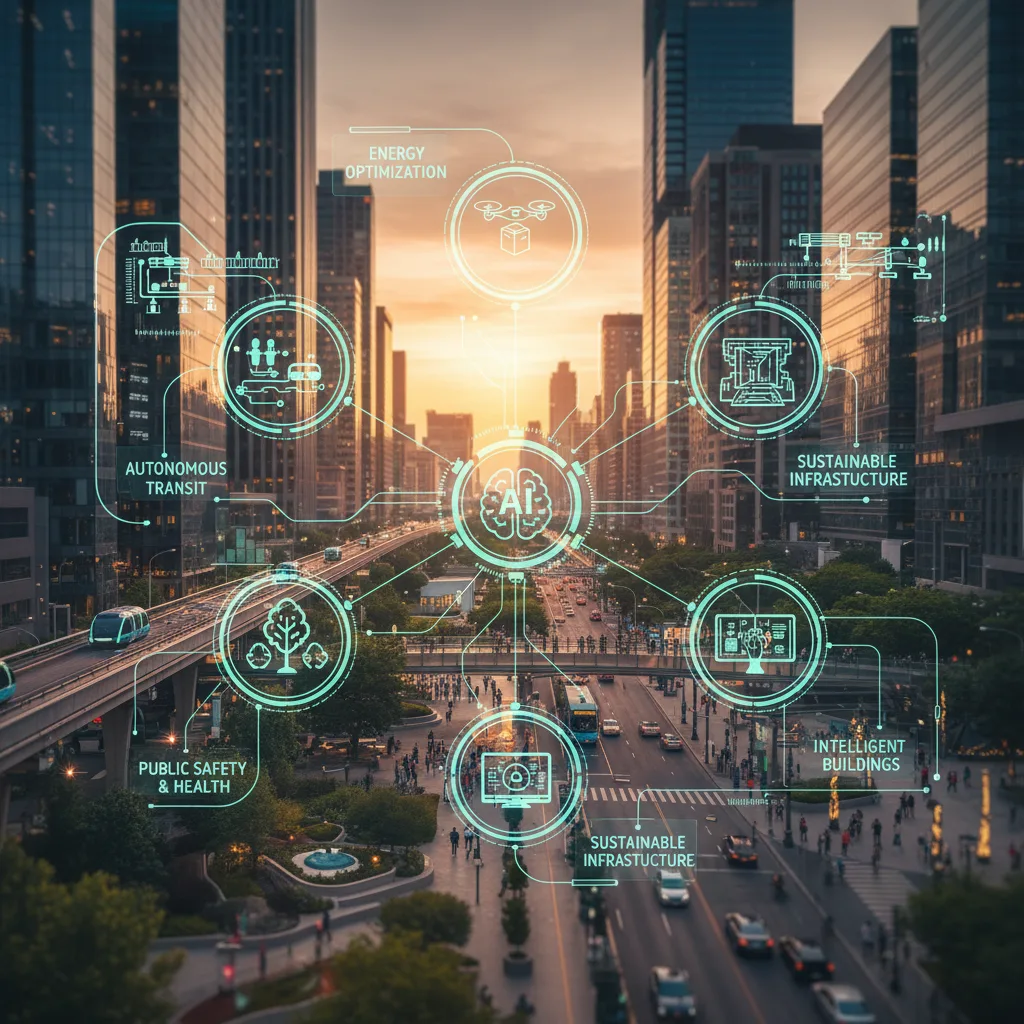
This dynamic, adaptive approach to urban development mirrors the brain’s incredible neuroplasticity. Just as the brain constantly reorganizes itself in response to new experiences, learning, and challenges, a smart city, powered by Smart Cities & AI, adapts and evolves its physical and digital infrastructure to meet the changing needs of its inhabitants. It’s about building cities that are not just functional, but truly intelligent and capable of continuous self-improvement.
5. The Smart Grid’s Synapse: Optimizing City Grids with AI-Powered Technology
The underlying utility grids – electricity, water, waste management – are the lifeblood of any modern city. Without their efficient operation, the entire urban system falters. AI in Smart Cities is revolutionizing these critical services, transforming them into “smart grids” that are responsive, resilient, and sustainable. This optimization process is akin to the brain’s meticulous management of its own metabolic energy, ensuring no resource is wasted and every process is fueled efficiently.
To optimize city grids with tech, AI for smart cities leverages real-time data to achieve:
- • Intelligent Energy Management: AI monitors energy consumption patterns across the city, predicting demand fluctuations and dynamically adjusting supply. It integrates renewable energy sources (solar, wind) into the grid more effectively, balancing their intermittent nature with stable supply. This minimizes waste and reduces reliance on fossil fuels.
- • Predictive Maintenance for Utilities: Beyond infrastructure, AI can predict failures in power lines, water pipes, and sewage systems, allowing utility companies to perform maintenance before outages or leaks occur, saving resources and preventing disruptions.
- • Optimized Waste Collection: Smart bins equipped with sensors can inform waste management systems when they are full, allowing AI to optimize collection routes, reducing fuel consumption and operational costs.
- • Water Leak Detection: AI analyzes water flow data across the network to detect anomalies indicative of leaks, enabling rapid repair and significant water conservation – a critical factor in increasingly water-stressed regions.
The integration of CO2 Monitors within this smart grid framework further enhances environmental awareness, allowing cities to track and reduce their carbon footprint in real-time. This holistic approach to resource management mirrors the brain’s intrinsic ability to maintain homeostasis, balancing energy expenditure with nutrient supply to ensure optimal function and longevity. By creating highly efficient and responsive urban grids, AI in Smart Cities ensures the foundational elements of urban living operate with unparalleled precision.
6. Enhanced Public Safety and Surveillance: The Proactive Urban Watchdog
Ensuring the safety and security of citizens is a paramount responsibility of any urban center. AI in Smart Cities is transforming public safety from a reactive police response to a proactive, predictive model, acting like an advanced, vigilant prefrontal cortex for the entire city. This isn’t just about surveillance; it’s about creating an environment where risks are minimized and emergency services can respond with unprecedented speed and effectiveness.
The applications of AI for smart cities in public safety include:
- • Predictive Policing: By analyzing historical crime data, social patterns, and real-time events, AI algorithms can identify areas at higher risk of criminal activity, allowing law enforcement to strategically deploy resources and deter crime before it happens.
- • Intelligent Video Analytics: Cameras equipped with AI can detect unusual behavior, abandoned packages, or even early signs of crowd distress, alerting authorities in real-time. This helps in managing large public gatherings and responding to potential threats.
- • Emergency Response Optimization: Beyond disaster management, AI assists in optimizing response routes for ambulances, fire trucks, and police vehicles, ensuring the fastest possible arrival times during emergencies. This is critical for saving lives and minimizing damage.
- • Cybersecurity for Infrastructure: As cities become more connected, they also become more vulnerable to cyberattacks. AI-powered cybersecurity systems monitor the smart city network infrastructure for threats, protecting critical systems from malicious actors.
However, the implementation of such pervasive surveillance and predictive systems raises significant ethical questions regarding privacy, bias, and civil liberties. As experts in neuro-technology, we understand the delicate balance between data-driven optimization and individual autonomy. Therefore, the development of robust ethical guidelines and transparent governance frameworks is crucial for ensuring that AI in Politics and public administration is deployed responsibly, fostering trust rather than apprehension. This dynamic interplay between surveillance and freedom, prediction and privacy, is a continuous challenge that mirrors the intricate ethical considerations within biohacking itself.
7. Fostering Cognitive Urban Environments: AI for Citizen Well-being and Engagement
Beyond infrastructure and safety, the ultimate goal of AI in Smart Cities is to create environments that genuinely enhance the well-being and engagement of their citizens. This goes beyond mere efficiency; it delves into the realm of human experience, comfort, and cognitive flourishing. It’s about building a city that understands and responds to the subtle rhythms of its inhabitants, much like a well-regulated Circadian Rhythm contributes to peak cognitive function.
Here’s how AI for smart cities is contributing to citizen well-being:
- • Personalized Public Services: AI-powered platforms can offer tailored recommendations for public services, events, and facilities based on individual preferences and needs, enhancing civic participation and satisfaction.
- • Environmental Quality Monitoring: Beyond CO2, AI monitors air and noise pollution in real-time, identifying hotspots and informing urban planning decisions to create healthier living zones.
- • Optimized Public Spaces: AI can analyze foot traffic and usage patterns in parks and public squares to inform design improvements, making these spaces more inviting and functional for relaxation and social interaction.
- • Creating Immersive & Stimulating Environments: In the future, AI Scent Creation and dynamic light installations could be used in public spaces to evoke specific moods, reduce stress, or enhance cognitive alertness, creating truly responsive urban experiences that cater to human psychology.
The Human Element: Biohacking Our Urban Experience
Just as smart cities are optimized for their inhabitants, we too can optimize our internal environments for peak performance. The principles of data-driven feedback and adaptive response are not exclusive to urban planning; they are cornerstones of biohacking. Technologies that support cognitive enhancement often focus on stimulating specific brainwave states, improving neural connectivity, and enhancing sensory processing.
For instance, consider the impact of light on our Circadian Rhythm and mood, or how specific frequencies can induce states of deep relaxation or heightened focus. Advanced techniques involve precise interventions to guide brain activity. When we seek to improve our sleep quality, boost focus, or achieve states of deep relaxation, we often look to external stimuli or tools that can gently guide our brain’s activity. This could involve sound frequencies for Alpha and Theta waves induction, or targeted light exposure. To truly unlock your brain’s potential and achieve optimal cognitive flow, exploring tools such as visual brain entrainment tools can offer a profound advantage, guiding your neural landscape towards desired states of alertness or tranquility.
This blend of urban and personal optimization highlights a fundamental truth: the pursuit of efficiency and well-being, whether for a city or an individual, relies on intelligent design, continuous feedback, and the strategic application of advanced technology.
The Broader Societal and Economic Impact of AI in Smart Cities
While we’ve explored the seven key ways AI in Smart Cities is transforming urban operations, it’s crucial to acknowledge the broader ramifications of this technological revolution. The shift towards intelligent urban environments is not just about convenience; it fundamentally reshapes economies, labor markets, and the very fabric of society. This holistic impact is akin to how a significant lifestyle change affects every aspect of our biological and psychological well-being.
Economic Transformation and the AI Job Market Impact
Smart city initiatives stimulate economic growth by creating new industries and job roles. The demand for AI developers, data scientists, cybersecurity specialists, and urban data analysts skyrockets. While some traditional jobs might be automated, the focus shifts to higher-value tasks requiring human creativity, critical thinking, and interpersonal skills. Cities that embrace AI for smart cities often become innovation hubs, attracting talent and investment. This dynamic mirrors the brain’s ability to adapt through neuroplasticity, forging new neural pathways and developing new skills in response to changing demands.
However, this transformation also necessitates a proactive approach to workforce retraining and education. Governments and educational institutions must collaborate to ensure the populace is equipped with the skills needed for the future economy. Understanding the potential AI Job Market Impact is vital for policymakers and individuals alike, ensuring a smooth transition into this new era of urban intelligence.
Governance and Ethical Considerations in the Age of Urban AI
The widespread deployment of AI in Smart Cities brings with it profound ethical and governance challenges. Issues of data privacy, algorithmic bias, and equitable access to technology must be addressed head-on. Who owns the data collected by smart city sensors? How do we ensure AI systems do not perpetuate or amplify existing societal inequalities? These are not trivial questions but fundamental considerations for the responsible evolution of our urban spaces.
Just as a biohacker must carefully consider the ethical implications of augmenting human capabilities, city planners and policymakers must establish robust regulatory frameworks. Transparent algorithms, public oversight, and clear accountability mechanisms are essential. The integration of AI in urban planning and public services requires a new form of collaborative governance, where technology serves humanity, not the other way around. This extends to how AI in Politics might influence urban policy, demanding vigilance to ensure democratic principles are upheld.
Conclusion: Navigating the Future – From Smart Cities to Smart Selves
We have embarked on a journey through the intricate neural networks of the modern metropolis, witnessing how AI in Smart Cities is fundamentally reshaping our urban experience. From intelligently planning traffic flow with AI and leveraging the hyper-speed of 6G artificial intelligence, to bolstering AI in disaster management and revolutionizing AI in urban planning, these technologies are crafting cities that are not merely efficient but truly symbiotic with their inhabitants. The ability to optimize city grids with tech means resources are conserved, services are responsive, and the quality of life is elevated for everyone.
Just as an autonomous car processes vast amounts of data to navigate its environment flawlessly, these intelligent urban systems are learning, adapting, and predicting, creating safer, cleaner, and more productive places to live. This revolution in urban intelligence provides more than just external benefits; it offers a powerful metaphor for our own cognitive optimization. The principles of data-driven feedback, predictive analysis, and continuous adaptation are universal, applying equally to the intricate systems of a smart city and the complex machinery of the human brain.
As a neuroscientist and biohacker, I urge you to consider this: if our cities can become intelligent, self-optimizing entities, so too can our minds. By understanding the “why” and “how” of these urban transformations, we gain insights into the optimal functioning of any complex system, including ourselves. Embracing data-driven strategies for sleep, focus, and overall cognitive health is not just a trend; it’s the logical next step in our evolution, mirroring the very advancements we celebrate in our smart cities.
Expert Tip: Biohack Your Urban Experience
Don’t just observe the smart city revolution; apply its principles to your personal well-being. Start by becoming a data scientist of your own body and mind. Track your sleep patterns, monitor your energy levels, and identify what truly enhances your focus. Just as smart cities use sensors for feedback, consider using wearables or journaling to gain insights into your own internal operating system. Then, make small, iterative changes – fueled by data and guided by intention – to optimize your daily rhythms and cognitive performance. This continuous feedback loop of observation, adjustment, and improvement is the essence of both smart urban development and effective biohacking. Begin today by consciously optimizing one aspect of your daily routine, and watch your internal “city” flourish.