Wired vs. Wireless Sleep Phones: Cutting the Cord for Optimal Brain Performance
In the relentless symphony of modern life, where demands on our cognitive faculties are ever-increasing, sleep remains the ultimate reset button for our high-performance biological engine: the brain. Yet, for many, this crucial nightly maintenance cycle is fraught with disruption. The insidious creep of insomnia, the frustrating lack of morning focus, and the nagging desire to elevate personal performance often lead us down pathways of self-optimization. We fine-tune our diets, calibrate our exercise, and meticulously plan our days, but how much attention do we truly pay to the quality of our sleep environment, especially when it comes to auditory input?
As a neuroscientist and biohacker dedicated to unlocking peak human potential, I’ve observed a fascinating evolution in how we approach nocturnal sensory management. For years, the default was a tangled mess of wires – headphones that promised solace but delivered logistical nightmares. Today, however, we stand at the precipice of a wireless revolution, particularly with the advent of Wireless Sleep Phones. This isn’t merely a matter of convenience; it’s a profound shift that impacts everything from physical comfort and sleep architecture to our exposure to electromagnetic fields. This deep dive will dissect the fundamental differences between wired and wireless sleep headphones, exploring the scientific rationale behind cutting the cord and how this technological upgrade can genuinely enhance your brain’s nightly rejuvenation process, propelling you towards superior daytime performance and an optimized state of being.
Key Takeaways
- • Enhanced Comfort and Sleep Architecture: Wireless Sleep Phones eliminate physical discomfort and entanglement, promoting uninterrupted sleep, especially for side sleepers, and supporting the natural flow of sleep stages.
- • Addressing Practical and Perceived Concerns: Modern advancements mitigate battery life worries and connectivity issues, while scientific understanding helps contextualize low-level EMF exposure from Bluetooth devices, distinguishing it from higher-frequency health debates.
- • Neuro-Optimization Through Auditory Entrainment: Beyond masking noise, wireless headband devices facilitate targeted auditory therapies like binaural beats and guided meditations, which can promote beneficial brainwave states (Alpha, Theta) crucial for deep relaxation and cognitive rejuvenation through neuroplasticity.
- • A Strategic Upgrade for Biohackers: For those committed to optimizing brain function, transitioning to no wires sleep solutions represents a data-driven choice to reduce sleep disruptors, enhance recovery, and support long-term cognitive health.
Decoding Sleep Audio: What Exactly Are Wireless Sleep Phones, and How Do They Influence Our Brain’s Nightly Reset?
At its core, a Wireless Sleep Phone is an auditory device meticulously engineered for nocturnal use. Unlike conventional headphones, which are often bulky, rigid, and prone to entanglement, sleep phones prioritize comfort, discretion, and a seamless integration into the sleep environment. The “wireless” aspect, predominantly leveraging Bluetooth technology, liberates the user from physical constraints, allowing for unrestricted movement and a truly unencumbered slumber.
The primary mechanism by which Wireless Sleep Phones influence our brain’s nightly reset lies in their ability to deliver controlled auditory input. Our brains are remarkably sensitive to sound, even during sleep. While deep sleep might raise the auditory threshold, our subcortical structures are constantly processing acoustic information. This auditory processing can either be a source of disruption (e.g., street noise, snoring) or a powerful tool for entrainment and relaxation. By introducing calming sounds, white noise, guided meditations, or Binaural Beats Sleep, these devices can:
- • Mask Disruptive Noise: By providing a consistent, low-level auditory baseline, bluetooth sleep headphones can effectively mask sudden, jarring noises that might otherwise pull the brain out of deeper sleep stages or prevent it from entering them altogether. This creates a more stable acoustic environment, fostering longer periods of restorative sleep.
- • Facilitate Brainwave Entrainment: Specific auditory frequencies, like those found in Binaural Beats Sleep, can guide the brain into desirable states, such as the Alpha waves associated with relaxation or the Theta waves characteristic of deep meditative states and early sleep stages. This is a subtle yet powerful form of neuro-modulation.
- • Induce Relaxation and Reduce Cognitive Arousal: Calming Sleep Music, Nature Sounds, or soothing narrations (Sleep Stories) can downregulate the sympathetic nervous system, reducing the “fight or flight” response and promoting a parasympathetic state conducive to sleep. This helps quell the racing thoughts that often precede insomnia.
The distinction between a wired and wireless sleep phone extends beyond mere cable presence; it touches upon the very philosophy of sleep enhancement. Wired solutions, while offering reliable audio, introduce a physical impedance that can counteract the very relaxation they aim to foster. Wireless, on the other hand, embraces freedom, a critical component for true, restorative rest. This foundational understanding sets the stage for a deeper exploration of how these devices address specific biohacker concerns.
The Biohacker’s Imperative: Why Cutting the Cord Matters for Comfort and Performance
For the individual committed to optimizing every facet of their biological performance, the concept of “cutting the cord” with Wireless Sleep Phones is far more than a luxury; it’s a strategic move. The rationale stems from a deep understanding of how physical comfort directly impacts sleep quality and, by extension, cognitive function and overall well-being. Wired headphones, no matter how well-designed, introduce an undeniable impedance into the sleep environment.
The Tyranny of Tangled Wires: Physical Discomfort and Micro-Awakenings
Consider the common scenario: you drift off to the soothing sounds of Sleep Music, only to be jolted awake by a wire snagging on your pillow, pulling an earbud out, or wrapping uncomfortably around your neck. These are not minor inconveniences; they are micro-awakenings, brief interruptions that fragment sleep architecture. Each such interruption, even if not fully remembered, can prevent the brain from progressing through the vital stages of NREM (Non-Rapid Eye Movement) and REM (Rapid Eye Movement) sleep essential for memory consolidation, emotional regulation, and physical restoration.
Wireless Sleep Phones, especially those integrated into a soft wireless headband, eliminate this physical impedance entirely. There are no wires to sleep on, no cables to get caught, and no rigid components pressing uncomfortably against the head. This freedom allows for:
- • Unrestricted Movement: We naturally shift positions many times during the night. Wireless devices accommodate this physiological necessity without disruption.
- • Reduced Pressure Points: Traditional earbuds can create uncomfortable pressure, particularly for side sleepers. Wireless designs often feature flat, integrated speakers that minimize this issue.
- • Seamless Transition into Sleep: The absence of physical irritants allows the brain to more easily downregulate from wakefulness to sleep, facilitating a smoother onset of the critical Alpha and Theta brainwave states that precede deep sleep.
By removing these common sleep disruptors, Sleep Headphones enable a more consistent and higher-quality sleep. From a neuroscientific perspective, this translates directly to enhanced neuroplasticity – the brain’s ability to adapt and form new connections. Uninterrupted sleep is paramount for this process, allowing the brain to consolidate learning, repair cellular damage, and clear metabolic waste products accumulated during wakefulness. For the biohacker, this means waking up sharper, more focused, and ready to tackle the day’s cognitive challenges.
Powering Your Potential: Navigating Battery Life Concerns in Wireless Sleep Devices
One of the most frequently cited reservations about adopting Wireless Sleep Phones is battery life. The thought of a device dying mid-sleep, leaving you exposed to ambient noise or interrupting a carefully curated Sleep Music track, can be a significant deterrent. However, modern battery technology and intelligent device design have largely mitigated these concerns, transforming them from critical flaws into manageable considerations for the discerning biohacker.
Advances in Power Management and Battery Density
The landscape of portable power has evolved dramatically. Lithium-ion and increasingly, lithium-polymer batteries, offer higher energy density and more efficient power delivery than their predecessors. This means smaller, lighter batteries can now power devices for extended periods. For bluetooth sleep headphones, this translates into designs that can comfortably last an entire 8-10 hour sleep cycle, and often much longer, on a single charge. Many premium models boast 12-24 hours of playback, providing ample buffer even for those with fragmented sleep patterns or who desire pre-sleep relaxation and post-wake meditation.
Furthermore, advancements in Bluetooth standards, particularly Bluetooth Low Energy (LE), have revolutionized power efficiency. Devices utilizing LE consume significantly less power, extending battery life without compromising connectivity range or audio quality. This is a critical development for devices designed to be “always on” or active for prolonged periods.
Strategic Charging and Smart Features
For the biohacker, managing battery life becomes another facet of optimizing their routine. Integrating charging into a daily habit – much like charging a smartphone – ensures consistent readiness. Most Wireless Sleep Phones feature fast-charging capabilities, meaning even a brief charge before bed can provide several hours of use.
Beyond simple charging, many devices now incorporate intelligent power-saving features:
- • Auto-Off Timers: Users can set devices to automatically power down after a certain period (e.g., 60-90 minutes) once they’ve fallen asleep, conserving battery for future use. This is particularly useful for those who only need sound to initiate sleep.
- • Low-Power Modes: Some devices automatically switch to a lower power consumption mode once playback stops or the user enters a deep sleep state (if equipped with sleep tracking).
- • Battery Status Indicators: Clear visual or auditory cues alert users to remaining battery life, allowing for proactive charging.
While the “always-on” nature of a wired connection offers theoretical infinite playback, the practical disruptions it introduces often outweigh this benefit. The slight mental overhead of managing battery life for no wires sleep is a small price to pay for the profound improvement in comfort and freedom, directly contributing to a more stable and restorative sleep cycle, which is fundamental to optimizing Circadian Rhythm and subsequent daytime cognitive performance.
The Ergonomics of Rest: Optimizing Side Sleeping Comfort with Wireless Solutions
For a significant portion of the population, sleeping on one’s side is the preferred, or even necessary, Sleep Position. While this posture can offer benefits like reduced snoring and improved spinal alignment, it presents a unique ergonomic challenge for traditional wired headphones. The pressure exerted by an earbud or over-ear cup against the pillow can be excruciatingly uncomfortable, leading to disturbed sleep and even ear pain. This is where Wireless Sleep Phones truly shine, demonstrating a superior understanding of sleep biomechanics.
The Side Sleeper’s Dilemma with Wired Devices
Imagine trying to find comfort with a rigid piece of plastic or metal jammed between your ear and a pillow. Traditional earbuds are simply not designed for lateral pressure. They protrude, creating a painful focal point that forces the sleeper into awkward positions, or worse, leads to repeated awakenings. Over-ear headphones, while comfortable for upright listening, are entirely impractical for sleep, being bulky and easily dislodged. This inherent design flaw in wired solutions forces side sleepers to compromise their comfort, leading to:
- • Frequent Position Adjustments: Constantly shifting to relieve pressure, disrupting sleep cycles.
- • Suboptimal Spinal Alignment: Sacrificing proper Sleep Position for ear comfort, leading to neck or back pain.
- • Reduced Sleep Quality: Pain and discomfort translate to fragmented sleep, preventing the brain from achieving deep, restorative stages.
Design Innovations for No Wires Sleep: The Rise of the Wireless Headband
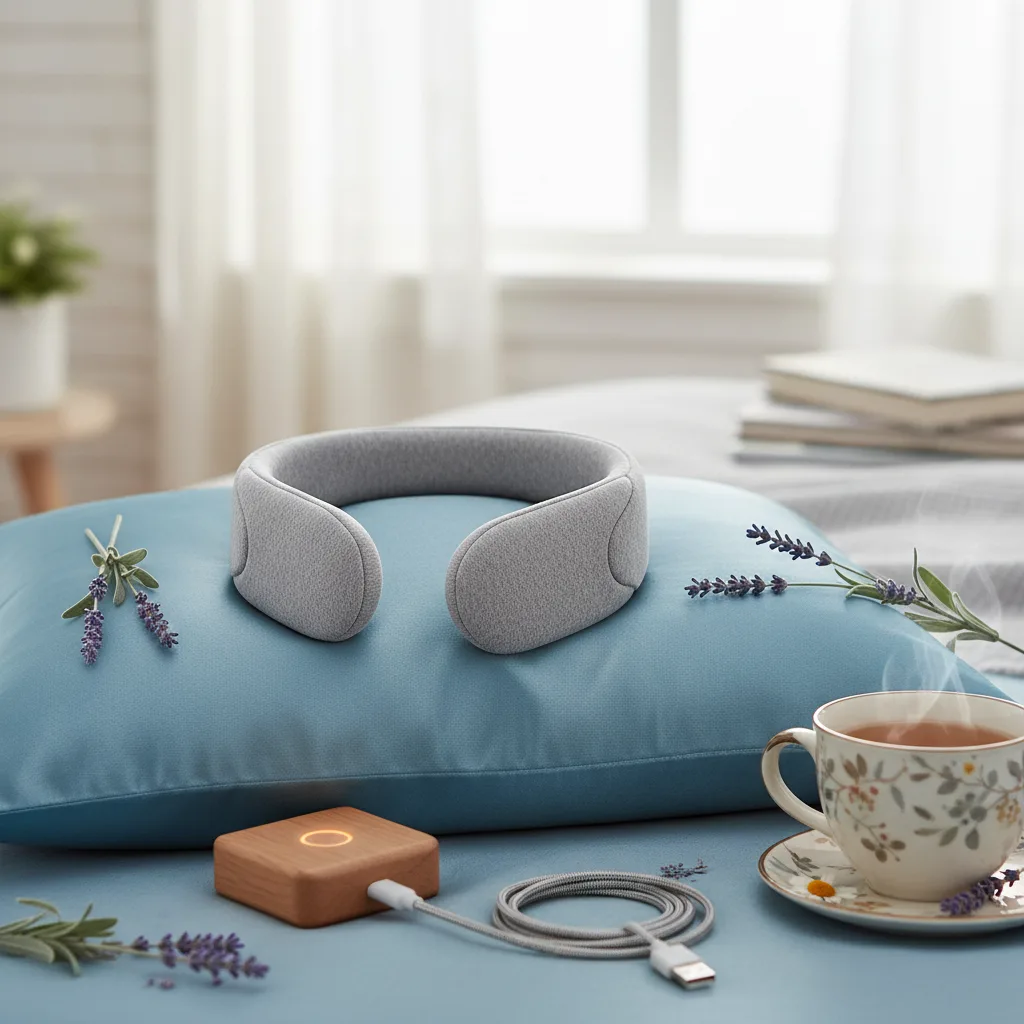
The advent of the wireless headband has been a game-changer for side sleepers. These devices integrate ultra-thin, flat speakers directly into a soft, breathable fabric band that wraps comfortably around the head. The key design principles at play are:
- • Minimal Profile Speakers: The speakers are specifically designed to be as flat as possible, often less than 5mm thick, making them virtually imperceptible against a pillow.
- • Soft, Breathable Fabrics: Materials like Lycra, fleece, or bamboo ensure comfort, moisture-wicking, and temperature regulation throughout the night.
- • Adjustable Speaker Placement: Many wireless headband designs allow users to slide the speakers to perfectly align with their ears, ensuring optimal sound delivery without pressure points.
- • Integrated Audio Sleep Masks: Some models combine the headband with an eye mask, providing complete sensory deprivation for light sleepers and those sensitive to ambient light, further enhancing the ability to reach deep Alpha and Theta states.
By embracing these ergonomic advancements, Wireless Sleep Phones facilitate a truly comfortable and undisturbed sleep experience for side sleepers. This comfort is not just about avoiding pain; it’s about creating an optimal environment for the brain’s restorative processes. When the body is physically at ease, the brain can more readily enter and maintain the deep sleep stages (N3 and REM) that are critical for cognitive repair, emotional processing, and the strengthening of neural connections – all hallmarks of robust neuroplasticity. For the biohacker, this means waking up not just rested, but truly rejuvenated, with a mind primed for peak performance.
Uninterrupted Flow: Exploring Connectivity Range and Signal Integrity for Seamless Sleep
The promise of no wires sleep is contingent on reliable wireless connectivity. For a device designed to deliver consistent auditory input throughout the night, signal integrity and range are paramount. A dropped connection or intermittent audio can be just as disruptive as a tangled wire, potentially derailing the delicate process of sleep induction and maintenance. Fortunately, advancements in Bluetooth technology have made these concerns largely obsolete, offering robust and seamless auditory experiences.
The Evolution of Bluetooth: From Stutter to Seamless Stream
Early iterations of Bluetooth were plagued by limited range and susceptibility to interference. However, modern Bluetooth standards, particularly Bluetooth 5.0 and its subsequent enhancements, have dramatically improved performance. Key advancements relevant to Wireless Sleep Phones include:
- • Extended Range: Bluetooth 5.0 boasts up to four times the range of Bluetooth 4.2, allowing for connections up to 240 meters (though practical indoor range is typically less, still ample for a bedroom). This means your phone or tablet can be on a bedside table, across the room, or even in an adjacent room without signal degradation, providing true no wires sleep freedom.
- • Increased Bandwidth and Speed: This translates to more stable audio streaming, reducing latency and preventing the frustrating skips or dropouts that can jar you awake.
- • Improved Interference Resistance: Modern Bluetooth protocols are more adept at navigating crowded wireless environments, ensuring a cleaner signal even with multiple devices operating nearby.
The Impact on Auditory Sleep Therapies
For biohackers utilizing auditory input for specific neuro-optimization goals, consistent signal delivery is critical. Whether you’re listening to Binaural Beats Sleep for brainwave entrainment, a carefully constructed Sleep Music playlist, or immersive Sleep Stories, any disruption can negate the therapeutic effect. A robust bluetooth sleep headphones connection ensures that the auditory stimulus remains constant, allowing the brain to fully engage with the content and transition smoothly into desired brainwave states (Alpha and Theta).
Furthermore, the reliability of modern wireless headband technology allows for the consistent delivery of environmental sounds, such as Nature Sounds, which are powerful tools for noise masking and relaxation. The integrity of these soundscapes is crucial; even a momentary glitch can break the immersive experience and pull the listener out of their pre-sleep trance. By providing a stable, wide-ranging connection, Wireless Sleep Phones empower users to construct and maintain an optimal auditory sleep environment, directly supporting the brain’s ability to achieve deep, restorative rest and maintain a healthy Circadian Rhythm.
Navigating the Invisible Landscape: Addressing Concerns About Sleeping with EMFs
In the realm of biohacking and holistic health, concerns about electromagnetic fields (EMFs) are increasingly prevalent. For those considering Wireless Sleep Phones, the question inevitably arises: what is the impact of sleeping with a Bluetooth device emitting EMFs in close proximity to the brain? This is a valid and important query that deserves a nuanced, scientifically grounded answer, distinguishing evidence from speculation.
Understanding Bluetooth EMFs: A Scientific Perspective
Bluetooth technology operates in the 2.4 GHz ISM band, the same frequency range as Wi-Fi and some cordless phones. However, the power output of Bluetooth devices, especially those designed for personal use like bluetooth sleep headphones, is exceptionally low. Bluetooth Class 2 devices, which include most headphones, typically emit power in the milliwatt range (e.g., 2.5 mW). For comparison, a typical smartphone can emit up to 200 mW, and a Wi-Fi router often operates around 100 mW.
The primary mechanism of concern for EMFs is thermal heating of tissues. Scientific consensus, based on extensive research by organizations like the World Health Organization (WHO) and the International Commission on Non-Ionizing Radiation Protection (ICNIRP), is that EMF exposure from low-power Bluetooth devices falls well below established safety limits, which are designed to prevent any measurable thermal effects. These limits are conservative and built on decades of research into non-ionizing radiation.
It is crucial to differentiate the low-power, short-range nature of Bluetooth from higher-frequency, higher-power technologies like cellular networks or future communication infrastructure such as 6G & Health, which operate at different power levels and frequencies and therefore present different considerations.
Prudent Avoidance vs. Over-Concern: A Biohacker’s Approach
While current scientific evidence does not indicate a significant health risk from low-power Bluetooth devices, a biohacker’s ethos often includes a principle of prudent avoidance and minimizing unnecessary exposure. For those who remain cautious, even in the absence of definitive harm, several factors regarding Wireless Sleep Phones can offer reassurance:
- • Proximity and Power: The power output of Bluetooth devices decreases exponentially with distance. While Wireless Sleep Phones are close to the head, their power is inherently low. The primary source device (phone, tablet) can be kept at a greater distance, further reducing overall exposure.
- • Intermittent Use: Many users set their bluetooth sleep headphones to an auto-off timer after they’ve fallen asleep, minimizing exposure during the deepest parts of the sleep cycle.
- • Benefit-Risk Analysis: For individuals whose sleep is severely disrupted by noise, the benefits of using Wireless Sleep Phones to achieve restorative sleep – which is critical for cognitive function, immune health, and neuroplasticity – may significantly outweigh the scientifically unsubstantiated risks of low-level Bluetooth EMFs. Poor sleep, by contrast, has well-documented, profound negative health consequences.
In essence, while it’s wise to stay informed about emerging research regarding all forms of electromagnetic exposure, the current body of scientific evidence suggests that the EMFs emitted by Wireless Sleep Phones are not a significant health concern. For the biohacker, the decision often comes down to a calculated balance: leveraging a technology that demonstrably improves sleep quality against a theoretical, low-probability risk. Optimizing sleep, the bedrock of cognitive performance and health, often takes precedence, making no wires sleep a powerful tool in the biohacking arsenal.
Beyond Sound: Leveraging Wireless Sleep Phones for Neuro-Optimization
The utility of Wireless Sleep Phones extends far beyond simply playing Sleep Music or masking noise. For the advanced biohacker, these devices represent a potent tool for targeted neuro-optimization, leveraging auditory pathways to influence brainwave states, enhance relaxation, and even support cognitive training. This is where the “Why” behind brain function meets the “How” of technological application.
Brainwave Entrainment: Guiding the Mind to Optimal States
Our brains operate on electrical impulses, generating rhythmic patterns known as brainwaves, measured in Hertz (Hz). Different states of consciousness correspond to different dominant brainwave frequencies:
- • Beta (13-30 Hz): Active, alert, focused thinking.
- • Alpha (8-12 Hz): Relaxed wakefulness, pre-sleep state, light meditation.
- • Theta (4-7 Hz): Deep relaxation, meditation, creativity, REM sleep, hypnagogic state.
- • Delta (0.5-3 Hz): Deep, dreamless sleep (N3).
Wireless Sleep Phones, especially when paired with specialized audio programs like Binaural Beats Sleep or isochronic tones, can facilitate brainwave entrainment. This phenomenon occurs when the brain’s electrical activity synchronizes with an external rhythmic stimulus. By delivering precise frequencies, these devices can gently guide the brain from a busy Beta state into a more relaxed Alpha state, and then deeper into the restorative Theta and Delta states essential for sleep and cognitive repair.
For a biohacker, this means the ability to:
- • Accelerate Sleep Onset: Transitioning faster from wakefulness to Alpha and Theta states.
- • Enhance Deep Sleep: Prolonging time spent in Delta wave sleep, crucial for physical restoration and growth hormone release.
- • Boost Daytime Cognition: A well-rested brain exhibits superior focus, memory, and problem-solving abilities, all supported by healthy neuroplasticity.
The Role of Sensory Resonance and Neuroplasticity
Beyond direct entrainment, the consistent and comfortable delivery of specific auditory stimuli via Wireless Sleep Phones fosters a state of sensory resonance. This means the brain, freed from external distractions and physical discomfort, can more fully immerse itself in the chosen soundscape. This deep immersion facilitates a profound state of relaxation, reducing sympathetic nervous system activity and activating the parasympathetic “rest and digest” response.
Consistent exposure to such optimal pre-sleep and sleep environments can actually train the brain. This is a prime example of neuroplasticity in action. Over time, the brain learns to associate specific auditory cues and the comfortable sensation of a wireless headband with the onset of sleep and deep relaxation. This conditioned response can make it easier to fall asleep and maintain sleep, even on nights when external factors are less than ideal. For biohackers, this is about building robust neural pathways that support resilience and optimal functioning.
Furthermore, the integration of Audio Sleep Masks or full Sleep Headphones can also block visual stimuli, enhancing the brain’s ability to achieve profound states of deep relaxation. When the brain is supported in this way, its inherent capacity for self-repair and optimization is maximized. For those keenly interested in enhancing their cognitive abilities through multi-sensory approaches, integrating tools that combine auditory input with visual brain entrainment can be particularly powerful. Devices that offer advanced light therapy devices or visual brain entrainment tools can further amplify the benefits, guiding the brain into even deeper states of restorative and creative function. This synergy of auditory and visual stimuli represents the next frontier in personalized neuro-optimization.
The transition to no wires sleep is not just about convenience; it’s about strategically removing obstacles and introducing powerful catalysts for superior brain function. By understanding the “Why” behind our brain’s need for specific auditory environments and the “How” of modern wireless technology, we can unlock a new level of sleep quality and, consequently, a higher tier of waking performance and cognitive resilience.
Conclusion: Unleashing Your Brain’s Full Potential Through Uninterrupted Rest
In the intricate dance between our waking aspirations and nightly restoration, sleep remains the undisputed linchpin of human performance. For the dedicated neuroscientist and biohacker, the pursuit of optimal brain function is a continuous journey of understanding and strategic implementation. This deep dive into Wired vs. Wireless Sleep Phones: Cutting the Cord reveals that the choice between the two is not merely a matter of preference but a calculated decision with profound implications for our cognitive vitality.
We’ve explored how the liberation from wires offered by Wireless Sleep Phones directly addresses critical pain points: the quest for unparalleled comfort, especially for the often-neglected side sleeper; the intelligent management of battery life through advanced technology; the assurance of stable connectivity for seamless auditory experiences whether for Sleep Music, Sleep Stories, or Binaural Beats Sleep; and a clear, data-driven perspective on the low-level EMF emissions from these devices, distinguishing them from more potent sources of concern like 6G & Health discussions.
The true power of bluetooth sleep headphones lies in their capacity for neuro-optimization. By creating an undisturbed auditory sanctuary, these devices facilitate the brain’s natural journey through critical sleep stages, promoting neuroplasticity, supporting a healthy Circadian Rhythm, and allowing for targeted brainwave entrainment into restorative Alpha and Theta states. The freedom of a wireless headband or Audio Sleep Mask removes physical impediments that often lead to micro-awakenings, directly contributing to longer periods of deep, rejuvenating sleep. This is not just about getting more sleep, but getting higher-quality, more effective sleep.
Expert Tip: To truly begin optimizing your sleep and, by extension, your brain’s performance, consider your sleep environment as a biofeedback loop. Invest in high-quality Sleep Headphones, ideally wireless, that prioritize comfort and deliver consistent, curated audio. Experiment with Nature Sounds, Binaural Beats Sleep, or guided meditations to find what resonates with your unique neurophysiology. Furthermore, ensure consistency in your sleep schedule to reinforce your Circadian Rhythm. By embracing no wires sleep and integrating sound as a therapeutic tool, you’re not just improving your nights; you’re building a stronger, sharper, and more resilient brain for life.