
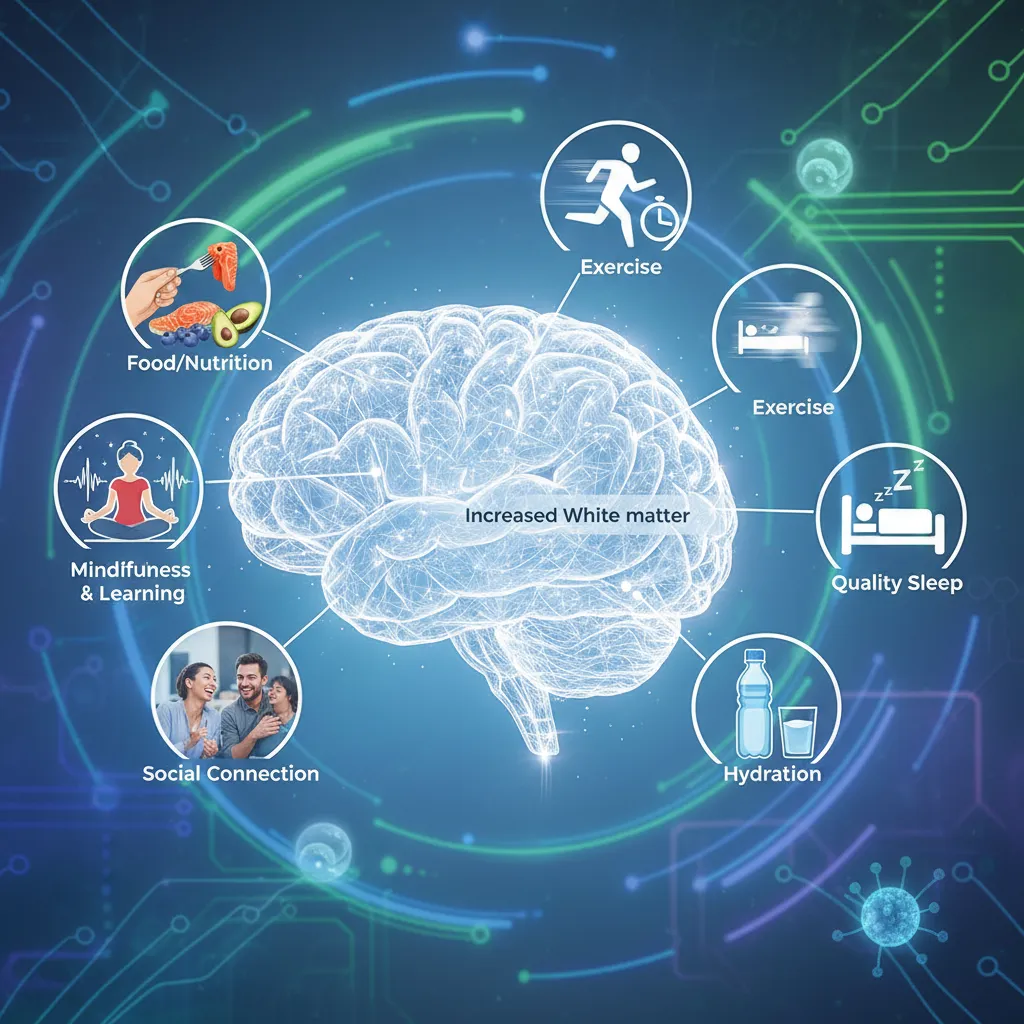
Key Takeaways
✅ Pros
- Enhanced cognitive speed and processing
- Improved learning capabilities and memory
- Stronger neural connections and overall brain connectivity
- Increased resilience against age-related cognitive decline
- Potential for recovery and improved function after brain injury
❌ Cons
- White matter naturally declines with age
- Vulnerable to damage from brain injuries (e.g., concussions, strokes)
- Can be affected by diseases like Multiple Sclerosis
- Requires consistent effort across multiple lifestyle areas for significant improvement
6 Ways to Increase White Matter & Boost Brain Speed
White matter brain health is fundamental for optimal cognitive function, acting as the high-speed information highway of your central nervous system. At NeuroTech Insider, we understand the profound impact of enhancing these neural connections to significantly improve cognitive speed and overall brain performance, supporting your journey towards neuro-optimization and peak mental acuity.
What Exactly Is White Matter and Why Is It So Vital for Your Brain?
Quick Answer: White matter comprises the myelinated axons that connect different regions of the brain and spinal cord, facilitating rapid communication and information processing essential for cognitive speed, learning, and coordinated bodily functions.
The human brain is an intricate network, and at its core, white matter brain tissue serves as the critical infrastructure for efficient neural communication. Unlike gray matter, which primarily contains neuronal cell bodies involved in processing information, white matter consists of bundles of nerve fibers, or axons, that are insulated with a fatty substance called myelin. This myelin sheath is crucial for accelerating electrical signals, enabling seamless brain connectivity and superior cognitive performance.
Imagine your brain as a supercomputer. Gray matter represents the processors, where calculations and decisions are made. White matter, then, is the vast network of fiber optic cables connecting these processors, ensuring data travels swiftly and accurately. Without healthy myelin health, these signals would slow down, leading to reduced cognitive speed and impaired neurological function. Research published in the journal Nature Reviews Neuroscience highlights myelin’s dynamic role not just in conduction, but also in supporting axonal integrity and plasticity, underscoring its importance beyond mere insulation.

Understanding the distinction between white matter vs gray matter is key to appreciating its specialized functions. While gray matter is responsible for functions like memory, attention, and thought, white matter’s primary role is to transmit information between different areas of the gray matter and between the gray matter and other parts of the body. This efficient transmission is what allows for complex cognitive processes and coordinated actions. A robust white matter network is associated with higher IQ scores, enhanced learning capabilities, and faster reaction times.
| Feature | White Matter | Gray Matter |
|---|---|---|
| Primary Components | Myelinated axons, oligodendrocytes | Neuronal cell bodies, dendrites, unmyelinated axons, synapses |
| Main Function | Information transmission, communication between brain regions | Information processing, thought, memory, sensation, voluntary movement |
| Appearance | White due to myelin sheath | Pinkish-gray due to capillaries and neuronal cell bodies |
| Location | Inner parts of brain, outer parts of spinal cord | Outer layer of cerebrum (cortex), inner parts of spinal cord |
How Can We Actively Increase White Matter & Boost Brain Speed?
Quick Answer: You can actively increase white matter integrity and density by consistently engaging in cognitive training, prioritizing restorative sleep, adopting regular physical activity, optimizing nutrition, practicing stress management, and exploring advanced neuro-optimization technologies.
The remarkable plasticity of the brain allows for continuous growth and adaptation, even into adulthood. Emerging research shows that white matter, traditionally thought to be static, can actually be enhanced and improved. By implementing targeted lifestyle interventions and embracing modern advancements, individuals can proactively increase white matter volume and fortify their neural pathways, leading to measurable gains in mental acuity and processing speed. NeuroTech Insider is dedicated to exploring these pathways to neuro-optimization.

What is the First Way to Enhance White Matter? Engage in Targeted Cognitive Training.
Quick Answer: Consistently challenging your brain with novel and complex tasks stimulates myelination and the formation of new neural connections, directly contributing to white matter growth and improved cognitive function.
Just as muscles grow stronger with exercise, the brain’s white matter can be strengthened through consistent mental engagement. Learning new, complex skills, especially those that involve multiple cognitive domains, is a powerful driver of neuroplasticity. A study published in PNAS (Proceedings of the National Academy of Sciences) demonstrated that learning to juggle led to observable increases in white matter volume in specific brain regions related to motor planning and visual-spatial processing. This highlights how acquiring new motor skills can actively remodel brain structure.
Consider incorporating activities such as learning a musical instrument, mastering a new language, or taking up complex strategy games. These activities demand sustained attention, problem-solving, and the integration of sensory and motor information, all of which encourage the brain to build and reinforce its neural pathways. For example, learning to play the piano requires fine motor control, auditory processing, and memory recall, leading to enhanced Neuroplasticity Exercises that directly support white matter integrity. Regular engagement, even for 20-30 minutes daily, can yield significant positive outcomes over several months, fostering greater brain connectivity and improved information flow.

What is the Second Strategy for Strengthening Brain Connectivity? Prioritize Quality Sleep and Rest.
Quick Answer: Adequate, restorative sleep is crucial for myelin repair and synthesis, allowing glial cells to maintain and rebuild the white matter tracts that ensure efficient brain communication and prevent cognitive decline.
Sleep is not merely a period of inactivity; it is an active state of regeneration for the brain. During deep sleep cycles, specialized glial cells, particularly oligodendrocytes, are highly active in producing and repairing myelin. This process is vital for maintaining robust myelin health and ensuring the structural integrity of white matter. Chronic sleep deprivation, conversely, has been linked to compromised white matter integrity and increased risk of cognitive issues, including Brain Fog Causes.
Aim for 7-9 hours of high-quality sleep nightly. Establishing a consistent sleep schedule, creating a dark and cool sleep environment, and avoiding stimulants before bed can significantly enhance sleep quality. Research published in the Journal of Neuroscience indicates that sleep plays a critical role in the maintenance of white matter microstructure, with chronic sleep deprivation leading to reductions in white matter volume. Prioritizing sleep is a straightforward yet profoundly effective strategy for preserving and enhancing your white matter brain. Devices like the NeuroVizr, developed by NeuroTech Insider, are designed to support optimal sleep cycles and neuro-synchronization, promoting restorative states beneficial for myelin repair.

How Does Physical Activity Impact White Matter Health? Incorporate Regular Aerobic Exercise.
Quick Answer: Regular aerobic exercise enhances blood flow to the brain, delivers essential nutrients, and stimulates the release of neurotrophic factors that support myelin production and white matter integrity, improving overall brain connectivity and function.
Physical activity is a cornerstone of overall health, and its benefits extend powerfully to brain health. Aerobic exercise, in particular, has been shown to positively influence white matter brain structure. When you engage in activities like brisk walking, jogging, swimming, or cycling, your heart rate increases, leading to improved circulation and oxygen delivery to the brain. This enhanced blood flow is crucial for nourishing brain cells and supporting the metabolic processes involved in myelin production.
Beyond circulation, exercise stimulates the release of brain-derived neurotrophic factor (BDNF), a protein that promotes the growth and survival of neurons and glial cells, including those responsible for myelination. A review published in the Journal of Alzheimer’s Disease underscores the role of physical activity in preserving white matter integrity and reducing the risk of age-related cognitive decline. Aim for at least 150 minutes of moderate-intensity aerobic exercise or 75 minutes of vigorous-intensity exercise per week. This commitment can lead to tangible improvements in cognitive speed and resilience against neurological challenges.

What Role Does Nutrition Play in Supporting Myelin and White Matter? Adopt a Myelin-Boosting Diet.
Quick Answer: A nutrient-rich diet, particularly one high in Omega-3 fatty acids, B vitamins, and antioxidants, provides the essential building blocks and protective compounds necessary for myelin synthesis, maintenance, and the overall health of white matter.
Your diet directly impacts the health and function of your brain, especially the intricate structures of white matter. Myelin, being largely composed of lipids and proteins, requires a consistent supply of specific nutrients for its formation and repair. The Neuroplasticity Diet emphasizes nutrient-dense foods that support optimal brain function and myelin health.
- • Omega-3 Fatty Acids: Essential for myelin sheath integrity and anti-inflammatory processes. Found in fatty fish (salmon, mackerel), flaxseeds, chia seeds, and walnuts.
- • B Vitamins (B12, Folate, B6): Crucial for nerve health and the synthesis of neurotransmitters and myelin. Rich sources include leafy greens, legumes, eggs, and fortified cereals.
- • Antioxidants (Vitamins C, E, Beta-carotene): Protect myelin from oxidative damage. Abundant in colorful fruits and vegetables (berries, citrus, bell peppers, spinach).
- • Iron and Copper: Involved in myelin synthesis and maintenance. Found in lean meats, nuts, seeds, and whole grains.
A study published in Nutrients highlighted how dietary patterns rich in these micronutrients are associated with better white matter integrity and reduced cognitive decline. Focus on a balanced diet rich in whole foods, minimizing processed items, and staying well-hydrated to provide your brain with the optimal environment to increase white matter and support overall neurological health.

| Nutrient Category | Key Role in Myelin | Food Sources |
|---|---|---|
| Omega-3 Fatty Acids | Structural component of myelin, anti-inflammatory | Fatty fish (salmon, sardines), flaxseeds, walnuts |
| B Vitamins (B12, Folate) | Co-factors for myelin synthesis, nerve function | Leafy greens, eggs, legumes, fortified cereals |
| Antioxidants (Vit C, E) | Protects myelin from oxidative stress | Berries, citrus fruits, nuts, seeds, spinach |
Can Stress Management and Mindfulness Improve White Matter Structure? Practice Meditation and Mindfulness.
Quick Answer: Regular meditation and mindfulness practices can reduce chronic stress, which is detrimental to brain health, thereby fostering an environment conducive to white matter integrity and enhanced emotional regulation and cognitive function.
Chronic stress has a well-documented negative impact on brain structure and function, including potential degradation of white matter. Elevated levels of stress hormones, such as cortisol, can impair the production of new oligodendrocytes, the cells responsible for creating myelin. By actively managing stress through practices like meditation and mindfulness, you can create a more favorable environment for myelin health and overall brain connectivity.
Mindfulness meditation involves focusing on the present moment, observing thoughts and sensations without judgment. This practice has been shown to reduce activity in the amygdala, the brain’s fear center, and increase activity in the prefrontal cortex, which is involved in executive functions and emotional regulation. A study published in PLOS ONE found that long-term meditators exhibited increased white matter integrity in brain regions associated with attention and self-regulation. Incorporating just 10-15 minutes of mindfulness or meditation daily can significantly contribute to better emotional resilience, clearer Mental Acuity, and the preservation of crucial white matter pathways.

Are There Emerging Technologies to Support White Matter Regeneration? Explore Advanced Neuro-Optimization Devices.
Quick Answer: Cutting-edge neuro-optimization technologies, such as specific light and sound therapies, are showing promise in supporting brain health by promoting neuroplasticity and potentially enhancing myelin repair and white matter integrity.
Beyond traditional lifestyle approaches, the field of neurotechnology is rapidly advancing, offering innovative tools to support brain health and potentially enhance white matter. Devices that utilize precise light and sound frequencies are gaining attention for their ability to promote neuro-optimization. For example, some forms of transcranial photobiomodulation (tPBM), which often involves a Brain Helmet emitting specific wavelengths of light, have been explored for their potential to improve cellular energy production and reduce inflammation, processes that are beneficial for myelin health.
NeuroTech Insider is at the forefront of these innovations, developing tools like the NeuroVizr device. This advanced technology employs carefully calibrated light and sound patterns to guide the brain into optimal states, supporting relaxation, cognitive enhancement, and potentially aiding in the brain’s natural restorative processes. While more research is always ongoing, preliminary findings and user experiences suggest that such technologies can contribute to improved Improve Memory, better sleep, and enhanced overall brain function, which indirectly supports white matter brain integrity. These non-invasive approaches offer a promising frontier for those seeking to proactively boost their cognitive speed and brain resilience, even showing potential in areas like Stroke Recovery Light therapies.

How Does White Matter Change with Age and What Can Be Done to Preserve It?
Quick Answer: White matter naturally declines with age due to myelin degradation and axonal changes, leading to reduced cognitive speed; however, engaging in a brain-healthy lifestyle encompassing diet, exercise, cognitive challenges, and stress reduction can significantly mitigate this decline and preserve brain function.
As we age, it is natural for the brain to undergo various changes, and white matter is particularly susceptible to age-related decline. Starting around the age of 40, a gradual process of myelin degradation begins, where the myelin sheath thins or fragments, impairing the efficiency of nerve impulse transmission. This can manifest as a subtle but noticeable reduction in cognitive speed, slower reaction times, and sometimes mild memory difficulties. Longitudinal studies using advanced neuroimaging techniques like Diffusion Tensor Imaging (DTI) have consistently shown age-related decreases in white matter integrity and volume, particularly in frontal and temporal lobes, which are critical for executive functions and memory.
The impact of this age-related white matter decline can be significant. Reduced brain connectivity means that different parts of the brain communicate less efficiently, affecting everything from problem-solving to multi-tasking. However, this decline is not inevitable or entirely irreversible. The same strategies discussed earlier for increasing white matter are highly effective in preserving it as we age. For instance, maintaining a myelin health-supporting diet rich in antioxidants and Omega-3s can protect against oxidative stress and inflammation, two key drivers of age-related damage. Regular physical activity, especially aerobic exercise, has been shown to slow down age-related white matter changes and even promote some regeneration.

Engaging in lifelong learning and mentally stimulating activities helps build cognitive reserve and maintain robust neural networks, compensating for some age-related structural changes. For example, individuals who regularly engage in complex hobbies or social interactions tend to exhibit better cognitive function in later life, despite some physiological brain aging. NeuroTech Insider advocates for a proactive approach to brain aging, emphasizing that consistent application of these strategies can significantly extend periods of optimal white matter brain function and cognitive vitality.
What Happens to White Matter After Brain Injury or Disease? Understanding Damage and Recovery.
Quick Answer: Brain injuries like concussions and strokes, along with diseases such as Multiple Sclerosis, can cause significant damage to white matter, leading to impaired cognitive and motor functions; however, the brain’s inherent neuroplasticity offers avenues for rehabilitation and partial recovery through targeted therapies and supportive interventions.
White matter is particularly vulnerable to damage from various neurological insults, including traumatic brain injuries (TBIs) like concussions, cerebrovascular events such as strokes, and neurodegenerative diseases. In the case of concussions, the violent shaking of the brain can cause diffuse axonal injury (DAI), where the axons are stretched and torn, disrupting their delicate myelin sheaths and impairing brain connectivity. This damage can lead to persistent symptoms like headaches, dizziness, and cognitive difficulties, including reduced cognitive speed and concentration issues.
Strokes, particularly ischemic strokes, can deprive brain tissue of oxygen, leading to the death of neurons and glia, including oligodendrocytes responsible for myelin. The resulting lesions can directly damage white matter tracts, leading to a range of impairments depending on the affected brain regions. For instance, damage to white matter in motor pathways can cause paralysis or weakness, while damage in language areas can lead to aphasia. Diseases like Multiple Sclerosis (MS) are characterized by the autoimmune destruction of myelin in the central nervous system, leading to widespread white matter lesions and progressive neurological dysfunction.
Frequently Asked Questions
What is white matter and why is it crucial for brain function?
White matter consists of myelinated axons that facilitate rapid communication between brain regions and the spinal cord, essential for cognitive speed, learning, and coordinated functions.
Can white matter be increased or improved?
Yes, white matter integrity and density can be enhanced through cognitive training, quality sleep, regular physical activity, optimized nutrition, stress management, and advanced neuro-optimization technologies.
How does aging affect white matter, and can it be preserved?
White matter naturally declines with age due to myelin degradation, reducing cognitive speed. However, a brain-healthy lifestyle, including diet, exercise, and cognitive challenges, can significantly mitigate this decline.