Key Takeaways
✅ Pros
- Improved communication and collaboration.
- Enhanced self-awareness and understanding of others.
- Complementary strengths in problem-solving and decision-making.
- Balanced and effective workforce leveraging diverse approaches.
- Dynamic and enriching personal relationships through mutual appreciation.
❌ Cons
- Sensors may perceive Intuitives as impractical, dreamy, or out of touch.
- Intuitives may view Sensors as unimaginative, rigid, or overly focused on the mundane.
- Communication gaps leading to frustration and misinterpretations.
- Differences in values and priorities can cause disagreements in relationships.
Sensors Vs Intuitives: 5 Key Differences
Sensors vs Intuitives represent two distinct cognitive functions within the Myers-Briggs Type Indicator (MBTI), significantly impacting how individuals perceive and interact with the world. Understanding these differences is crucial for improved communication, collaboration, and self-awareness, especially in personal and professional settings. NeuroTech Insider is dedicated to helping you optimize your cognitive functions, explore your personality type, and enhance your overall well-being. Dive into the nuances of sensing and intuition, observant vs visionary traits, and S vs N personality differences.
What is the Fundamental Clash Between Sensors and Intuitives Regarding Detail vs Big Picture?
Quick Answer: The fundamental clash stems from Sensors focusing on concrete details and immediate realities, while Intuitives prioritize abstract concepts and future possibilities. This difference in perception can lead to misunderstandings and friction in various aspects of life.
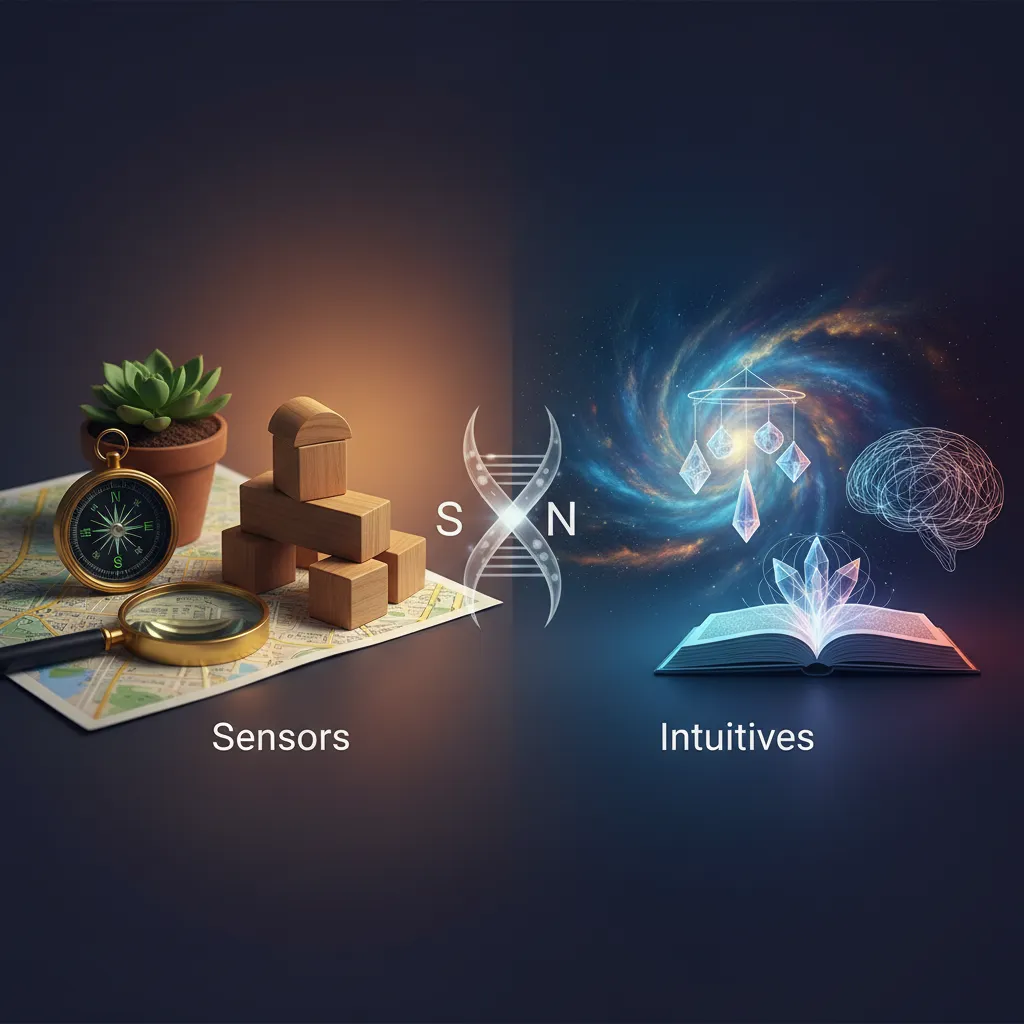
The core divergence between Sensors (S) and Intuitives (N) lies in their preferred mode of perceiving information. Sensors, or observant individuals, rely on their five senses to gather data, focusing on what is tangible, factual, and present. They are grounded in reality, appreciating the concrete details that make up their experiences. Intuitives, on the other hand, look beyond the surface, seeking patterns, connections, and possibilities. They are drawn to abstract concepts, theories, and future implications.
This difference manifests in various ways. For example, when planning a vacation, a Sensor might meticulously research specific hotels, read reviews, and create a detailed itinerary. They want to know exactly what to expect and ensure a comfortable, predictable experience. An Intuitive, however, might focus on the overall theme of the vacation, such as adventure or relaxation, and leave the specific details open to spontaneity. They are more interested in the potential for new experiences and discoveries than in adhering to a rigid plan.
Consider another scenario: a Sensor and an Intuitive are tasked with solving a problem at work. The Sensor is likely to break down the problem into smaller, manageable steps, focusing on the immediate issues and practical solutions. They might consult existing data, conduct experiments, and implement proven methods. The Intuitive, conversely, might brainstorm innovative ideas, explore unconventional approaches, and challenge the underlying assumptions of the problem. They are more interested in finding a creative, long-term solution than in simply applying a quick fix.
This fundamental difference can lead to significant misunderstandings. Sensors may perceive Intuitives as impractical, dreamy, or out of touch with reality. Intuitives, in turn, may view Sensors as unimaginative, rigid, or overly focused on the mundane. However, both perspectives are valuable and contribute to a well-rounded approach to problem-solving and decision-making. Recognizing and appreciating these differences can foster greater understanding and collaboration between these two personality types. Understanding your N vs S Personality can help you leverage your strengths.
How Do Sensors and Intuitives Handle Tasks Differently in the Workplace?
Quick Answer: Sensors excel in tasks requiring precision, attention to detail, and adherence to established procedures. Intuitives thrive in roles that demand creativity, innovation, and strategic thinking.
The contrasting preferences of Sensors and Intuitives significantly influence their approach to work. Sensors are typically drawn to roles that involve concrete tasks, practical problem-solving, and tangible results. They excel in environments that value accuracy, efficiency, and consistency. Examples include accounting, quality control, project management, and technical support.
In these roles, Sensors leverage their keen observational skills, methodical approach, and attention to detail. They are adept at following instructions, adhering to deadlines, and maintaining high standards of quality. They find satisfaction in completing tasks accurately and efficiently, contributing to the smooth operation of the organization.
Intuitives, on the other hand, gravitate towards roles that allow them to explore new ideas, develop innovative solutions, and shape the future direction of the organization. They thrive in environments that encourage creativity, experimentation, and strategic thinking. Examples include research and development, marketing, product design, and executive leadership.
In these roles, Intuitives utilize their visionary thinking, conceptual abilities, and pattern-recognition skills. They are skilled at identifying emerging trends, anticipating future challenges, and developing innovative strategies to achieve organizational goals. They find fulfillment in generating new ideas, inspiring others, and driving positive change.
The following table summarizes the key differences in how Sensors and Intuitives approach tasks in the workplace:
| Characteristic | Sensors (S) | Intuitives (N) |
|---|---|---|
| Focus | Concrete details, present realities | Abstract concepts, future possibilities |
| Approach | Practical, methodical, step-by-step | Innovative, creative, big-picture |
| Strengths | Accuracy, efficiency, attention to detail | Visionary thinking, strategic planning, problem-solving |
| Preferred Tasks | Following procedures, maintaining standards, implementing solutions | Generating ideas, developing strategies, innovating processes |
By understanding these differences, organizations can create a more balanced and effective workforce, leveraging the unique strengths of both Sensors and Intuitives. Understanding the Intuitive vs Observant dichotomy can improve team dynamics.
Why Do Sensors and Intuitives Often Misunderstand Each Other in Communication?
Quick Answer: Misunderstandings arise because Sensors communicate using concrete facts and specific details, while Intuitives prefer abstract concepts and theoretical explanations. This difference can lead to frustration and misinterpretations.
Communication styles are heavily influenced by personality preferences, and the differences between Sensors and Intuitives can often lead to miscommunication. Sensors tend to communicate in a clear, concise, and factual manner. They focus on providing specific details and concrete examples to support their points. They value accuracy and clarity, avoiding ambiguity and jargon.
For example, when explaining a problem, a Sensor might say, “The printer is not working because the paper tray is empty. I checked the tray, and it’s completely empty. We need to refill it with paper.” This communication style is direct, specific, and easy to understand.
Intuitives, on the other hand, tend to communicate in a more abstract, conceptual, and theoretical manner. They focus on exploring possibilities, making connections, and generating insights. They value creativity and innovation, embracing ambiguity and complexity.
When explaining the same problem, an Intuitive might say, “The printer issue might be related to a broader system malfunction. Perhaps the network is down, or there’s a software conflict. We need to consider the overall context and explore potential underlying causes.” This communication style is more open-ended, exploratory, and focused on the bigger picture.
These contrasting communication styles can lead to several challenges. Sensors may perceive Intuitives as vague, rambling, or lacking in concrete evidence. They may struggle to understand the point being made and feel frustrated by the lack of specific details. Intuitives, in turn, may view Sensors as narrow-minded, unimaginative, or overly focused on the trivial. They may feel stifled by the need for constant detail and yearn for more open-ended discussions.
To bridge this communication gap, it’s essential to be aware of these differences and adapt your communication style accordingly. Sensors can benefit from trying to see the bigger picture and appreciating the value of abstract thinking. Intuitives can benefit from providing more concrete examples and focusing on specific details to support their ideas.
Here are some tips for improving communication between Sensors and Intuitives:
- • For Sensors: Ask clarifying questions to understand the underlying concepts and connections.
- • For Intuitives: Provide specific examples and data to support your ideas.
- • Use visual aids, such as charts and diagrams, to illustrate complex concepts.
- • Be patient and respectful of each other’s communication styles.
Effective communication is key to successful collaboration and understanding between individuals with different personality types. Considering Thinking vs Feeling preferences can also improve communication.
What are the Statistics Regarding Which Type, Sensors or Intuitives, is More Common?
Quick Answer: Sensors are significantly more common than Intuitives in the general population. Approximately 70% of people are Sensors, while only 30% are Intuitives.
According to various studies and data collected on personality type distribution, Sensors represent a larger proportion of the population compared to Intuitives. This means that in most settings, you are more likely to encounter individuals who prefer concrete details and practical realities over abstract concepts and future possibilities.
The prevalence of Sensors can be attributed to several factors, including the emphasis on practical skills and tangible results in many societies. Traditional education systems and workplace environments often reward individuals who are detail-oriented, efficient, and able to follow established procedures. These are all characteristics commonly associated with Sensors.
However, the underrepresentation of Intuitives does not diminish their value or importance. Intuitives bring unique strengths and perspectives to the table, particularly in areas such as innovation, creativity, and strategic thinking. Their ability to see the bigger picture and generate novel solutions is essential for driving progress and adapting to change.
The following chart illustrates the approximate distribution of Sensors and Intuitives in the general population:
Approximate Distribution of Sensors and Intuitives
While Sensors are more common overall, the distribution of personality types can vary depending on the specific context. For example, certain professions, such as science, technology, engineering, and mathematics (STEM), may attract a higher proportion of Intuitives. Similarly, creative fields, such as art, music, and writing, may also be more appealing to Intuitives.
Understanding the statistical distribution of Sensors and Intuitives can help you better appreciate the diversity of perspectives and approaches in your environment. It can also inform your communication style and collaboration strategies, enabling you to build stronger relationships and achieve better outcomes. Recognizing these statistics can improve your understanding of INTP vs INTJ personality differences.
Can Sensors and Intuitives Make Relationships Work, and How?
Quick Answer: Yes, Sensors and Intuitives can absolutely make relationships work, but it requires understanding, appreciation, and compromise. Recognizing and valuing each other’s strengths and communication styles is crucial for a successful partnership.
Relationships between Sensors and Intuitives can be both challenging and rewarding. The differences in their perceptions, communication styles, and values can lead to misunderstandings and conflicts. However, these differences can also create a dynamic and enriching partnership, where each individual complements the other’s strengths and perspectives.
One of the key challenges in these relationships is the difference in communication styles. As mentioned earlier, Sensors tend to communicate in a clear, concise, and factual manner, while Intuitives prefer a more abstract, conceptual, and theoretical approach. This can lead to frustration and misinterpretations, as each individual struggles to understand the other’s point of view.
Another challenge is the difference in their values and priorities. Sensors tend to value practicality, efficiency, and stability, while Intuitives prioritize creativity, innovation, and growth. This can lead to disagreements about how to spend time and resources, as well as differing expectations about the future direction of the relationship.
However, these challenges can be overcome with understanding, appreciation, and compromise. By recognizing and valuing each other’s strengths, Sensors and Intuitives can create a balanced and fulfilling relationship.
Here are some tips for making relationships between Sensors and Intuitives work:
- • Communicate openly and honestly about your needs and expectations.
- • Practice active listening and try to understand each other’s perspectives.
- • Appreciate each other’s strengths and acknowledge the value of their contributions.
- • Be willing to compromise and find solutions that meet both of your needs.
- • Celebrate your differences and embrace the unique perspectives that each of you brings to the relationship.
In conclusion, while relationships between Sensors and Intuitives may require extra effort and understanding, they can be incredibly rewarding. By embracing their differences and learning from each other, these couples can create a strong and lasting bond. Understanding ESTP and INFJ compatibility can offer further insights into relationship dynamics. Consider how Diplomat Personality traits can influence relationships.
Don’t miss the chance to revolutionize your sleep and cognitive performance with the latest neuro-technology. Unlock your potential today! Visit NeuroTech Insider to explore cutting-edge resources.
Special Offer: Get an exclusive discount on the NeuroVizr device. Experience the power of light and sound therapy. Get Your Discount Code Here
Sources:
- • The Myers & Briggs Foundation: https://www.myersbriggs.org/
- • Truity Psychometrics: https://www.truity.com/
- • 16Personalities: https://www.16personalities.com/
- • Personality Hacker: https://www.personalityhacker.com/
- • Verywell Mind: https://www.verywellmind.com/
Frequently Asked Questions
What is the fundamental clash between Sensors and Intuitives regarding detail vs big picture?
The fundamental clash stems from Sensors focusing on concrete details and immediate realities, while Intuitives prioritize abstract concepts and future possibilities.
How do Sensors and Intuitives handle tasks differently in the workplace?
Sensors excel in tasks requiring precision, attention to detail, and adherence to established procedures. Intuitives thrive in roles that demand creativity, innovation, and strategic thinking.
Why do Sensors and Intuitives often misunderstand each other in communication?
Misunderstandings arise because Sensors communicate using concrete facts and specific details, while Intuitives prefer abstract concepts and theoretical explanations.