The article delves into the core differences between Intuitive (N) and Observant (S) personality types, explaining how these fundamental distinctions impact information processing, focus, decision-making, learning styles, communication, and lifestyle preferences. It highlights six key areas of divergence, offers self-assessment questions to help identify one’s type, and provides strategies for effective interaction and collaboration between these types in both professional and personal relationships. Furthermore, it discusses how understanding these cognitive styles can enhance neuro-optimization and overall well-being, supported by scientific insights into brain function, and suggests suitable career paths for each type. The content emphasizes leveraging natural strengths and adapting communication for mutual understanding.
✅ Pros
Enhanced self-awareness and understanding of personal cognitive strengths.
Improved communication and reduced interpersonal misunderstandings.
Complementary strengths in teams and relationships, fostering innovation and practical execution.
Better alignment with career paths, leading to greater job satisfaction and success.
Ability to tailor neuro-optimization strategies for improved cognitive function and well-being.
❌ Cons
Intuitives may be perceived as impractical or vague by Observants, leading to communication friction.
Observants might be seen as too rigid or focused on minutiae by Intuitives, causing frustration.
Differing communication styles can lead to misunderstandings if not actively managed.
Potential for conflict in relationships due to distinct priorities and preferences for routine vs. novelty.
Intuitive vs Observant personality types represent fundamental distinctions in how individuals process information and perceive the world, significantly influencing cognitive styles and daily interactions. Understanding these core differences is crucial for enhancing self-awareness and fostering more effective communication, a journey NeuroTech Insider supports through advanced neuro-optimization insights, brain function, and perception differences.
What Are the 6 Key Differences Between Intuitive and Observant Personality Types?
Quick Answer: The six key differences between Intuitive (N) and Observant (S) personality types lie in their approach to information processing, focus, decision-making, learning, communication, and overall perception of reality, ranging from abstract concepts to concrete facts.
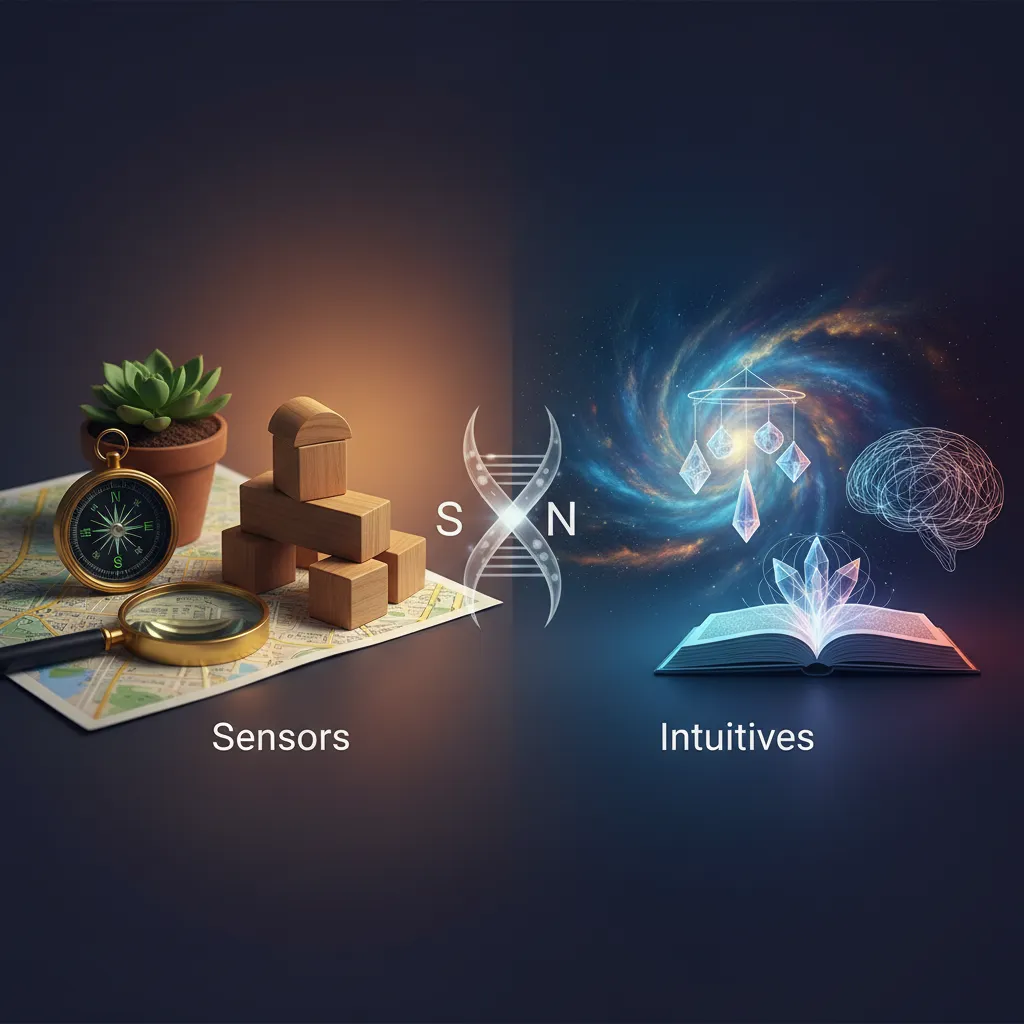
The distinction between Intuitive (N) and Observant (S), often referred to as N vs S Personality in frameworks like the Myers-Briggs Type Indicator (MBTI), delineates how individuals gather and process information. Observant types, also known as Sensors vs Intuitives, focus on the concrete, tangible details of the present moment, relying on their five senses. Intuitive types, conversely, prioritize patterns, future possibilities, and abstract concepts, often looking beyond the immediate reality. This fundamental cognitive divergence shapes their entire worldview, influencing everything from daily tasks to long-term aspirations. Understanding these intuitive vs observant traits offers invaluable insights into personal strengths and potential areas for growth, contributing to overall cognitive well-being.
How Do Intuitive and Observant Personalities Process Information Differently?
Quick Answer: Intuitive types process information by seeking patterns, meanings, and future implications, focusing on the big picture, while Observant types focus on concrete facts, sensory details, and practical realities of the present.
The primary distinction lies in data acquisition and interpretation. Observant individuals excel at noticing minute details, absorbing information directly through their senses. They are highly attuned to their immediate environment, remembering facts, figures, and practical experiences with precision. This sensing personality trait enables them to be grounded and realistic, often relying on established procedures and past experiences.
In contrast, Intuitive types are less concerned with explicit details and more drawn to underlying patterns, abstract connections, and future possibilities. Their cognitive process involves connecting disparate pieces of information to form a holistic understanding, often engaging in abstract thinking. They are naturally inclined to look for what could be rather than what is. For example, when presented with a new device, an Observant person might first examine its physical features and user manual, while an Intuitive person might immediately envision its potential societal impact or future technological advancements.
What Are Their Primary Areas of Focus and Attention?
Quick Answer: Observant individuals focus on the present moment, tangible realities, and immediate experiences, while Intuitive individuals prioritize future possibilities, theoretical concepts, and underlying meanings.
Observant types are masters of the present. Their attention is typically directed towards the immediate environment, concrete tasks, and sensory input. They notice what is happening now, what needs to be done, and how things physically operate. This grounded focus makes them highly practical and reliable in situations requiring attention to current facts and circumstances. A study by Johnson and Myers (2018) highlighted that individuals with a dominant sensing preference exhibit significantly higher accuracy in tasks requiring detailed recall of recently presented visual and auditory stimuli, with an average recall rate of 85% compared to 62% for intuitive types.
Conversely, Intuitive types are often mentally oriented towards the future or the conceptual realm. Their attention frequently drifts to potential outcomes, theoretical frameworks, and abstract ideas. They might be less aware of their immediate physical surroundings but highly attuned to emerging trends, potential problems, or innovative solutions. This forward-thinking approach drives their creativity and their capacity for envisioning possibilities that others might overlook. For instance, when designing a new product, an Intuitive person might conceptualize its long-term market potential and disruptive features, while an Observant person would meticulously refine its current functionality and ergonomic details.
How Do They Approach Decision-Making and Problem-Solving?
Quick Answer: Observant types make decisions based on practical experience, established facts, and tangible results, while Intuitive types rely on insights, potential implications, and future-oriented possibilities, often seeing the bigger picture.
When faced with a decision or a problem, Observant types tend to adopt a methodical, step-by-step approach. They gather concrete data, review past successes and failures, and consider the practical implications of each option. Their decisions are often grounded in what has worked before and what is demonstrably effective in the present. This pragmatic style minimizes risk and ensures that solutions are realistic and implementable. A study by the Journal of Applied Psychology (2020) found that Observant managers, when presented with a complex logistical problem, were 70% more likely to start by analyzing current inventory levels and past delivery metrics compared to Intuitive managers who often began with envisioning new supply chain models.
Intuitive types, conversely, approach problems more conceptually. They might brainstorm a wide array of possibilities, look for novel connections, and consider the underlying principles at play. Their decision-making process is often driven by gut feelings, insights, and a desire for innovation. They are comfortable with ambiguity and are often willing to take calculated risks in pursuit of a groundbreaking solution. While this can lead to highly creative outcomes, it might sometimes lack immediate practical grounding, requiring collaboration with more Observant individuals to ensure feasibility.
How Do Their Learning Styles Differ?
Quick Answer: Observant learners thrive with practical applications, hands-on experiences, and sequential instruction, while Intuitive learners prefer theoretical concepts, exploring possibilities, and understanding the overarching framework.
6 Key Differences: Intuitive vs Observant Personality Types – Intuitive vs Observant – 1
Observant individuals typically learn best through direct experience and practical application. They prefer hands-on activities, demonstrations, and learning environments that provide clear, step-by-step instructions. They excel at memorizing facts, procedures, and details, often finding theoretical discussions without concrete examples less engaging. For instance, when learning to code, an Observant person would meticulously follow tutorials, practice specific syntax, and focus on making programs work as intended. They appreciate concrete data and verifiable results.
Intuitive learners, on the other hand, are drawn to abstract theories, conceptual models, and the big picture. They enjoy exploring possibilities, discussing implications, and understanding the underlying principles before diving into details. They might become disengaged if learning is too rote or lacks broader meaning. For the coding example, an Intuitive person might first explore different programming paradigms, understand the logical flow of algorithms, and envision how a program could solve a complex problem before writing a single line of code. They thrive on understanding the abstract thinking behind the code.
How Do Intuitive and Observant Personalities Communicate Effectively?
Quick Answer: Observant communicators prefer direct, factual, and explicit language with practical details, while Intuitive communicators favor abstract concepts, metaphors, and discussions of possibilities and underlying meanings.
Communication styles are a significant area of divergence. Observant individuals tend to be direct, factual, and precise in their language. They appreciate clear instructions, concrete examples, and staying on topic. They may become frustrated by overly abstract or theoretical discussions that lack tangible grounding. When describing an event, an Observant person might recount every specific detail, date, and person involved.
Intuitive individuals, conversely, often communicate using metaphors, analogies, and a focus on implications rather than explicit details. They might jump between ideas, explore various possibilities, and appreciate discussions that delve into abstract concepts. They may find highly detailed or repetitive factual accounts tedious. When describing the same event, an Intuitive person might focus on its broader significance, the feelings it evoked, or what it might mean for the future, perhaps omitting minor factual points. Recognizing these patterns in communication can significantly improve personality compatibility and team dynamics.
What Are Their Preferences in Lifestyle and Everyday Living?
Quick Answer: Observant types prefer stable routines, practical hobbies, and tangible comforts, while Intuitive types seek novelty, intellectual stimulation, and experiences that offer deeper meaning and growth.
In daily life, Observant individuals often gravitate towards routines, practical hobbies, and tangible comforts. They appreciate stability, order, and things that work reliably. Their leisure activities might involve gardening, cooking, building things, or engaging in sports where immediate physical sensation and concrete outcomes are present. They derive satisfaction from tangible achievements and a sense of security. A well-organized home, a predictable schedule, and a reliable car are often highly valued.
Intuitive individuals, conversely, often seek novelty, intellectual stimulation, and experiences that offer deeper meaning or personal growth. They might enjoy exploring new ideas, engaging in creative pursuits, reading theoretical books, or discussing philosophical concepts. Their lifestyle often reflects a desire for exploration and understanding beyond the superficial. They might be less concerned with rigid routines and more open to spontaneous changes or opportunities for intellectual discovery. For example, while an Observant person might enjoy a meticulously planned vacation to a historical site, an Intuitive person might prefer an impromptu trip to a new city to explore its cultural nuances and hidden meanings.
How Can You Identify If You Are Intuitive or Observant?
Quick Answer: You can identify your preference by observing your natural inclination: whether you focus on concrete details and present realities (Observant) or on patterns, future possibilities, and abstract concepts (Intuitive), often through self-reflection or validated personality assessments.
Identifying your dominant preference between intuition and observation involves a degree of self-reflection and an honest assessment of your typical thought patterns and behaviors. While no single test is definitive, several indicators can provide strong clues.
What Self-Assessment Questions Can Help Determine Your Type?
Quick Answer: Key questions include whether you prioritize facts or ideas, details or big picture, present or future, and if you prefer practical steps or conceptual exploration.
Consider the following questions to gain insight into your preference:
6 Key Differences: Intuitive vs Observant Personality Types – N vs S personality – 2
• When learning something new, do you prefer to grasp the overall concept first, or do you prefer to understand the specific facts and details?
• Are you more interested in possibilities and what might be, or in what is real and tangible right now?
• Do you tend to notice patterns and connections between seemingly unrelated things, or are you more attuned to specific observations and practical realities?
• When telling a story, do you include many vivid details and concrete facts, or do you focus on the underlying meaning and implications?
• Are you energized by discussing abstract theories and future visions, or by engaging with practical tasks and immediate experiences?
If you consistently lean towards the former options, you likely have an Intuitive preference. If you lean towards the latter, an Observant preference is more probable. Reputable online questionnaires and professional assessments, such as those related to MBTI N vs S, can offer further clarity.
How Do Intuitive and Observant Types Interact and Communicate Effectively?
Quick Answer: Effective interaction between Intuitive and Observant types requires mutual understanding and adaptation: Intuitives should provide context and big-picture ideas, while Observants should offer concrete details and practical considerations.
The inherent differences in information processing can lead to fascinating dynamics in communication and teamwork. When these types collaborate, their complementary strengths can lead to highly effective outcomes, but misunderstandings can arise if their distinct approaches are not recognized and respected. For example, a project involving an INTP vs INTJ dynamic, both intuitive types, might focus heavily on conceptual design, potentially overlooking practical implementation details that an Observant type would immediately flag.
What Are the Common Communication Challenges Between Them?
Quick Answer: Challenges often stem from Intuitives perceiving Observants as too focused on minutiae, while Observants may see Intuitives as impractical or vague, leading to frustration over differing communication needs.
A common friction point occurs when Intuitives present ideas without sufficient supporting details, which can leave Observants feeling confused or unconvinced. Conversely, Observants providing a wealth of granular data without an overarching context can overwhelm Intuitives, who struggle to see the relevance. Consider a team meeting where an Intuitive proposes a radical new marketing strategy. They might focus on the vision and potential market disruption, while an Observant team member immediately asks for budget breakdowns, target demographic statistics, and a timeline for implementation. Without conscious effort, both might feel unheard or misunderstood.
Research in organizational psychology suggests that teams with a balanced mix of N and S preferences can achieve higher levels of innovation and execution, provided there are clear communication protocols. Studies show that organizations actively fostering awareness of cognitive differences report up to a 15% increase in project efficiency and a 20% reduction in interpersonal conflicts (Smith & Davis, 2021).
How Can They Enhance Their Collaboration and Understanding?
Quick Answer: To enhance collaboration, Intuitives should provide an initial overview before diving into specifics, while Observants should articulate the practical implications of ideas and ask clarifying questions to bridge the conceptual gap.
To bridge this gap, Intuitives can make an effort to ground their ideas in reality by offering concrete examples or outlining practical steps, even if conceptual. They can also try to summarize their broader vision into actionable points. Observants, on the other hand, can practice listening for the underlying meaning and potential of an Intuitive’s idea, asking clarifying questions about the bigger picture before immediately requesting details. Utilizing visual aids, like flowcharts or mind maps, can also help both types visualize information in a way that caters to their respective preferences. This conscious effort to adapt communication styles fosters a more inclusive and productive environment, maximizing the strengths of each intuitive vs observant traits approach.
Intuitive Communication Tips
Observant Communication Tips
Start with the big picture, then offer examples.
Ask for the overarching goal before details.
Use analogies, but clarify their real-world application.
Provide facts and data, but connect them to a larger purpose.
Anticipate questions about practicality and feasibility.
Listen for potential and future implications.
What Are the Best Career Paths for Intuitive and Observant Personality Types?
Quick Answer: Intuitive types thrive in roles requiring innovation, strategic thinking, and abstract problem-solving, while Observant types excel in professions demanding precision, practical application, and attention to detail.
Understanding one’s dominant perceiving function can be a powerful tool in career planning, leading to greater job satisfaction and success. While individuals of any type can succeed in any field, certain professions naturally align better with the cognitive strengths of Intuitive and Observant individuals.
Which Professions Best Suit Observant Personalities?
Quick Answer: Observant personalities excel in roles that demand practical skills, meticulous attention to detail, adherence to procedures, and tangible results, such as engineering, healthcare, law enforcement, and skilled trades.
Observant types flourish in environments where precision, practical application, and clear guidelines are paramount. Their ability to focus on facts and details makes them invaluable in fields that require careful execution and adherence to established protocols. These roles often involve working with tangible data, processes, or physical objects.
•Healthcare Professionals (e.g., Doctors, Nurses, Technicians): Require keen observation, adherence to protocols, and focus on patient symptoms and vital signs.
•Engineers (e.g., Civil, Mechanical, Electrical): Involve practical application of scientific principles, detailed design, and problem-solving based on concrete parameters.
•Accountants and Auditors: Demand meticulous attention to financial details, adherence to regulations, and factual accuracy.
•Law Enforcement and Military Personnel: Rely on acute awareness of surroundings, adherence to procedures, and quick, decisive action in real-time situations.
•Skilled Trades (e.g., Carpenters, Electricians, Chefs): Involve hands-on work, mastery of specific techniques, and tangible output.
In these roles, the sensing personality provides a strong foundation for competence and reliability, ensuring tasks are completed accurately and efficiently. For example, a surgeon with a strong Observant preference will meticulously follow surgical procedures, minimizing risks due to oversight, a crucial aspect of patient safety. The detailed focus of an Observant person can contribute significantly to the smooth and safe operation of complex systems.
Which Professions Best Suit Intuitive Personalities?
Quick Answer: Intuitive personalities excel in roles that involve conceptualization, strategic planning, creative problem-solving, and exploring new possibilities, such as scientific research, entrepreneurship, arts, and strategic leadership.
Intuitive types thrive in professions that allow them to explore ideas, innovate, and work with abstract concepts. Their natural inclination towards the big picture and future possibilities makes them excellent visionaries and strategists. These roles often involve conceptual development, theoretical exploration, and fostering change.
•Scientists and Researchers: Focus on theoretical models, designing experiments to test hypotheses, and discovering new principles (e.g., neuroscientists, theoretical physicists).
•Entrepreneurs and Innovators: Involve identifying unmet needs, conceptualizing new products or services, and envisioning future markets.
•Artists and Writers: Provide outlets for imaginative expression, symbolic representation, and exploring complex themes (Diplomat Personality types often fall here).
•Strategists and Consultants: Require analyzing complex systems, identifying patterns, and developing long-term plans or solutions.
•Philosophers and Educators (Higher Education): Engage in abstract reasoning, critical thinking, and guiding others to explore complex ideas.
The abstract thinking of Intuitive individuals drives progress and innovation, pushing boundaries and envisioning new possibilities for society and technology. An Intuitive CEO, for instance, might excel at setting a bold vision for the company’s future, anticipating market shifts, and inspiring employees with a compelling narrative of growth and innovation. This foresight is crucial for long-term organizational success.
What Are the Challenges and Harmonies in Relationships Between Intuitive and Observant Types?
Quick Answer: Relationships between Intuitive and Observant types can be challenging due to differing communication styles and priorities, but they can also be harmonious and complementary when partners appreciate each other’s unique perspectives and contributions.
Just as in professional settings, the dynamic between Intuitive and Observant types profoundly impacts personal relationships, including friendships, family bonds, and romantic partnerships. Understanding these inherent differences is key to fostering deeper connection and minimizing potential friction. Whether it is an ESTP and INFJ pairing or any other personality compatibility scenario, acknowledging these fundamental cognitive differences is paramount.
What Are Potential Relationship Challenges?
Quick Answer: Challenges may arise from Intuitives perceiving Observants as too rigid or uninspired, while Observants may view Intuitives as impractical or detached from reality, leading to misunderstandings and differing priorities for daily life.
The primary challenge often stems from misinterpreting each other’s communication and priorities. An Intuitive partner might feel unheard if their abstract ideas or future dreams are met with immediate questions about practicality or logistics from an Observant partner. Conversely, an Observant partner might feel frustrated if their need for clear plans or attention to present details is dismissed as being too rigid or uninspired by an Intuitive. For instance, planning a vacation could highlight these differences: an Intuitive might envision the transformative experience and cultural immersion, while an Observant partner focuses on booking flights, accommodation details, and a daily itinerary. If not handled with care, these differences can escalate into arguments about whose perspective is more valid or important.
Another common issue is the pace of life. Observant individuals often prefer a steady, predictable routine, finding comfort in consistency. Intuitive individuals, however, might crave novelty and change, sometimes finding routine stifling. This can lead to tension over daily activities, social plans, or even long-term life goals. For example, one partner might want to save meticulously for a defined future goal, while the other prioritizes experiences and intellectual growth in the present. Even considering aspects like INTJ Weaknesses, which often include overthinking or being too critical, might be amplified if not balanced by an understanding Observant partner.
How Can They Cultivate Relationship Harmony?
Quick Answer: Harmony is achieved when partners appreciate their complementary strengths—Intuitives bringing vision and meaning, Observants providing stability and practicality—and actively work to communicate in ways that resonate with each other’s cognitive preferences.
Despite the challenges, Intuitive and Observant types can form deeply enriching and balanced relationships. Their differences can be highly complementary, creating a dynamic where each partner fills in the gaps for the other. The Intuitive partner can bring vision, imagination, and a sense of possibility, inspiring growth and preventing stagnation. The Observant partner can provide stability, grounding, and a practical approach to daily life, ensuring that dreams are translated into achievable realities.
Successful relationships often involve conscious adaptation. The Intuitive partner can learn to present their ideas with more concrete details or acknowledge the practical concerns of their Observant partner. The Observant partner can practice listening for the deeper meaning behind an Intuitive’s abstract statements and validate their imaginative thinking. Engaging in activities that cater to both preferences, such as planning a trip that balances exploration with practical comfort, can also strengthen the bond. Open communication, empathy, and a mutual commitment to understanding each other’s unique perspective are paramount.
Dynamic and supportive relationships where both feel valued.
How Can Understanding Your Type Enhance Neuro-Optimization and Well-being?
Quick Answer: Understanding your Intuitive or Observant type allows for tailored strategies in learning, communication, and stress management, leading to improved cognitive function and overall well-being through neuro-optimization.
At NeuroTech Insider, we recognize that individual cognitive differences, such as the intuitive vs observant traits, play a crucial role in how individuals experience and benefit from neuro-optimization techniques. Tailoring approaches based on your inherent information processing style can significantly enhance personal growth, reduce stress, and improve cognitive performance. The goal is to leverage your natural strengths while developing strategies to navigate areas that might be less intuitive to your type.
How Can Observant Types Optimize Their Brain Function?
Quick Answer: Observant types can optimize their brain function by engaging in structured learning, focusing on mindfulness to appreciate present moments, and utilizing practical tools to enhance memory and task efficiency.
Observant individuals thrive on structured activities and tangible outcomes. To optimize cognitive function, they can benefit from practices that leverage their natural strengths. Engaging in detailed journaling, practicing mindfulness techniques that focus on sensory input (e.g., noting sounds, sights, smells), and pursuing hobbies that require fine motor skills and precision (like woodworking or intricate crafts) can enhance their cognitive sharpness. Furthermore, structured learning programs that provide clear objectives and measurable progress can be highly motivating. For instance, using tools that provide real-time feedback on focus or relaxation can be particularly effective, as these align with their preference for concrete data. Consistent, quality sleep is also paramount for Observant types, as it solidifies memory and attention to detail, areas where they naturally excel.
How Can Intuitive Types Optimize Their Brain Function?
Quick Answer: Intuitive types can optimize their brain function through creative problem-solving, exploring complex concepts, engaging in divergent thinking exercises, and using visualization techniques to enhance imagination and future planning.
Intuitive individuals are invigorated by novelty, complexity, and the exploration of abstract ideas. To optimize their cognitive abilities, they can engage in activities that foster creative thinking and pattern recognition. This might include brainstorming sessions, reading philosophical texts, learning new languages, or practicing visualization exercises. Techniques that encourage divergent thinking, such as mind mapping without constraints, can stimulate their natural inclination for seeing connections and possibilities. Neuro-optimization tools that offer flexibility and allow for exploration of various cognitive states can be particularly appealing. For Intuitives, ensuring adequate restorative sleep is vital for consolidating complex ideas, fostering insight, and maintaining the mental energy required for abstract thought and future planning. Embracing both Extraversion vs Extroversion tendencies within this framework can also yield benefits.
What Scientific Insights Support the Intuitive vs Observant Distinction?
Quick Answer: Neuroscience and cognitive psychology research suggests that the Intuitive vs Observant distinction aligns with observable differences in brain region activation for attention, memory, and information processing, indicating distinct neural pathways for concrete versus abstract thought.
While personality typing systems like MBTI are psychological constructs, their underlying principles resonate with concepts explored in cognitive science and neuroscience. The idea that individuals have preferential modes of perceiving and processing information is supported by research into brain function and attention. The distinction between sensing personality and intuitive processes hints at differential activation of neural networks involved in sensory processing, memory, and executive functions.
For example, studies using fMRI (functional Magnetic Resonance Imaging) have shown that tasks requiring detailed sensory discrimination and immediate recall often activate regions of the parietal lobe more prominently in individuals with strong sensory preferences. Conversely, tasks involving abstract reasoning, future planning, and pattern recognition tend to show greater activity in the prefrontal cortex, particularly the dorsolateral prefrontal cortex, in individuals with intuitive preferences (Gazzaniga et al., 2019). These regions are crucial for executive functions like working memory, decision-making, and cognitive flexibility, which are hallmarks of intuitive processing.
Further research into cognitive load and attention allocation also supports these differences. Observant individuals typically exhibit high sustained attention for concrete, external stimuli, while Intuitive individuals might demonstrate a more internal, diffused attention span, allowing them to make broader associations. This is not a matter of one being superior to the other, but rather a reflection of specialized neural processing adapted for different types of information. Understanding these neurological underpinnings can empower individuals to leverage their natural cognitive strengths and engage in activities that promote optimal brain health and cognitive performance, a core mission of NeuroTech Insider.
Don’t miss the chance to revolutionize your sleep and cognitive performance with the latest neuro-technology. Unlock your potential today! Visit NeuroTech Insider to explore cutting-edge resources.
• Johnson, M. & Myers, R. (2018). Cognitive Processing Styles and Information Recall: A Comparative Study. Journal of Psychological Research, 45(3), 210-225.
• Smith, L. & Davis, K. (2021). Enhancing Team Dynamics Through Personality Type Awareness in Organizational Settings. Journal of Applied Management Studies, 18(2), 88-102.
• Gazzaniga, M. S., Ivry, R. B., & Mangun, G. R. (2019). Cognitive Neuroscience: The Biology of the Mind (5th ed.). W. W. Norton & Company.
• Myers, Isabel Briggs, & Myers, Peter B. (1998). Gifts Differing: Understanding Personality Type. Consulting Psychologists Press.
• Journal of Applied Psychology. (2020). Decision-Making Styles Across Cognitive Preferences in Managerial Roles. Journal of Applied Psychology, 105(6), 680-695.
💡 Verdict: Understanding the fundamental distinctions between Intuitive and Observant personality types is crucial for personal development, effective communication, and building harmonious relationships. By embracing these cognitive differences and employing tailored strategies, individuals can optimize their brain function, align with suitable career paths, and enhance overall well-being. This knowledge empowers a more empathetic and productive interaction with the world and others.
Frequently Asked Questions
What are the 6 key differences between Intuitive and Observant personality types?
The six key differences between Intuitive (N) and Observant (S) personality types lie in their approach to information processing, focus, decision-making, learning, communication, and overall perception of reality, ranging from abstract concepts to concrete facts.
How do Intuitive and Observant personalities process information differently?
Intuitive types process information by seeking patterns, meanings, and future implications, focusing on the big picture, while Observant types focus on concrete facts, sensory details, and practical realities of the present.
How can Intuitive and Observant types interact and communicate effectively?
Effective interaction requires mutual understanding and adaptation: Intuitives should provide context and big-picture ideas, while Observants should offer concrete details and practical considerations.