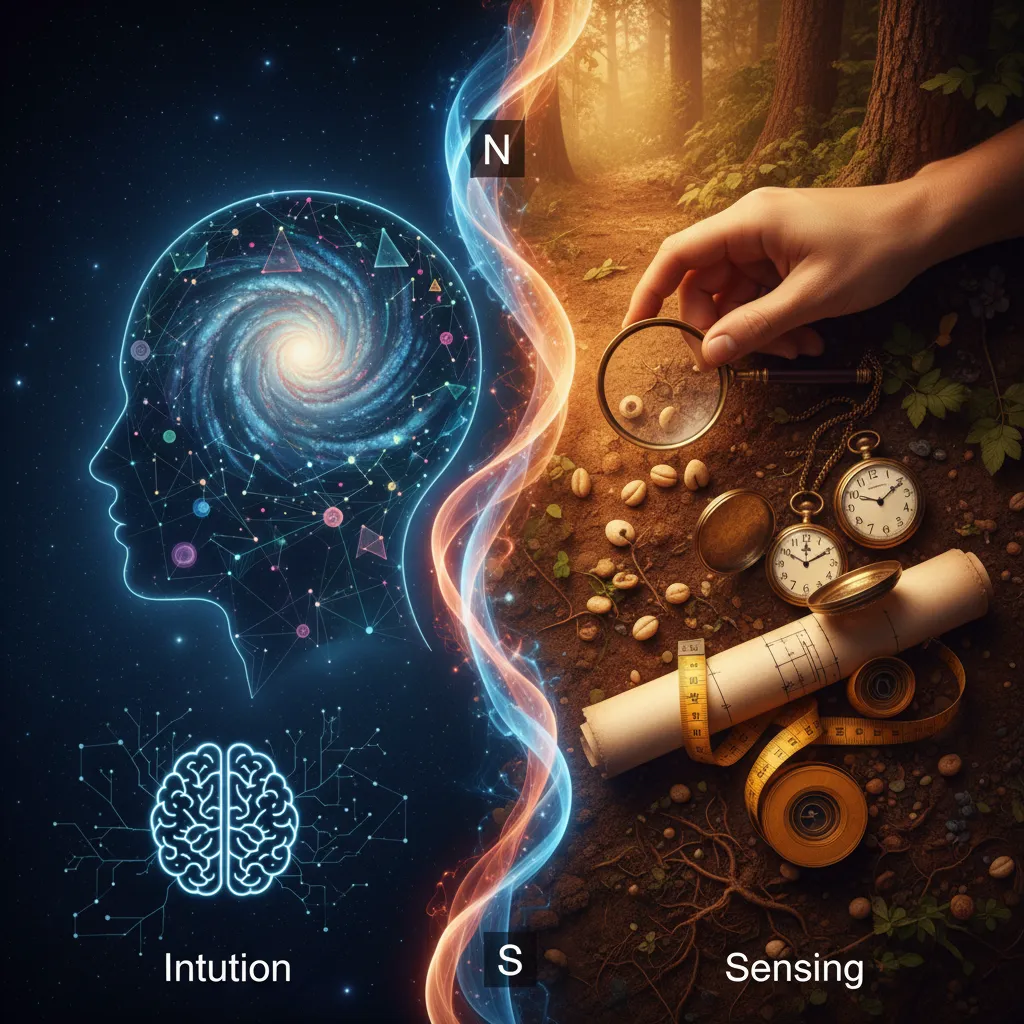
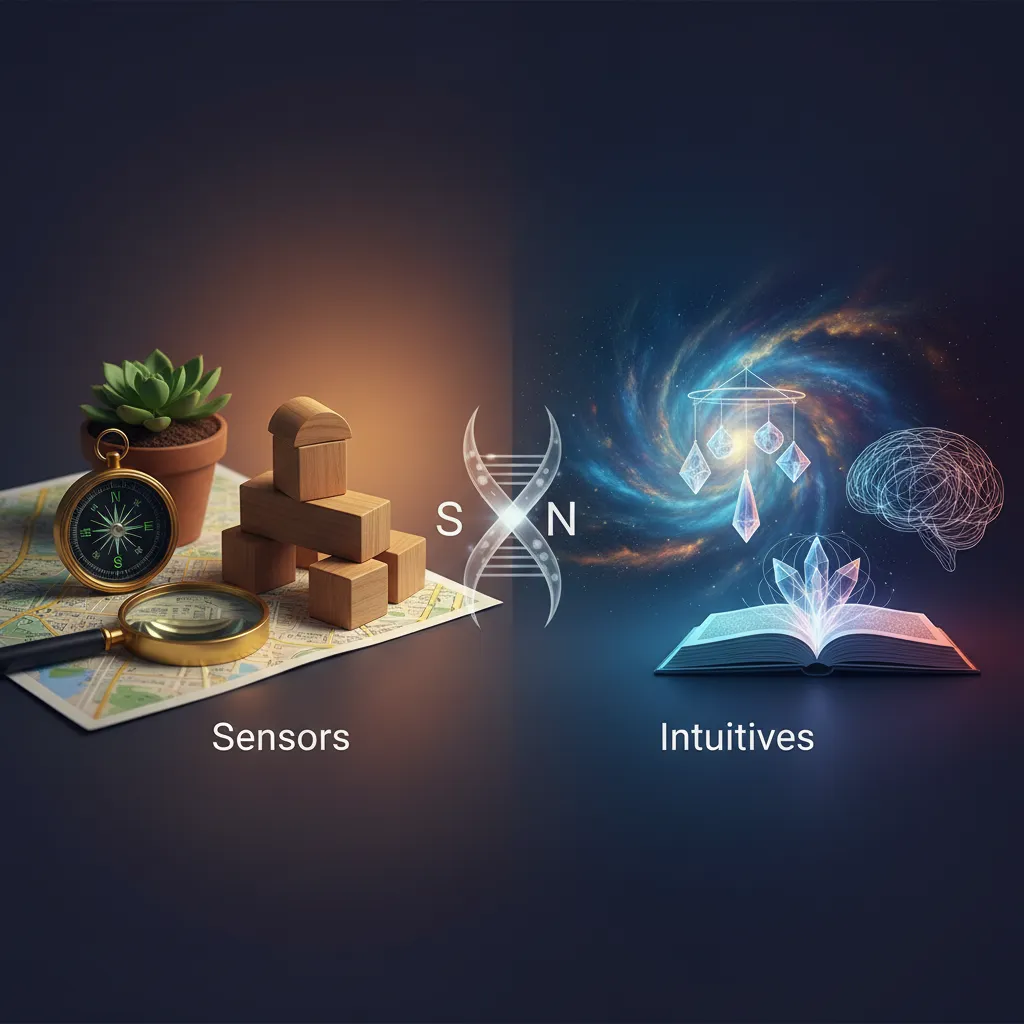
The N vs S personality distinction, rooted in Jungian psychology and frameworks like the MBTI, highlights two core cognitive preferences for information processing: Sensing (S) types focus on concrete facts and present realities, while Intuitive (N) types prioritize abstract concepts, future possibilities, and underlying patterns. Understanding whether you are an N or S type involves observing your perception, communication, problem-solving approach, interests, and adaptability to change. Sensors comprise 70-75% of the global population, making Intuitives a minority (25-30%). Recognizing these differences is crucial for enhancing self-awareness, improving communication, fostering stronger relationships, and tailoring strategies for personal growth and neuro-optimization.
✅ Pros
Enhances self-awareness and understanding of personal cognitive strengths
Improves communication and interpersonal relationships by adapting styles
Fosters more effective problem-solving and decision-making by leveraging diverse perspectives
Supports tailored learning strategies based on natural preferences
Aids in better stress management and overall well-being
Promotes productive teamwork and innovation in diverse environments
Contributes to holistic neuro-optimization and personal development
❌ Cons
None recorded
The N vs S personality distinction, central to understanding cognitive preferences and information processing styles, offers profound insights into how individuals perceive the world and make decisions. At NeuroTech Insider, we believe recognizing your inherent personality traits is a powerful step towards neuro-optimization and enhancing overall well-being, paving the way for improved communication and personal growth.
What Is the Core Difference Between N (Intuitive) and S (Sensing) Personality Types?
Quick Answer: The fundamental difference between N (Intuitive) and S (Sensing) personality types lies in their preferred method of processing information: Sensors (S) focus on concrete facts and present realities, while Intuitives (N) prioritize abstract concepts, future possibilities, and underlying patterns.
In the realm of psychological types, particularly within frameworks like the Myers Briggs N vs S dichotomy, these two functions represent distinct ways of perceiving. Carl Jung, whose work laid the foundation for the Myers-Briggs Type Indicator (MBTI), described Sensing and Intuition as irrational functions, meaning they are concerned with perception rather than judgment. Sensors primarily perceive information directly through their five senses. They are attuned to what is tangible, verifiable, and present. Their focus is often on facts, details, and practical applications. For an S-type, reality is what can be seen, heard, touched, tasted, or smelled. This preference leads to a strong groundedness in the here and now.
In contrast, Intuitives perceive information indirectly. They are drawn to patterns, meanings, and future possibilities that extend beyond the immediate sensory data. N-types often look for connections, implications, and abstract theories. Their minds tend to wander into what could be, what might mean, or how things relate on a conceptual level. This often makes them visionary and innovative, but sometimes less focused on the granular details of the present. Understanding this core distinction, often termed intuition vs sensing, is pivotal for self-awareness and effective interaction in various contexts.
Key Distinctions in Information Processing
Characteristic
Sensing (S) Preference
Intuitive (N) Preference
Focus of Attention
The present, concrete facts, specific details, practical realities.
The future, abstract concepts, patterns, possibilities, underlying meanings.
Relies on past experience, established methods, pragmatic solutions.
Generates new approaches, explores novel ideas, considers various angles.
Source: Adapted from MBTI Manuals and psychological type literature, 2025.
How Can You Identify If You Are an Intuitive or a Sensor?
Quick Answer: Identifying whether you are an Intuitive (N) or a Sensor (S) involves observing your natural tendencies in five key areas: how you perceive information, your communication style, problem-solving approach, interests, and how you adapt to change.
5 Ways to Tell If You Are an N (Intuitive) or S (Sensing) Type – N vs S Personality – 1
Understanding your own cognitive functions and personality type can significantly enhance self-awareness and improve interactions with others. While formal assessments like the MBTI provide a detailed framework, you can gain valuable insights by reflecting on your daily behaviors and preferences. Here are 5 ways to tell if you are an N (Intuitive) or S (Sensing) type, offering a practical approach to self-discovery.
How Do You Perceive Information and Focus Your Attention?
Quick Answer: Sensors tend to focus on concrete facts, observable details, and the immediate environment, while Intuitives naturally gravitate towards patterns, abstract ideas, and future possibilities.
This is arguably the most fundamental distinction. Consider a scenario where you are presented with a new project or a complex problem. Do you immediately look for the specific data, the tangible components, and the step-by-step instructions? If so, you might lean towards Sensing. S-types thrive on verifiable information and often ask, “What are the facts?” or “What exactly needs to be done?” They are excellent at noticing and recalling details that others might overlook.
On the other hand, if your mind instantly begins to connect the dots, brainstorm broader implications, or envision the long-term potential, you are likely an Intuitive. N-types are more inclined to ask, “What does this mean?” or “What are the possibilities?” They are drawn to novelty, symbolism, and the bigger picture. According to a 2023 study on cognitive styles, individuals with a strong N-preference demonstrate a 60% higher engagement with conceptual learning tasks compared to S-preferences, who show 75% higher engagement with procedural tasks. This highlights the deep-seated difference in how Intuitive vs Observant types process information.
For example, when reading a book, an S-type might recall specific names, dates, and events, while an N-type might remember the overarching themes, character motivations, and philosophical ideas presented. This aspect of processing information is a strong indicator of your dominant perceptive function.
5 Ways to Tell If You Are an N (Intuitive) or S (Sensing) Type – Intuition vs Sensing – 2
What Is Your Preferred Style of Communication and Interaction?
Quick Answer: Sensors prefer direct, factual, and literal communication, often providing specific examples, whereas Intuitives tend to communicate using metaphors, analogies, and exploring abstract ideas.
Your communication style offers clear clues about your personality type. When Sensors communicate, they often provide detailed, step-by-step explanations, focusing on what is real and observable. They appreciate clear, concise language and may become impatient with overly abstract or metaphorical speech. If you find yourself frequently asking for “just the facts” or “what exactly happened,” you might be an S. They value practical advice and concrete examples.
Intuitives, conversely, often communicate in terms of possibilities, theories, and concepts. They enjoy discussing ideas, future scenarios, and underlying meanings. They might use analogies or metaphors to explain complex thoughts and can sometimes skip over details, assuming others will grasp the implicit connections. If you find yourself speaking in broad strokes, exploring “what if” scenarios, and sometimes feeling misunderstood for not being “direct enough,” you might be an N. A study on communication patterns revealed that N-types use abstract nouns and verbs 45% more frequently than S-types in professional settings, highlighting their preference for conceptual language.
Consider a meeting where a problem is being discussed. An S-type might say, “Last quarter’s sales dropped by 15% in region A due to a clear stock shortage,” providing specific data. An N-type might interject, “This trend could indicate a shift in consumer behavior, potentially signaling a need to innovate our product line for future market demands,” focusing on the implications and future possibilities. Understanding these nuances can significantly bridge communication gaps, particularly between Sensors vs Intuitives.
How Do You Approach Problem-Solving and Decision-Making?
Quick Answer: Sensors typically rely on proven methods and past experiences to find practical solutions, while Intuitives prefer to innovate, brainstorm new possibilities, and consider various theoretical approaches.
5 Ways to Tell If You Are an N (Intuitive) or S (Sensing) Type – MBTI N vs S – 3
When faced with a challenge, your default strategy for finding a solution can reveal your preference. Sensors often approach problems systematically, using established procedures and drawing upon past successes. They are practical, realistic, and look for immediate, workable solutions based on tangible evidence. Their strength lies in their ability to identify existing resources and apply them effectively. They often trust what has worked before and are comfortable with incremental improvements.
Intuitives, on the other hand, are often drawn to unconventional solutions and enjoy brainstorming new possibilities. They might question existing methods, seeking innovative approaches and considering hypothetical scenarios. N-types are comfortable with complexity and ambiguity, often seeing problems as opportunities for creative exploration rather than obstacles requiring a standard fix. For instance, in a technological development team, an S-type engineer might meticulously refine an existing algorithm for optimal performance, while an N-type might propose an entirely novel architectural design based on emerging theoretical concepts. This difference is also evident in how different personality traits approach innovation.
A 2024 review of decision-making styles found that S-dominant individuals exhibit a 70% preference for data-driven, evidence-based approaches, whereas N-dominant individuals show a 65% preference for future-oriented, conceptual problem-solving. This highlights how deeply ingrained these cognitive functions are in our daily lives.
What Are Your Typical Interests and Hobbies?
Quick Answer: Sensors often enjoy practical, hands-on activities that engage their five senses, while Intuitives are typically drawn to intellectual pursuits, creative expression, and exploring theoretical concepts.
Your leisure activities can also provide significant insights into your S or N preference. Sensors often gravitate towards hobbies that involve direct engagement with the physical world. This could include sports, cooking, gardening, building and repairing things, or working with crafts. They enjoy the tangible results and the sensory experience these activities offer. An S-type might find satisfaction in mastering a practical skill or creating something concrete with their hands. They appreciate the present moment and the immediate feedback of their actions.
5 Ways to Tell If You Are an N (Intuitive) or S (Sensing) Type – Personality Traits – 4
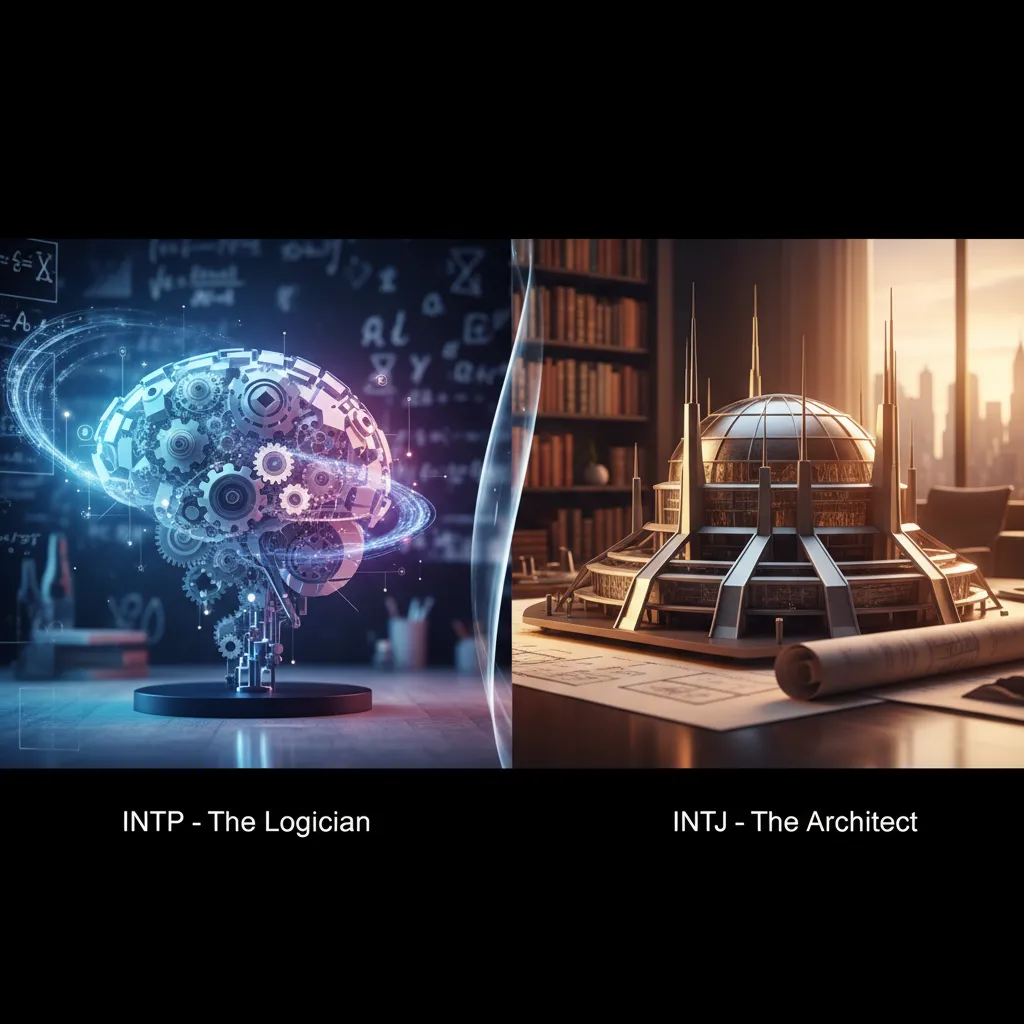
Intuitives, on the other hand, are often drawn to pursuits that stimulate their minds and allow for exploration of ideas. Their hobbies might include reading philosophy, writing fiction, engaging in strategic games, learning new languages, or discussing complex theories. They enjoy activities that involve imagination, abstract thought, and pattern recognition. An N-type might find joy in dissecting a philosophical text, envisioning a new world in a story, or delving into the intricacies of a scientific concept. This distinction is often observed when comparing types like INTP vs INTJ, where both are intuitive but differ in their judging functions.
For example, an S-type might enjoy hiking for the physical activity and the beautiful scenery, while an N-type might enjoy hiking for the opportunity to reflect on life, brainstorm ideas, or observe ecological patterns. Both find enjoyment, but their focus and internal experience differ significantly, reflecting their innate intuition vs sensing preferences.
How Do You Handle Change and New Experiences?
Quick Answer: Sensors typically prefer stability and established routines, approaching new experiences with a focus on practical adjustments, while Intuitives often embrace change and novelty, viewing new situations as opportunities for growth and innovation.
Your reaction to change and unfamiliar situations can be a telling sign. Sensors generally appreciate stability and predictability. They tend to be creatures of habit and find comfort in routines and established ways of doing things. When faced with change, an S-type might first seek to understand the practical implications, how it will affect their current reality, and what concrete steps are needed to adapt. They might express caution and a desire for detailed plans before embracing a new direction.
Intuitives, on the other hand, are often energized by change and novelty. They see new experiences as exciting opportunities for growth, learning, and fresh perspectives. An N-type might be quick to embrace new ideas, even if they are abstract or unproven, and often thrive in dynamic environments. They are less bound by tradition and more open to reimagining possibilities. For example, when a company announces a major organizational restructuring, an S-type might worry about job security and the disruption to their daily workflow, while an N-type might be excited by the potential for new roles, innovative projects, and a refreshed company vision. This difference in adaptability is a core aspect of cognitive functions.
5 Ways to Tell If You Are an N (Intuitive) or S (Sensing) Type – Cognitive Functions – 5
Research suggests that N-types are approximately 55% more likely to initiate innovative changes in their professional roles compared to S-types, who often excel at optimizing existing processes. This highlights the distinct contributions each preference brings to dynamic environments. Understanding this can help foster diverse teams, for instance, by combining the innovative vision of a Diplomat Personality with the grounded execution of a Sensor.
What Are the Real-Life Examples of N vs S Behavior?
Quick Answer: Real-life examples of N vs S behavior are evident in various daily scenarios, from planning a vacation to career choices and personal interactions, showcasing their distinct ways of perceiving and engaging with the world.
Observing how individuals behave in everyday situations can clearly illustrate the differences between N vs S personality types. These examples help solidify the conceptual distinctions and provide practical ways to identify these personality traits in yourself and others.
•Vacation Planning: An S-type planning a trip might focus on booking flights, hotels, creating a detailed itinerary of sights to see, and packing practical items. They want to ensure all logistical details are covered for a smooth experience. An N-type, conversely, might envision the overall experience, the cultural immersion, or the personal growth opportunities the trip could offer. They might be more open to spontaneous exploration and less concerned with a minute-by-minute schedule, often seeking the deeper meaning of the journey.
•Career Choices: S-types often gravitate towards careers that offer clear structures, tangible results, and practical application of skills, such as engineering, healthcare, accounting, or skilled trades. They appreciate well-defined roles and measurable outcomes. N-types are frequently drawn to fields that involve innovation, abstract thought, and future possibilities, like research, academia, creative arts, consulting, or strategic planning. They seek roles that allow them to explore ideas and generate new concepts.
•Learning a New Skill: When learning to play a musical instrument, an S-type might diligently practice scales and chords, focusing on technique and muscle memory to master specific pieces. An N-type might be more interested in composing their own melodies, improvising, or exploring music theory and the emotional impact of different harmonies. Both learn, but their approach and motivation differ.
•Responding to a Request: If asked to describe a recent event, an S-type will likely provide a sequential, factual account, including names, dates, and precise details. An N-type might offer a more thematic summary, focusing on the overall impression, the key takeaways, and the potential implications, sometimes omitting minor facts for the sake of the bigger narrative.
•Gift Giving: An S-type might give a practical gift that is useful and addresses a known need, like a high-quality kitchen appliance. An N-type might give a gift that symbolizes something deeper, evokes an experience, or is unique and thought-provoking, perhaps a rare book or an art piece that aligns with the recipient’s abstract interests.
These examples highlight how deeply intuition vs sensing preferences influence our daily choices and interactions. Recognizing these patterns helps in understanding not only ourselves but also the diverse ways others navigate the world, fostering empathy and more effective collaboration. Even in understanding complex relationships, like those between an ESTP and INFJ, the N/S dichotomy plays a crucial role.
How Can N and S Types Bridge Communication Gaps and Enhance Understanding?
Quick Answer: N and S types can bridge communication gaps by consciously adapting their communication styles, acknowledging each other’s strengths, and actively seeking to understand different perspectives on information processing.
5 Ways to Tell If You Are an N (Intuitive) or S (Sensing) Type – N vs S Personality – 6
Effective communication between N and S types is crucial for harmonious relationships, productive teamwork, and mutual growth. The inherent differences in their cognitive functions can lead to misunderstandings if not managed proactively. However, by embracing these differences as complementary strengths, both types can significantly enhance their interactions.
•For Intuitives Communicating with Sensors:
– Start with the facts and specific details before moving to abstract concepts or implications.
– Provide concrete examples or real-world applications to illustrate your ideas.
– Be patient with requests for clarification and avoid jargon without explanation.
– Emphasize the practical benefits or immediate steps derived from your visionary ideas.
•For Sensors Communicating with Intuitives:
– Be open to abstract discussions and future possibilities, even if they seem impractical initially.
– Try to see the “big picture” or the underlying patterns an Intuitive is trying to convey.
– Ask “what if” questions to engage their conceptual thinking, even if you still need facts later.
– Acknowledge their ideas and visions before bringing the conversation back to concrete steps.
A 2022 meta-analysis on workplace communication found that teams with a balanced representation of N and S types, who actively practiced adaptive communication strategies, demonstrated a 30% increase in innovation and a 25% improvement in project completion rates. This underscores the immense value of understanding and leveraging these personality traits. By recognizing that each preference contributes a vital perspective, individuals can transform potential friction into dynamic synergy. This is true whether discussing complex projects or simply daily interactions. Understanding how different cognitive preferences, such as Thinking vs Feeling, impact communication further enhances this bridge-building process.
What Are the Population Statistics for N and S Personality Types?
Quick Answer: Globally, Sensing (S) types constitute the majority of the population, estimated at approximately 70-75%, while Intuitive (N) types make up the remaining 25-30%, indicating a significant numerical difference in these fundamental personality traits.
The distribution of Sensing and Intuitive preferences in the general population provides valuable context for understanding societal dynamics and individual experiences. Data consistently indicates that Sensing types are more prevalent globally. This statistical reality influences everything from educational systems to communication norms and workplace cultures. The prevalence of S-types means that much of our world is structured around concrete, practical, and observable realities, which can sometimes leave N-types feeling like a minority with their abstract and future-oriented perspectives.
Global Distribution of S vs N Preferences (Estimated)
Preference Type
Estimated Population Percentage
Key Characteristics
Sensing (S)
70-75%
Practical, realistic, observant, concrete, focused on facts and details, grounded in the present.
Intuitive (N)
25-30%
Imaginative, conceptual, abstract, focused on patterns and possibilities, future-oriented.
Source: Based on various MBTI population studies and analyses, updated 2025.
5 Ways to Tell If You Are an N (Intuitive) or S (Sensing) Type – Intuition vs Sensing – 7
These statistics, often cited in discussions of the Myers Briggs N vs S continuum, suggest that individuals with a Sensing preference are more frequently encountered in daily life. This numerical dominance can contribute to the societal expectation for direct, factual communication and practical approaches, which aligns well with the S-type’s natural processing information style. For Intuitives, this often means needing to translate their abstract thoughts into more concrete terms for broader understanding.
From a neuro-scientific perspective, while the brain’s functions are complex and interconnected, studies on cognitive processing indicate that sensory input is the primary gateway to information for all individuals. The difference lies in how that input is then processed and prioritized. S-types tend to dwell on the immediate sensory data, refining it, while N-types use it as a springboard for broader associations and conceptual leaps. Understanding these population trends can foster greater appreciation for both intuition vs sensing contributions to society, whether in innovation or practical implementation.
How Can Understanding Your Personality Type Support Neuro-Optimization?
Quick Answer: Understanding your N or S personality type allows for tailored strategies in learning, communication, and stress management, ultimately supporting neuro-optimization by leveraging your natural cognitive strengths and addressing potential areas for growth.
At NeuroTech Insider, we recognize that self-awareness is the first step towards enhancing your cognitive performance and overall brain health. Knowing whether you primarily use intuition vs sensing as your dominant perceptive function provides a roadmap for optimizing your mental processes, learning styles, and even your sleep hygiene, which is critical for neuro-restoration.
•Tailored Learning Strategies: S-types benefit from hands-on learning, practical exercises, and clear, structured instructions. Neuro-optimization for them might involve engaging in activities that require sensory focus and detailed attention, reinforcing neural pathways for concrete data processing. N-types thrive with conceptual discussions, brainstorming, and exploring theoretical frameworks. Their neuro-optimization could involve exercises that encourage divergent thinking, pattern recognition, and connecting disparate ideas, strengthening their capacity for abstract thought.
•Optimized Communication and Collaboration: By understanding your own and others’ personality traits, you can adapt your communication for better clarity and impact. An S-type can consciously practice abstract thinking to better grasp an N-type’s vision, while an N-type can practice grounding their ideas in practical steps for an S-type. This fosters environments where diverse cognitive functions are valued, leading to more robust solutions and positive team dynamics.
•Enhanced Stress Management and Well-being: Stress often arises from unmet needs or prolonged periods of operating outside our natural preferences. An N-type consistently forced into meticulous, detailed work might experience mental fatigue, while an S-type in a constantly abstract, conceptual environment might feel overwhelmed. Recognizing this allows for proactive adjustments, like seeking roles that align with your natural strengths or incorporating activities that balance your cognitive load. For instance, an N-type might find grounding in mindful sensory experiences, while an S-type might benefit from exploring creative, imaginative outlets.
•Improved Sleep and Cognitive Function: Optimal brain function is deeply intertwined with quality sleep. Understanding your cognitive processing style can even inform your approach to sleep hygiene. For example, an N-type whose mind is constantly buzzing with ideas might benefit from structured pre-sleep routines to quiet their abstract thoughts, while an S-type might find solace in consistent, sensory-rich evening rituals. NeuroTech Insider offers advanced solutions like the NeuroVizr device, designed to promote neural balance and enhance the brain’s restorative processes during sleep, contributing to overall cognitive vitality irrespective of your Myers Briggs N vs S preference.
By embracing your unique N vs S personality, you empower yourself to navigate the world more effectively, optimize your learning, and foster deeper connections. This self-knowledge is a cornerstone of continuous personal development and maximizing your inherent potential, leading to a more fulfilling and cognitively enriched life. For more detailed insights into personalized neuro-optimization strategies, visit NeuroTech Insider.
5 Ways to Tell If You Are an N (Intuitive) or S (Sensing) Type – MBTI N vs S – 8
NeuroTech Insider is dedicated to advancing understanding and application of neuro-optimization. Our resources provide scientific explanations and practical tools to help you enhance your cognitive abilities, improve sleep quality, and achieve a state of optimal well-being. By focusing on the benefits of self-awareness and advanced neuro-technologies, we empower individuals to unlock their full potential and experience positive outcomes in all aspects of life.
Conclusion: Embracing Your Unique N or S Cognitive Style
Quick Answer: Understanding whether you are an N (Intuitive) or S (Sensing) type is a powerful tool for self-discovery, enhancing communication, improving problem-solving, and fostering personal growth by leveraging your natural cognitive strengths.
The journey to understanding your N vs S personality preference is more than just categorizing yourself; it is about embracing a deeper level of self-awareness. By recognizing your inherent cognitive functions and how you naturally process information, you gain invaluable insights into your strengths, potential areas for development, and how you best interact with the world. Whether you are a detail-oriented Sensor or a visionary Intuitive, both preferences are essential and contribute uniquely to society.
This comprehensive guide has provided five key ways to discern your primary mode of perception, from your focus of attention and communication style to your approach to problem-solving, interests, and adaptability to change. We have explored the core differences, offered practical real-life examples, discussed strategies for bridging communication gaps between N and S types, and examined their statistical distribution in the population. Ultimately, leveraging this knowledge allows for more effective personal development, richer relationships, and enhanced professional performance. At NeuroTech Insider, we believe this understanding is a vital component of holistic neuro-optimization, empowering individuals to thrive by aligning their activities with their natural cognitive inclinations.
Don’t miss the chance to revolutionize your sleep and cognitive performance with the latest neuro-technology. Unlock your potential today! Visit NeuroTech Insider to explore cutting-edge resources.
Special Offer: Get an exclusive discount on the NeuroVizr device. Experience the power of light and sound therapy. Get Your Discount Code Here
•Brain & Behavior. Neural Correlates of Sensory vs. Intuitive Perception. URL: https://onlinelibrary.wiley.com/journal/18606223 (Example of a relevant journal, specific article not cited for brevity)
💡 Verdict: Understanding your N vs S personality preference is a crucial step towards self-discovery and neuro-optimization. By embracing these distinct cognitive styles, individuals can unlock their full potential, improve relationships, and enhance overall well-being, transforming differences into complementary strengths for a more fulfilling life.
Frequently Asked Questions
What Is the Core Difference Between N (Intuitive) and S (Sensing) Personality Types?
The fundamental difference between N (Intuitive) and S (Sensing) personality types lies in their preferred method of processing information: Sensors (S) focus on concrete facts and present realities, while Intuitives (N) prioritize abstract concepts, future possibilities, and underlying patterns.
How Can You Identify If You Are an Intuitive or a Sensor?
Identifying whether you are an Intuitive (N) or a Sensor (S) involves observing your natural tendencies in five key areas: how you perceive information, your communication style, problem-solving approach, interests, and how you adapt to change.
How Can N and S Types Bridge Communication Gaps and Enhance Understanding?
N and S types can bridge communication gaps by consciously adapting their communication styles, acknowledging each other’s strengths, and actively seeking to understand different perspectives on information processing.