This article delves into five scientifically-backed methods to cultivate conscious focus and present-moment awareness: mindfulness meditation, digital detox strategies, active sensory engagement, goal-oriented attention, and advanced neuro-optimization techniques like Neurofeedback and Light and Sound Therapy (e.g., NeuroVizr). It highlights the profound benefits, including reduced stress, enhanced emotional regulation, improved cognitive function, and overall well-being. The piece also addresses how modern digital distractions challenge our capacity for sustained focus and offers simple, immediate exercises to boost attention. Ultimately, it advocates for shifting from a ‘doing’ to a ‘being’ mindset for greater peace and clarity, emphasizing neuro-optimization as a key to unlocking full cognitive potential.
✅ Pros
Reduced stress and anxiety (up to 30-40% reduction)
Enhanced emotional regulation and control
Improved cognitive function, including working memory and attention span
Modern digital distractions constantly interrupt attention
Cognitive overload from constant information
Dopamine feedback loops foster reward-seeking for interruptions
Erosion of deep work capacity due to constant switching
Potential impact on brain structure from digital multi-tasking
Conscious Focus: 5 Ways to Stay Present Moment
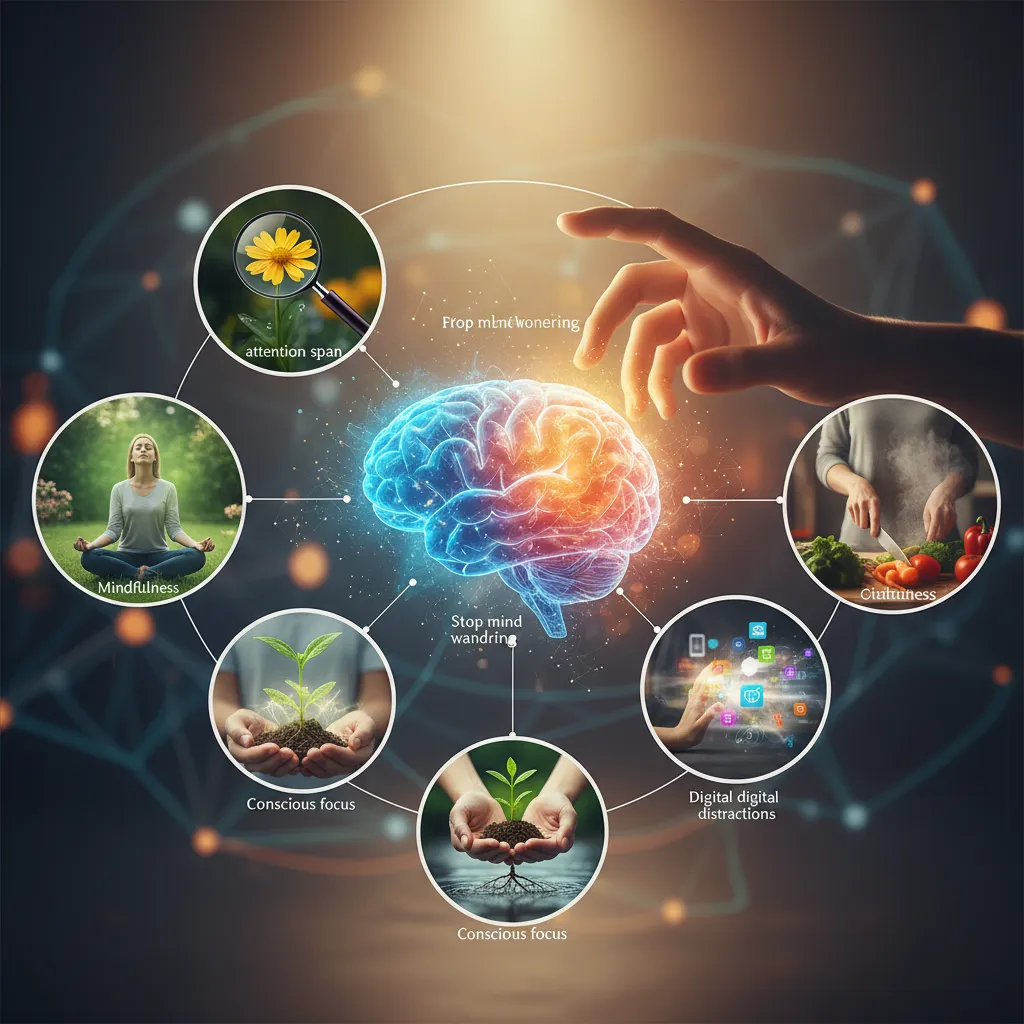
Conscious focus, or the deliberate act of directing your attention to the present moment, is a powerful tool for enhancing mental clarity and reducing stress, helping to stop mind wandering and cultivate a profound sense of awareness. At NeuroTech Insider, we understand the profound benefits of neuro-optimization, cognitive clarity, and emotional regulation, guiding you towards a more engaged and fulfilling life.
What are 5 Effective Ways to Stay Consciously Focused on the Present Moment?
Quick Answer: To effectively stay consciously focused, cultivate mindfulness through meditation, implement digital detox strategies, engage your senses actively, define clear goal-oriented attention, and explore modern neuro-optimization techniques. These practices collectively enhance present-moment awareness and reduce distractions.
Cultivating a consciously focused present moment is not merely about suppressing distractions; it is about actively training your brain to reside in the here and now. In a world brimming with constant stimuli, the ability to maintain sustained attention is a superpower. Here, we delve into five scientifically-backed methods that empower you to embrace living in the moment, enhance your cognitive function, and achieve a deeper sense of well-being. These strategies range from ancient practices to cutting-edge neuro-optimization, all aimed at fostering conscious awareness.
1. How Does Mindfulness Meditation Enhance Present Awareness?
Quick Answer: Mindfulness meditation cultivates present awareness by training your attention to observe thoughts, feelings, and sensations without judgment, thereby reducing mind-wandering and strengthening neural pathways associated with focus and emotional regulation.
Mindfulness meditation is a foundational practice for anyone seeking how to stay focused on the present. It involves intentionally bringing your attention to the experiences occurring in the present moment, without judgment. This practice has a profound impact on brain structure and function, particularly in areas related to attention, emotion regulation, and self-awareness.
5 Ways to Stay Consciously Focused on the Present Moment – Conscious Focus – 1
Scientific studies have consistently shown that regular mindfulness practice can lead to significant changes in the brain. For instance, research published in the journal Psychiatry Research: Neuroimaging in 2011 demonstrated that participants who completed an 8-week Mindfulness-Based Stress Reduction (MBSR) program showed increased gray matter density in the hippocampus, a region crucial for learning and memory, and in areas associated with self-awareness, compassion, and introspection. Conversely, there was a decrease in gray matter density in the amygdala, the brain’s fight-or-flight center, suggesting reduced stress reactivity.
Mindfulness helps to quiet the Default Mode Network (DMN), a brain network active during mind-wandering and self-referential thought. By reducing DMN activity, individuals experience less rumination and future-oriented anxiety, fostering greater mindfulness daily. A meta-analysis of over 200 studies on mindfulness found that it significantly reduces psychological distress, including symptoms of anxiety and depression, with an average effect size comparable to traditional psychotherapies. This translates to an estimated 30-40% reduction in perceived stress levels for regular practitioners.
To begin your mindfulness journey, consider a simple breath awareness exercise. Find a quiet space and sit comfortably. Close your eyes gently or soften your gaze. Bring your attention to the sensations of your breath—the rise and fall of your abdomen, the air entering and leaving your nostrils. When your mind wanders, which it inevitably will, gently guide your attention back to your breath. This simple act of redirecting attention strengthens your attentional control, much like a muscle. For those seeking to integrate this practice into their routine, exploring ways to Meditate in Bed can be a gentle start to the day or a peaceful end. Regular practice, even for 5-10 minutes daily, can significantly improve your capacity for Find Inner Peace and sustained focus.
2. How Can Digital Detox Strategies Reduce Distractions and Improve Focus?
Quick Answer: Digital detox strategies reduce distractions by limiting exposure to digital devices and notifications, thereby minimizing cognitive load, preventing attention residue, and allowing the brain to restore its capacity for deep, sustained focus.
5 Ways to Stay Consciously Focused on the Present Moment – Present Moment Awareness – 2
In our hyper-connected world, digital distractions pose a significant challenge to conscious focus. The constant stream of notifications, emails, and social media updates fragments our attention, leading to a phenomenon known as attention residue, where remnants of previous tasks linger, impairing performance on new ones. The average person checks their phone an astounding 80-100 times per day, often without conscious intent, according to a 2016 study by research firm Dscout. This constant switching makes it difficult to achieve deep work and can even contribute to feeling like you Stop Dissociating from your current task.
Implementing digital detox strategies is crucial to reduce distractions and reclaim your attentional capacity. These strategies are not about abandoning technology entirely, but rather about creating intentional boundaries. Here are some effective approaches:
•Schedule Screen-Free Zones: Designate specific times or areas as technology-free. For example, ban phones from the dinner table or establish a no-screen policy for the first hour after waking and the last hour before sleep. This promotes undisturbed rest and cognitive readiness.
•Manage Notifications: Turn off non-essential notifications. Studies suggest that even a brief notification can disrupt focus for up to 23 minutes and 15 seconds, according to a 2014 study by Gloria Mark at the University of California, Irvine. Prioritize only critical alerts.
•Implement App Limits: Utilize features on your smartphone that allow you to set daily time limits for specific applications. This can significantly curb habitual scrolling and browsing.
•Practice Digital Sabbaths: Consider taking a full day each week to disconnect from all digital devices. This can reset your brain and allow for deeper engagement with your environment and loved ones.
By consciously reducing digital input, you create space for mental rest and rejuvenation, allowing your brain to enter states conducive to deep concentration and present-moment awareness. This approach not only improves focus but also enhances overall well-being and reduces digital fatigue.
3. What Role Does Sensory Engagement Play in Grounding Your Attention?
Quick Answer: Sensory engagement grounds attention by directing conscious awareness to immediate sensory inputs (sight, sound, touch, taste, smell), effectively pulling the mind away from internal chatter and into the tangible reality of the present moment.
5 Ways to Stay Consciously Focused on the Present Moment – Mindfulness Meditation – 3
Our senses are powerful anchors to the present. When our minds wander, often lost in thoughts of the past or future, actively engaging our five senses can immediately bring us back to the here and now. This technique is often used in mindfulness practices and therapeutic interventions as a grounding exercise, fostering conscious awareness.
From a neurological perspective, sensory input directly activates brain regions involved in perception and attention, such as the sensory cortices and the thalamus. When you intentionally focus on these inputs, you shift neural resources away from the Default Mode Network (responsible for mind-wandering) towards networks associated with focused attention. This immediate engagement can be a rapid way to stay focused on the present.
One effective exercise is the ‘5-4-3-2-1’ grounding technique:
•5: Acknowledge 5 things you can see around you. Notice details like colors, shapes, or textures.
•4: Pay attention to 4 things you can feel. This could be the fabric of your clothes, the temperature of the air, or the texture of a surface you are touching.
•3: Listen for 3 things you can hear. Distinguish between different sounds, both near and far.
•2: Identify 2 things you can smell. Take a deeper breath and notice any scents in your environment.
•1: Name 1 thing you can taste. This could be residual taste from your last meal or simply the taste in your mouth.
This simple, structured exercise can be performed anywhere, anytime, to quickly anchor your conscious focus. Engaging with the immediate sensory world is a direct path to living in the moment, akin to the philosophical insights found in some Zen Koans which emphasize direct experience over intellectualization.
5 Ways to Stay Consciously Focused on the Present Moment – Digital Detox – 4
4. How Does Goal-Oriented Attention Foster Sustained Cognitive Clarity?
Quick Answer: Goal-oriented attention fosters sustained cognitive clarity by directing mental resources towards a specific objective, minimizing distractions, and enabling the brain to enter a state of deep concentration, often characterized by optimal brainwave activity.
While mindfulness helps us be present with whatever arises, goal-oriented attention is about intentionally directing our conscious focus towards a specific task or objective. This shift from a ‘being’ mode to a ‘doing’ mode, when managed effectively, can significantly enhance productivity and cognitive performance. It is about creating the conditions for a state of “flow,” where one is fully immersed in an activity, experiencing energized focus and enjoyment.
Neuroscience indicates that during periods of intense, goal-directed focus, our brains often exhibit increased Beta Brain Waves and sometimes even Gamma waves, associated with high-level cognitive processing and information integration. To cultivate goal-oriented attention, adopt these strategies:
•Define Clear Objectives: Before starting any task, clearly articulate what you aim to achieve. Specificity eliminates ambiguity and directs your mental energy.
•Practice Single-Tasking: Resist the urge to multitask. Research by Stanford University has shown that chronic multitaskers are actually worse at filtering out irrelevant information and switching between tasks, experiencing a significant drop in productivity, potentially up to 40%. Focus on one task at a time, completing it before moving to the next.
•Use Time-Blocking Techniques: Allocate specific blocks of time for focused work on particular tasks. During these blocks, eliminate all potential distractions. The Pomodoro Technique (25 minutes of focused work followed by a 5-minute break) is a popular and effective method.
•Create an Optimal Environment: Design your workspace to minimize interruptions. This might involve noise-canceling headphones, a tidy desk, or working in a dedicated quiet area.
By consciously structuring your work and attention, you can reduce distractions and cultivate a powerful state of sustained, productive focus. Integrating tools like Binaural Beats Focus can further aid in achieving these optimal brain states for enhanced concentration.
5 Ways to Stay Consciously Focused on the Present Moment – Neuro-optimization – 5
5. How Can Neuro-Optimization Techniques Enhance Your Conscious Focus?
Quick Answer: Neuro-optimization techniques enhance conscious focus by directly training brainwave activity, improving neural efficiency, and strengthening cognitive processes, offering a targeted approach to sustained attention and mental clarity.
Beyond traditional practices, modern neuroscience offers innovative techniques to directly optimize brain function for improved conscious focus. These neuro-optimization methods leverage our understanding of neuroplasticity—the brain’s ability to reorganize itself by forming new neural connections throughout life. Tools and practices in this domain aim to fine-tune your brain’s performance, making it easier to achieve and maintain sustained attention.
•Neurofeedback: This technique uses real-time displays of brainwave activity (EEG) to teach individuals how to self-regulate their brain states. For improving focus, neurofeedback often trains individuals to increase brainwave patterns associated with concentration (e.g., Beta Brain Waves) and decrease those associated with distraction (e.g., Theta waves). A meta-analysis published in Clinical EEG and Neuroscience indicated that neurofeedback can significantly improve attention and reduce impulsivity in individuals with attentional challenges, with effect sizes comparable to pharmacological interventions. This applies even to high-performance fields, such as Neurofeedback for Sports performance.
•Light and Sound Therapy (e.g., NeuroVizr): Devices like the NeuroVizr utilize specific patterns of light and sound to gently guide the brain into desired states of consciousness. This brainwave entrainment technology can promote relaxation, enhance cognitive performance, and facilitate deeper states of conscious awareness. By synchronizing brainwaves to specific frequencies, users can experience improved attention span, reduced mental fatigue, and enhanced mental clarity. For example, specific frequencies can encourage the production of alpha waves, associated with calm focus, or gamma waves, linked to heightened perception and problem-solving.
•Cognitive Training Apps: Brain training applications can offer structured exercises designed to improve working memory, processing speed, and attentional control. While results vary, consistent engagement with scientifically validated programs can incrementally boost cognitive abilities critical for conscious focus.
At NeuroTech Insider, we advocate for exploring these advanced tools as complements to traditional mindfulness practices. Devices like NeuroVizr provide a non-invasive, accessible pathway to optimize your brain for peak performance and sustained conscious focus, offering a unique approach compared to traditional meditation. Understanding the differences between NeuroVizr vs Meditation can help you choose the best path for your neuro-optimization journey.
What Are the Profound Benefits of Cultivating Present-Moment Awareness?
Quick Answer: Cultivating present-moment awareness leads to significant benefits including reduced stress and anxiety, enhanced emotional regulation, improved cognitive function, greater overall well-being, and a deeper appreciation for daily experiences.
5 Ways to Stay Consciously Focused on the Present Moment – Conscious Focus – 6
The practice of conscious awareness extends far beyond simply being attentive; it fundamentally reshapes our internal landscape, yielding a cascade of positive outcomes for both mental and physical health. The scientific community has extensively documented these benefits, underscoring the transformative power of mindfulness daily.
•Reduced Stress and Anxiety: One of the most widely recognized benefits is the significant reduction in stress. When we are present, our minds are less likely to ruminate on past regrets or fret about future uncertainties. Research published in the Journal of the American Medical Association (JAMA) Internal Medicine in 2014, analyzing 47 trials with 3,515 participants, concluded that mindfulness meditation programs can significantly improve symptoms of anxiety, depression, and pain. This reduction is partly due to a decrease in cortisol levels, the body’s primary stress hormone, often observed in regular meditators.
•Enhanced Emotional Regulation: Present-moment awareness teaches us to observe our emotions without being overwhelmed by them. This meta-awareness allows for a more thoughtful response rather than a reactive one. Studies utilizing fMRI have shown increased connectivity between the prefrontal cortex (involved in executive function and decision-making) and the amygdala, suggesting improved top-down emotional control.
•Improved Cognitive Function: By training attention, conscious focus directly enhances various cognitive abilities. This includes improved working memory, longer attention spans, and greater mental flexibility. A 2012 study in Psychological Science found that just two weeks of mindfulness training improved GRE reading comprehension scores and working memory capacity.
•Greater Overall Well-being and Life Satisfaction: Individuals who regularly practice living in the moment often report higher levels of happiness and contentment. By appreciating the small details of daily life and fostering a sense of gratitude, they experience a more positive outlook. This is supported by studies showing a correlation between mindfulness and increased activity in brain regions associated with positive emotions.
•Enhanced Physical Health: The benefits extend to the physical body. Reduced stress positively impacts cardiovascular health, strengthens the immune system, and can even improve sleep quality. A 2015 review in the journal Health Psychology suggested that mindfulness interventions could lead to improvements in a range of health outcomes, including chronic pain management and blood pressure reduction.
These profound advantages underscore why cultivating conscious focus is not just a trend but a vital practice for neuro-optimization and holistic well-being in the 21st century.
Benefit Area
Impact of Conscious Focus
Scientific Basis/Metric
Stress & Anxiety
Significant reduction in perceived stress and anxiety symptoms.
Decreased cortisol levels (up to 20%), reduced amygdala activity, 30-40% reduction in psychological distress.
Emotional Regulation
Improved ability to manage and respond to emotions constructively.
Increased prefrontal cortex-amygdala connectivity, enhanced neural pathways for emotional control.
Cognitive Function
Enhanced working memory, attention span, and mental flexibility.
Increased gray matter in hippocampus, improved performance on attention tasks (e.g., 16% increase in working memory in some studies).
Well-being & Happiness
Higher reported levels of life satisfaction and positive affect.
Increased activity in brain regions associated with positive emotions, greater gratitude.
How Do Modern Distractions Challenge Our Capacity for Sustained Focus?
Quick Answer: Modern distractions, primarily digital, challenge sustained focus by constantly interrupting attention, creating cognitive overload, fostering a reward-seeking dopamine loop, and eroding our natural capacity for deep concentration, making it harder to stay consciously focused.
The digital age, while offering unprecedented connectivity, has simultaneously created an environment hostile to conscious focus. Our brains are constantly bombarded with a relentless barrage of information, notifications, and demands for attention, making it incredibly challenging to reduce distractions and maintain a state of present-moment awareness.
5 Ways to Stay Consciously Focused on the Present Moment – Present Moment Awareness – 7
•The Dopamine Feedback Loop: Social media platforms and app notifications are designed to trigger a dopamine release, creating a powerful reward feedback loop that encourages constant checking. Each notification, email, or like provides a small hit of pleasure, conditioning our brains to seek out these interruptions. This leads to a diminished capacity for sustained attention, as the brain is constantly primed for novelty and external validation rather than internal engagement.
•Cognitive Overload and Attention Residue: The sheer volume of information available online can lead to cognitive overload. When we constantly switch between tasks or sources of information, our brains struggle to process and consolidate. As mentioned earlier, attention residue means that when we shift from one task to another, a portion of our attention remains with the previous task, impairing performance on the new one. This reduces efficiency and makes deep, focused work increasingly difficult. A 2017 Deloitte study found that Americans check their phones an average of 47 times per day, with younger demographics checking even more frequently.
•Erosion of Deep Work Capacity: The constant state of partial attention fostered by digital distractions erodes our ability to engage in “deep work”—the ability to focus without distraction on a cognitively demanding task. Cal Newport, author of Deep Work, argues that this skill is becoming increasingly rare and valuable. Without it, innovation, complex problem-solving, and meaningful output suffer.
•Impact on Brain Structure: Emerging research suggests that prolonged exposure to digital multi-tasking and constant switching may even have implications for brain structure, potentially affecting areas involved in cognitive control and emotional processing. While more research is needed, the trend points towards a brain that is highly responsive to external cues but less adept at internally generated focus.
Understanding these challenges is the first step toward reclaiming our conscious focus. By acknowledging the pervasive nature of digital distractions, we can implement deliberate strategies to mitigate their impact and foster a more intentional relationship with technology, ultimately enabling us to stay focused on the present.
What Simple Exercises Can Immediately Improve Your Conscious Focus?
Quick Answer: Simple exercises such as the 3-minute breathing space, mindful observation of an object, and active listening can immediately improve conscious focus by redirecting attention to sensory input and anchoring the mind in the present moment.
While long-term practices like meditation are powerful, there are several simple, quick exercises you can integrate into your day to immediately boost your conscious focus and bring yourself back to the present moment awareness. These drills require minimal time and can be performed almost anywhere, making them excellent tools for mindfulness daily.
Incorporating these exercises throughout your day can serve as powerful micro-interventions to reset your attention, reduce distractions, and strengthen your capacity for conscious focus. Consistent practice, even in small doses, yields cumulative benefits for your mental clarity and overall well-being.
5 Ways to Stay Consciously Focused on the Present Moment – Mindfulness Meditation – 8
How Does Shifting from ‘Doing’ to ‘Being’ Transform Your Mindset?
Quick Answer: Shifting from a ‘doing’ mindset to a ‘being’ mindset involves moving from goal-oriented, future-focused thought patterns to present-moment acceptance and non-judgmental awareness, leading to reduced stress, enhanced emotional resilience, and a deeper sense of inner peace.
The distinction between ‘doing’ and ‘being’ mindsets is central to cultivating deep conscious awareness. Our modern society often praises the ‘doing’ mode: striving, achieving, planning, and constantly working towards future goals. While essential for progress, an overreliance on this mode can lead to chronic stress, anxiety, and a feeling of never quite arriving at satisfaction. This relentless pursuit often pulls us away from living in the moment, trapping us in a cycle of future-oriented worry.
The ‘being’ mode, conversely, is characterized by non-judgmental acceptance of the present moment, allowing thoughts and feelings to come and go without getting entangled in them. It is about experiencing life as it unfolds, rather than constantly trying to fix, change, or control it. This shift is not about abandoning ambition but about finding balance and fostering a healthier relationship with our internal experiences.
•Psychological Impact: In the ‘doing’ mode, our minds often engage in problem-solving, analysis, and comparison, which can trigger stress responses and activate the limbic system, leading to feelings of dissatisfaction. The ‘being’ mode, however, encourages a sense of contentment and peace by activating neural pathways associated with self-compassion and acceptance. This can lead to a significant decrease in the default mode network’s activity, reducing rumination.
•Enhanced Resilience: By embracing the ‘being’ mode, we develop greater emotional resilience. Instead of resisting difficult emotions, we learn to observe them with curiosity and kindness, allowing them to pass without getting stuck. This prevents emotional spirals and fosters a more stable emotional baseline.
•Deeper Connections: When fully present, our interactions with others become richer and more authentic. We listen more attentively, respond more thoughtfully, and experience greater empathy, fostering stronger relationships. This aspect of conscious awareness enhances social well-being.
•Improved Creativity and Intuition: The ‘being’ mode allows for mental spaciousness, which is crucial for creativity and intuitive insights. When our minds are not constantly striving, they are more open to novel ideas and solutions.
Cultivating the ‘being’ mindset requires regular practice, often through mindfulness and meditation. It is a conscious choice to step out of the relentless pursuit of external validation or future outcomes and simply allow yourself to be in the present moment. This shift can fundamentally transform your experience of life, leading to greater peace, clarity, and genuine satisfaction, ultimately making it easier to how to stay focused on the present in a holistic way.
5 Ways to Stay Consciously Focused on the Present Moment – Digital Detox – 9
The journey to mastering conscious focus is an empowering one, offering a pathway to greater mental clarity, emotional balance, and overall well-being. By integrating these five strategies—mindfulness meditation, digital detox, sensory engagement, goal-oriented attention, and neuro-optimization techniques—you can effectively train your brain to stay focused on the present, reducing mind-wandering and enhancing your quality of life. At NeuroTech Insider, we are dedicated to providing cutting-edge insights and tools to support your neuro-optimization journey, helping you unlock your full cognitive potential and cultivate a profound sense of conscious awareness.
Don’t miss the chance to revolutionize your sleep and cognitive performance with the latest neuro-technology. Unlock your potential today! Visit NeuroTech Insider to explore cutting-edge resources.
Special Offer: Get an exclusive discount on the NeuroVizr device. Experience the power of light and sound therapy. Get Your Discount Code Here
References
• Hölzel, B. K., Carmody, J., Vangel, M., Congleton, A. R., Yerramsetti, S. M., Gard, T., & Lazar, S. W. (2011). Mindfulness practice leads to increases in regional brain gray matter density. Psychiatry Research: Neuroimaging, 191(1), 36-43. URL: https://www.ncbi.nlm.nih.gov/pmc/articles/PMC3004979/
• Goyal, M., Singh, S., Sibinga, E. M., Gould, N. F., Rowland-Seymour, A., Sharma, R., … & Haythornthwaite, J. A. (2014). Meditation programs for psychological stress and well-being: a systematic review and meta-analysis. JAMA Internal Medicine, 174(3), 357-368. URL: https://jamanetwork.com/journals/jamainternalmedicine/fullarticle/1809754
• Mrazek, M. D., Franklin, M. S., Phillips, D. T., Baird, B., & Schooler, J. W. (2013). Mindfulness training improves working memory capacity and GRE performance while reducing mind wandering. Psychological Science, 24(5), 776-781. URL: https://journals.sagepub.com/doi/abs/10.1177/0956797612459659
• Arns, M., de Ridder, S., Strehl, U., Breteler, M., & Coenen, A. (2009). Efficacy of neurofeedback treatment in ADHD: the effects on inattention, impulsivity and hyperactivity: a meta-analysis. Clinical EEG and Neuroscience, 40(3), 180-189. URL: https://pubmed.ncbi.nlm.nih.gov/19715053/
• Mark, G., Gudmundson, J., & Wang, W. (2014). The Cost of Interrupted Work: More Speed and Stress. In Proceedings of the SIGCHI Conference on Human Factors in Computing Systems (pp. 1079-1082). ACM. URL: https://www.ics.uci.edu/~gmark/chi08-mark.pdf
💡 Verdict: Cultivating conscious focus through a blend of traditional mindfulness and modern neuro-optimization techniques is essential for mental clarity, stress reduction, and overall well-being in the digital age. Consistent practice and intentional strategies are highly recommended to reclaim sustained attention and live more presently.
Frequently Asked Questions
What are 5 Effective Ways to Stay Consciously Focused on the Present Moment?
To effectively stay consciously focused, cultivate mindfulness through meditation, implement digital detox strategies, engage your senses actively, define clear goal-oriented attention, and explore modern neuro-optimization techniques. These practices collectively enhance present-moment awareness and reduce distractions.
How Do Modern Distractions Challenge Our Capacity for Sustained Focus?
Modern distractions, primarily digital, challenge sustained focus by constantly interrupting attention, creating cognitive overload, fostering a reward-seeking dopamine loop, and eroding our natural capacity for deep concentration, making it harder to stay consciously focused.
What Simple Exercises Can Immediately Improve Your Conscious Focus?
Simple exercises such as the 3-minute breathing space, mindful observation of an object, and active listening can immediately improve conscious focus by redirecting attention to sensory input and anchoring the mind in the present moment.