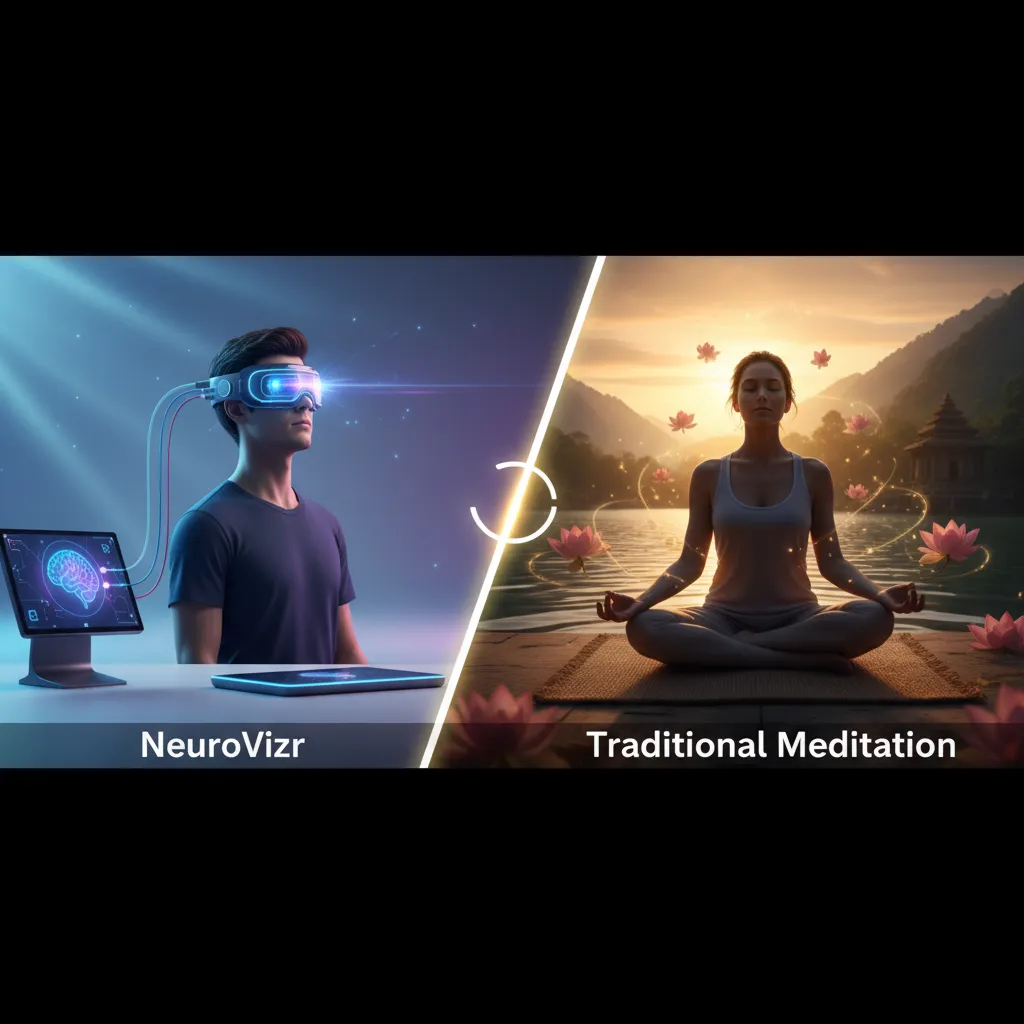
This article provides a comprehensive comparison between NeuroVizr, a technology-assisted meditation device, and traditional meditation practices. NeuroVizr utilizes light and sound patterns to passively guide users into meditative states, offering a potentially faster and more beginner-friendly approach to stress relief and cognitive enhancement. In contrast, traditional meditation demands active mental effort, fostering deep focus, self-awareness, and emotional regulation over consistent practice. While NeuroVizr requires an initial investment, traditional meditation is free. The choice between these methods depends on individual preferences for effort, speed of results, and budget, with both aiming for improved well-being.
NeuroVizr has a gentler learning curve for beginners.
NeuroVizr provides a passive, guided experience using technology.
Traditional meditation requires no equipment cost and fosters deep self-awareness.
Traditional meditation can lead to improved emotional regulation and inner peace over time.
❌ Cons
NeuroVizr requires an initial device investment.
NeuroVizr offers a less active mental development experience compared to traditional meditation.
NeuroVizr vs Meditation is a common query for those seeking effective stress relief and cognitive enhancement. At NeuroTech Insider, we explore how technology-assisted meditation compares to traditional methods, offering insights into which approach best suits your needs. Discover the benefits of both brain machine vs meditation, tech-assisted meditation and how it might offer a faster path to neuro-optimization, ultimately promoting better sleep and overall well-being.
What Are the Key Differences Between NeuroVizr and Traditional Meditation?
Quick Answer: NeuroVizr uses technology to guide your brain into meditative states, while traditional meditation relies on your own focus and mental discipline. One is passive, the other is active.
The core difference between NeuroVizr and traditional meditation lies in their approach to achieving a meditative state. Traditional meditation involves active mental effort, requiring you to focus your attention, observe your thoughts, and cultivate mindfulness. This can be challenging, especially for beginners, as it demands sustained concentration and the ability to quiet the mind. On the other hand, NeuroVizr employs technology, specifically light and sound patterns, to passively guide your brain into a meditative state. This technology-assisted meditation can be particularly beneficial for those who find it difficult to focus or who are new to meditation.
Here’s a breakdown of the key differences:
NeuroVizr vs. Traditional Meditation: Which is Better for Your Brain? – NeuroVizr vs Meditation – 1
•Method: NeuroVizr uses light and sound entrainment; traditional meditation uses focused attention and mindfulness.
•Effort: NeuroVizr is more passive; traditional meditation requires active mental effort.
•Learning Curve: NeuroVizr has a gentler learning curve; traditional meditation can take time to master.
•Technology: NeuroVizr relies on technology; traditional meditation requires no equipment.
Which Method, NeuroVizr or Meditation, Offers Faster Stress Relief?
Quick Answer: NeuroVizr may provide faster stress relief for some, as it bypasses the initial learning curve of traditional meditation.
When it comes to fast meditation for stress relief, NeuroVizr can offer an advantage, particularly for individuals who struggle to quiet their minds or maintain focus. The light and sound patterns used by NeuroVizr can quickly entrain brainwaves, guiding them towards a relaxed and meditative state. This can lead to a more immediate sense of calm and reduced stress levels.
Traditional meditation, while highly effective in the long run, often requires consistent practice to achieve significant stress reduction. It can take time to develop the mental discipline needed to effectively manage stress through meditation. However, the benefits of traditional meditation extend beyond stress relief, encompassing improved emotional regulation, enhanced self-awareness, and a greater sense of inner peace.
NeuroVizr vs. Traditional Meditation: Which is Better for Your Brain? – tech-assisted meditation – 2
Consider this comparison:
Method
Time to Notice Stress Relief
Factors Influencing Speed
NeuroVizr
Potentially faster, often within a few sessions
Individual responsiveness to light and sound, session frequency
Traditional Meditation
May take weeks or months of consistent practice
Prior experience, consistency of practice, quality of instruction
Is NeuroVizr Easier for Beginners Compared to Traditional Meditation?
Quick Answer: Yes, NeuroVizr can be easier for beginners because it requires less active mental effort and provides a guided experience.
One of the significant advantages of NeuroVizr is its accessibility for beginners. Traditional meditation often presents a steep learning curve, as individuals must learn to control their thoughts, focus their attention, and cultivate mindfulness. This can be challenging, and many beginners become discouraged by the difficulty of quieting their minds.
NeuroVizr vs. Traditional Meditation: Which is Better for Your Brain? – traditional meditation benefits – 3
NeuroVizr, on the other hand, offers a more passive and guided experience. The device uses light and sound patterns to gently guide your brain into a meditative state, requiring less active mental effort on your part. This can make it easier for beginners to experience the benefits of meditation without the frustration of struggling to focus.
•Traditional Meditation: Steeper learning curve, requires active mental effort, may be challenging for beginners.
What Are the Cost Implications: Free Meditation vs. NeuroVizr Device Investment?
Quick Answer: Traditional meditation is generally free, while NeuroVizr requires an initial investment in the device.
NeuroVizr vs. Traditional Meditation: Which is Better for Your Brain? – stress relief technology – 4
Cost is a significant factor when considering NeuroVizr vs. meditation. Traditional meditation is generally free, requiring no equipment or subscriptions. You can practice meditation anywhere, anytime, using only your mind and breath. There are also numerous free resources available, such as guided meditations online or in apps. However, NeuroVizr requires an initial investment in the device itself. While this represents an upfront cost, it’s important to consider the potential long-term benefits and the value you place on a guided and technology-assisted experience.
What Kind of Experience Do They Offer: Passive (Device) vs. Active (Focus) Effort?
Quick Answer: NeuroVizr offers a passive experience, where the device guides your brain; traditional meditation requires active mental focus and effort.
NeuroVizr vs. Traditional Meditation: Which is Better for Your Brain? – brain machine meditation – 5
The experiential difference between NeuroVizr and traditional meditation is crucial in determining which method aligns best with your preferences and needs. NeuroVizr provides a passive experience, where the device’s light and sound patterns do the work of guiding your brain into a meditative state. You simply relax and allow the device to entrain your brainwaves. This can be particularly appealing to those who find it difficult to focus or who prefer a more effortless approach.
Traditional meditation, conversely, demands active mental focus and effort. You must consciously direct your attention, observe your thoughts without judgment, and cultivate mindfulness. This active engagement can be challenging but also deeply rewarding, fostering a sense of self-awareness and inner control. The choice between passive and active meditation depends on your individual preferences and what you seek to gain from the experience.
Here’s a summary of the experiential differences:
NeuroVizr vs. Traditional Meditation: Which is Better for Your Brain? – NeuroVizr vs Meditation – 6
•NeuroVizr: Passive, guided, effortless, relies on technology.
Are There Any NeuroVizr Alternatives Worth Considering?
Quick Answer: Yes, several NeuroVizr alternatives use similar technology-assisted meditation approaches, including Muse and other brain-sensing devices.
While NeuroVizr offers a unique approach to tech assisted meditation, it’s worth exploring NeuroVizr alternatives to find the best fit for your needs. One popular alternative is Muse, a brain-sensing headband that provides real-time feedback on your brain activity during meditation. Muse uses EEG sensors to detect your brainwaves and translates them into guided meditation experiences, helping you learn to focus and quiet your mind. Other brain machine vs meditation options include devices that use audio-visual entrainment to guide you into relaxed states.
Here are a few alternatives to consider:
NeuroVizr vs. Traditional Meditation: Which is Better for Your Brain? – tech-assisted meditation – 7
•Muse: Brain-sensing headband with real-time feedback and guided meditations.
•MindPlace Kasina: Audio-visual entrainment device with a wide range of sessions for relaxation, focus, and creativity.
•Others: Explore apps like Calm and Headspace, which offer guided meditations and mindfulness exercises.
What Are the Scientifically Proven Benefits of Light Therapy?
Quick Answer: Light therapy, including NIR Light Therapy, has demonstrated benefits for mood, sleep, and certain skin conditions.
Light therapy, especially utilizing specific wavelengths like Near-Infrared (NIR) light, has gained recognition for its potential therapeutic effects. Research suggests that light therapy can influence various biological processes, leading to improvements in mood, sleep patterns, and even certain skin conditions. For instance, studies have shown that exposure to bright light can help regulate the body’s natural sleep-wake cycle, making it a valuable tool in combating seasonal affective disorder (SAD) and other sleep-related issues. Furthermore, the use of Autism Light Therapy is being explored as a potential avenue for managing certain symptoms associated with autism spectrum disorder.
Moreover, the potential benefits of Cancer Infrared Light therapy are being investigated in the context of cancer treatment, focusing on its ability to enhance the effectiveness of other therapies and reduce side effects. The convenience of Light Therapy at Home has also made it an accessible option for individuals seeking to improve their well-being. Understanding the Best Red Light Wavelengths for specific applications is crucial for optimizing treatment outcomes.
NeuroVizr vs. Traditional Meditation: Which is Better for Your Brain? – traditional meditation benefits – 8
Where Can I Find More Information About NeuroVizr?
Quick Answer: You can find detailed information, including FAQs and user guides, on the NeuroVizr FAQ page.
For those interested in learning more about NeuroVizr, a wealth of information is available. The NeuroVizr FAQ page provides comprehensive answers to frequently asked questions, covering topics such as how the device works, its benefits, and usage instructions. Additionally, you can explore user reviews and testimonials to gain insights into real-world experiences with NeuroVizr. For a deeper dive into related technologies, consider researching FlexBeam Review or understanding the science behind a Brain Helmet. These resources can help you make an informed decision about whether NeuroVizr is the right choice for you.
Don’t miss the chance to revolutionize your sleep and cognitive performance with the latest neuro-technology. Unlock your potential today! Visit NeuroTech Insider to explore cutting-edge resources.
NeuroVizr vs. Traditional Meditation: Which is Better for Your Brain? – stress relief technology – 9
Special Offer: Get an exclusive discount on the NeuroVizr device. Experience the power of light and sound therapy. Get Your Discount Code Here
Sources:
1. Meditation Programs for Psychological Stress and Well-being: https://jamanetwork.com/journals/jamainternalmedicine/fullarticle/1809754
2. Light therapy for sleep disorders: https://www.ncbi.nlm.nih.gov/pmc/articles/PMC3047226/
3. The benefits of mindfulness meditation: https://www.apa.org/monitor/2012/07-08/ce-corner
4. EEG and Meditation: https://www.ncbi.nlm.nih.gov/pmc/articles/PMC8000429/
5. Audio-Visual Entrainment (AVE) as a treatment modality: https://www.ncbi.nlm.nih.gov/pmc/articles/PMC6879191/
💡 Verdict: NeuroVizr offers a modern, accessible path to meditative states, ideal for quick relief and beginners, particularly those who struggle with traditional focus. Traditional meditation, conversely, builds deeper mental discipline and self-awareness over time. The optimal choice depends on individual preferences, desired speed of results, and budget.
Frequently Asked Questions
What are the key differences between NeuroVizr and traditional meditation?
NeuroVizr uses technology (light and sound) to passively guide the brain into meditative states, while traditional meditation relies on active mental effort, focus, and discipline.
Is NeuroVizr easier for beginners than traditional meditation?
Yes, NeuroVizr is generally easier for beginners due to its guided, passive experience, requiring less active mental effort compared to traditional meditation’s steeper learning curve.
What are the cost implications of NeuroVizr compared to meditation?
Traditional meditation is generally free, requiring no equipment, whereas NeuroVizr requires an initial device purchase.